%22%3E%0A%3Cpath%20d%3D%22M412%20101.2H393.7C393.1%20101.2%20392.3%20100.9%20391.8%20100.5C377.3%2087.6004%20362.9%2074.6004%20348.4%2061.6004C344.8%2058.4004%20341.3%2055.2004%20337.7%2052.0004C337.1%2051.5004%20336.2%2051.1004%20335.5%2051.0004C334.2%2050.8004%20333%2051.0004%20331.5%2051.0004V101.1H316.7V0.100391H331.4V44.3004C331.9%2044.3004%20332.2%2044.4004%20332.5%2044.4004C334.9%2044.4004%20337.2%2044.5004%20339.6%2044.4004C340.4%2044.4004%20341.3%2044.0004%20341.8%2043.5004C351.6%2034.4004%20361.4%2025.2004%20371.1%2016.0004C376.5%2010.9004%20381.9%205.90039%20387.3%200.800391C387.9%200.200391%20388.5%200.000390626%20389.3%200.000390626H400.9C384.2%2015.8004%20367.8%2031.3004%20351.2%2047.0004C371.5%2065.0004%20391.8%2082.9004%20412.1%20100.9C412.1%20101%20412.1%20101.1%20412%20101.2ZM180.9%20101.2C184.1%2094.9004%20187.2%2088.9004%20190.3%2082.8004C198.3%2067.3004%20206.2%2051.8004%20214.2%2036.2004C220.3%2024.4004%20226.4%2012.5004%20232.4%200.700391C232.7%200.100391%20233%20-0.0996094%20233.7%20-0.0996094H248.1C248.8%20-0.0996094%20249.2%200.100391%20249.6%200.800391C256%2013.3004%20262.4%2025.7004%20268.8%2038.2004C279.3%2058.6004%20289.8%2079.0004%20300.3%2099.5004C300.5%20100%20300.8%20100.4%20301.1%20101.1C300.5%20101.1%20300.1%20101.2%20299.7%20101.2H286.5C285.6%20101.2%20285.1%20100.9%20284.7%20100.2C280.1%2091.3004%20275.4%2082.4004%20270.8%2073.4004C270.1%2072.1004%20269.3%2071.6004%20267.8%2071.6004H209.9C208.7%2071.6004%20208.1%2072.0004%20207.5%2073.1004C202.9%2082.1004%20198.2%2091.0004%20193.6%20100C193.1%20101%20192.6%20101.3%20191.5%20101.3C188.4%20101.2%20185.3%20101.3%20182.3%20101.3C182%20101.2%20181.6%20101.2%20180.9%20101.2ZM239.1%2011.4004C230%2029.2004%20221.1%2046.7004%20212.1%2064.3004H266.4C257.2%2046.7004%20248.2%2029.2004%20239.1%2011.4004ZM0%200.000390626H43.4C51.2%200.000390626%2058.7%201.20039%2065.7%204.80039C75.9%2010.0004%2078.9%2018.0004%2078.6%2027.4004C78.3%2034.3004%2076%2040.5004%2071.2%2045.5004C67.3%2049.6004%2062.4%2052.3004%2057.1%2054.3004C50.6%2056.7004%2043.9%2058.0004%2037.1%2058.6004C30.1%2059.2004%2023.1%2059.4004%2016.2%2059.7004C15.8%2059.7004%2015.3%2059.8004%2014.8%2059.8004V101.1H0.1C0%2067.4004%200%2033.8004%200%200.000390626ZM14.8%207.10039V52.2004C23.7%2052.4004%2032.6%2052.3004%2041.2%2050.1004C44.4%2049.3004%2047.6%2048.2004%2050.6%2046.7004C58.4%2043.0004%2062.3%2036.7004%2062.7%2028.0004C63%2019.9004%2059.5%2014.1004%2052.4%2010.5004C47.6%208.00039%2042.5%207.10039%2037.2%207.10039H14.8ZM95.9%20101.1V0.100391H167.3V7.20039H110.7V44.7004H158.1V51.9004H110.8V93.9004H171.1V101C146.1%20101.1%20121%20101.1%2095.9%20101.1Z%22%20fill%3D%22black%22%2F%3E%0A%3Cpath%20d%3D%22M35.0004%2025.7996H42.5004V20.6996H44.8004V33.1996H42.6004V27.5996H34.9004V33.2996H32.7004V20.7996H35.0004V25.7996ZM54.4004%2025.8996V27.2996H48.9004V31.6996H55.9004C55.9004%2032.1996%2056.0004%2032.5996%2056.0004%2033.0996H46.5004V20.5996H55.5004V21.8996H49.0004V25.7996C50.7004%2025.8996%2052.5004%2025.8996%2054.4004%2025.8996ZM25.9004%2033.0996H23.5004V21.9996H17.9004V20.6996H31.6004V22.0996H27.1004C26.2004%2022.0996%2025.9004%2022.2996%2025.9004%2023.1996C26.0004%2026.0996%2025.9004%2028.9996%2025.9004%2031.7996V33.0996Z%22%20fill%3D%22black%22%2F%3E%0A%3C%2Fg%3E%0A%3Cdefs%3E%0A%3CclipPath%20id%3D%22clip0_388_462%22%3E%0A%3Crect%20width%3D%22411%22%20height%3D%22101.2%22%20fill%3D%22white%22%2F%3E%0A%3C%2FclipPath%3E%0A%3C%2Fdefs%3E%0A%3C%2Fsvg%3E%0A)
More Singapore creatives are depicting food in contemporary art
In the same way that Nanyang artists embraced Singapore’s identity through their food art, these next-generation creatives are extending the role of food in contemporary art.
By Rachel Genevieve Chia /

Share this article
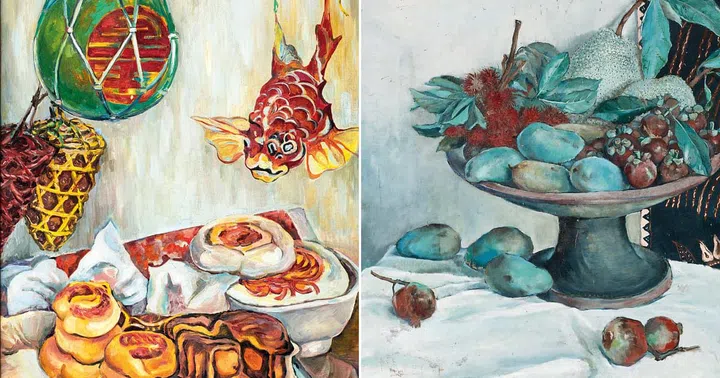
Georgette Chen’s Still Life (Moon Festival Table) (1962), from the collection of National Gallery Singapore. (Photo: National Heritage Board), Tchang Ju Chi’s Still Life (c. 1930s). Gift of the artist; Collection of Chang Si Fun (Shewin Chang). (Photo: National Heritage Board)
Cézanne’s fruit paintings in the last three decades of his life earned him a lifetime position on lists of top food paintings anywhere in the world. “Sumptuous beauty” is how the French institute Musée d’Orsay describes his still life Pommes et Oranges, one of over 100 canvases adorned with vibrant plump apples, oranges, peaches, pears, melons, and cherries.
Did the French artist have a fondness for produce? These were likely everyday kitchen staples, easy to obtain and arrange into tableaus, upon which the post-impressionist perfected a style that would inspire generations — from Matisse and Picasso to early Singapore painters.
Related: Art SG art fair to open in January 2023 with over 150 international galleries
Such is the pedigree of food art in the republic, whose value is still high. Last December, local icon Georgette Chen’s Still Life (Mid-Autumn Festival) sold through Christie’s for over S$1.8 million; her Still Life with Cut Apple and Orange, on display at the National Gallery Singapore, practically bursts with Cézanne’s influence.
Chen’s auction piece and her other works depicting local foods illustrate the Nanyang artists’ embrace of their uniquely Singaporean identity. No longer content to depict European harvests, she has immortalised pomelos, piggy biscuits, and mooncakes sliced to reveal their yolks. It was the same with her contemporaries. Tchang Ju Chi painted mangosteens, rambutans and jackfruit, Lee Boon Ngan presented his impression of the Singaporean breakfast of bread, eggs and coffee, and Chua Mia Tee painted fish head curry.
“Asians have focused their art on food since ancient times,” says Adele Tan, National Gallery Singapore’s senior curator in the podcast A Story of Food, Art and Singapore. “[Many artworks] reflect and reveal our communities.”
In a development that might shock Chen and those of her vintage, current creators also feature local food in their works, but on vastly different mediums.
“I made kaya the rarest trait because I love kaya toast,” says Chanel Lee about her series of non-fungible tokens (NFTs) featuring cartoon toast. “It’s something I ate growing up.”
All 7,600 of her Tasty Toastys sold out the week they were launched in January 2022, giving global buyers less than a 1 per cent chance of landing her NFT of toast with the pandan and coconut jam — the most expensive of which sold for about $800.
“I wanted people to pay attention,” Lee, 30, says. “I wanted them to go: ‘What is this green stuff with a slab of butter on it?’ Kaya is not easy to make. You have to stand in front of the stove for hours. That’s why it’s so special.”
Since the vast majority of prominent NFT projects are based in the United States and Europe, the self-taught illustrator wanted to include Singapore-centric ‘Easter eggs’ in her collection, using the rainbow hues of the Paddle Pop ice cream she ate as a child, for instance, or or a cup of bubble tea, the No. 1 drink of the nation’s youths.
With the growing interest in her kaya NFT, Lee now gives out branded jars of the sweet spread at overseas industry events. Recipients have even asked her to start selling them in the US. Her response: “Some day, when we’re big enough, I would love to do a kaya venture.”
With the entire dimension of taste so accessible to food art, it makes sense for the form to flow from the visual to the real world. Janice Wong, Singapore’s most prominent confectioner, can attest to this.
With her empire of dessert bars and retail concepts across Singapore, Japan and London, Wong is now creating pieces that are more interpretive than ever before. She also designs 40 edible art installations a year for corporate events, governments, and art fairs around the world.
Before our interview, she had just returned from the Maldives, where she constructed a massive, semi-translucent chocolate and gummy sculpture embodying the shifting colours of the Indian Ocean. “Food is art, and art is food,” declares the pastry chef, 39. “The line between the two is very blurred.”
I wanted people to pay attention. I wanted them to go: ‘What is this green stuff with a slab of butter on it?
Chanel Lee
Born in Singapore and having spent parts of her childhood in Japan and Hong Kong, Wong — like everyone else — enjoyed sweets as a kid. “I had bubblegum and I had Nerds. They were super fun,” she says of the crunchy American candy. “They helped shape me into the artist I am today. I use those memories of my childhood in my food.”
Her distinctly Wonka-esque inventions feature everything from multi-coloured isomalt corals to lychee gumdrop walls, chocolate diamonds, gummy sculptures, glow-in-the-dark sugar flowers, and — her favourite — 150kg of chewy hanging bergamot and seaweed marshmallows.
“When we did our first exhibition, there were no artists using food as a medium and no chefs curating food displays the way we did. So I thought: let’s combine the two,” she explains, referencing a stippled marshmallow ceiling made for a cookbook launch in 2011. “Because we are confectioners, we make our own recipes, which is the beauty of it. We can cook the sugar, and make it the flavour and texture we want.”
Her greatest joy today is watching people interact with her edible installations, whether they take photos or eat them. “As an artist, you can’t be happier to be showcasing your craft and having others enjoy it,” she says. “The public is a big part of what we do, and that’s why it’s so fun. Either they paint on it or they destroy it — the art is constantly changing.”
“It’s memorable. It’s addictive. I don’t think I could have created a better experience than this in my lifetime.”
Related: Artists at Art Basel reflect the times
While Wong is renowned for sugary confections that encapsulate children’s wildest dreams, Lim Qixuan, or @Qimmyshimmy, might be the queen of some people’s nightmares.
“Food has always been portrayed as desirable and enticing. Turning that familiarity into something strange and surprising has always been central to my work,” she says, of her macabre creations that incorporate miniature polymer clay body parts — hearts, brains, teeth, tongues — into everyday sweet wrappers, sardine cans, even dim sum and sushi.
To Singaporeans, food is not just sustenance, but a core part of our identity. It is one thing that truly unites us as a nation
Lim Qixuan
It’s clear to Lim that her art “is not for everyone. Some find it intriguing, some find it offensive, and some find it a little bit of both.” But the 30-year-old UX designer and self-taught sculptor is no newbie, having exhibited her work in the US, UK, Italy, Japan, and Portugal.
Having started with dead fairies and moved on to sweets and baby heads, she has settled on food as a universally relatable subject. “Everyone has to eat, no matter who they are or where they come from,” she says.
Of course, Singapore’s national obsession with cuisines has not gone unnoticed, and Lim wants to turn this appeal on its head to “capture the tension of the beautiful and the grotesque”.
“To Singaporeans, food is not just sustenance, but a core part of our identity,” she says. “It is one thing that truly unites us as a nation.”
How then is such art inspired? “By everyday things” like trips to the supermarket comes the answer. Dessert maestro Wong has a similar take. Whatever you imagine is your world, she says, “there is no rule to food art”.
So perhaps, even with the decades between them, the modern maker and the old master have more in common than not when it comes to the subject of sustenance. Think of Cézanne, who declared, “With an apple, I will astonish Paris”.
It is clear their desires remain much the same: to elevate the fare we live on into something more profound. “The day is coming,” the father of modern art famously quipped, “when a single carrot, freshly observed, will set off a revolution.”
Related: Art, memes, and a revolution: a conversation with Metakovan