
Share this article
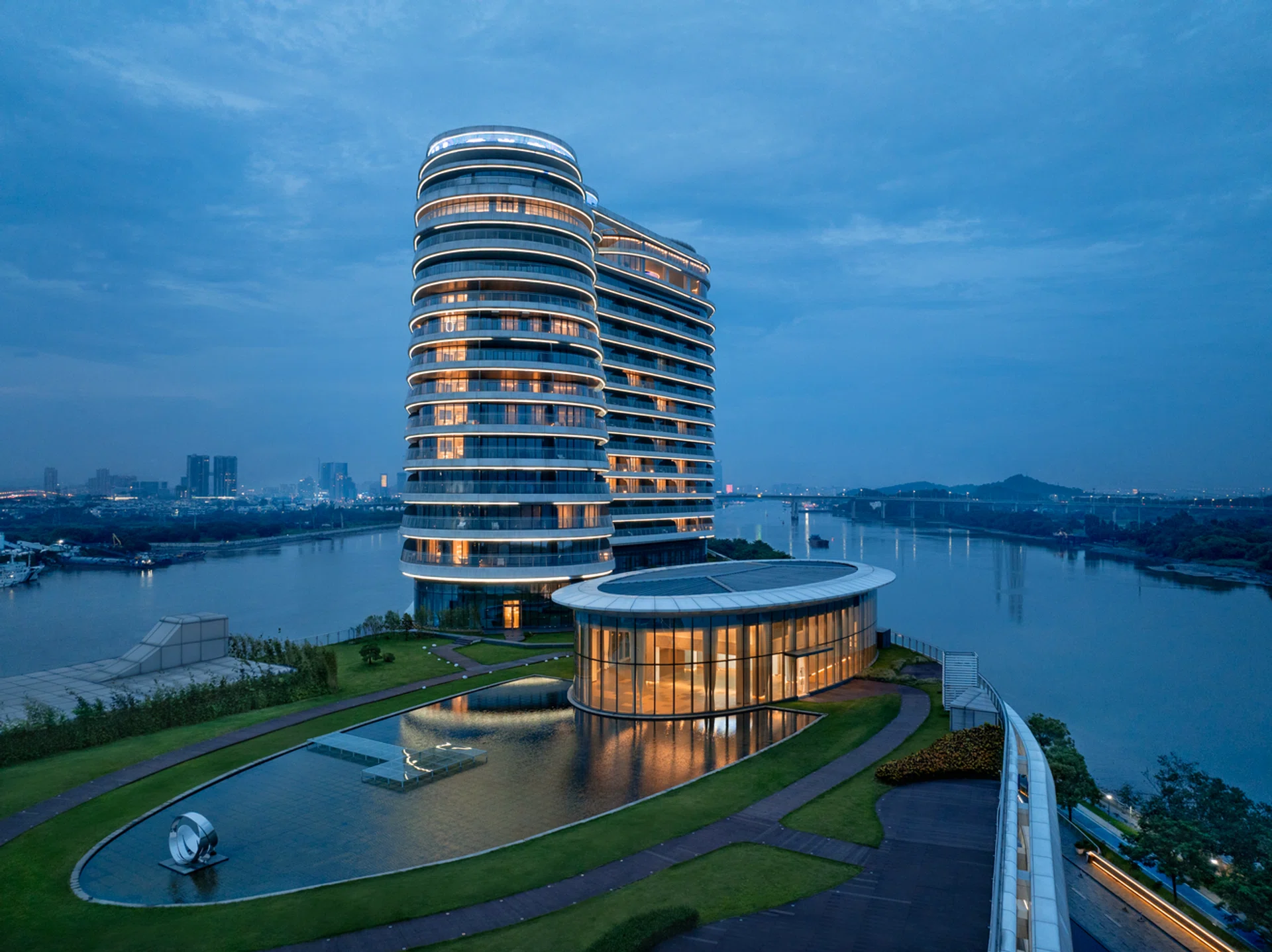
From across the Pearl River, The Xanadu Guangzhou appears almost excessively coherent. Long white bands wrap around the facade, balconies stack like decks, and the building seems to stretch horizontally towards the water rather than rise from it.
IHG Hotels & Resorts, which now operates the property under Vignette Collection, compares the architecture to a cruise ship moored beside the river. The resemblance is obvious, but the hotel’s background is considerably less straightforward than that neat metaphor suggests.
Xanadu did not begin as an IHG lifestyle hotel. When it opened in 2022, it belonged to Guangzhou Xiangxue Pharmaceutical and formed part of the broader ecosystem around Guangzhou International Bio Island and the Guangzhou International Bio Forum.
Its original context was tied to health technology, scientific exchange, and biomedical research, alongside 276 guestrooms, extensive meeting facilities, and a 16,146 sq ft ballroom.
At roughly 1,492,588 sq ft, with two basement levels, a five-storey podium, and a 17-storey principal block, the project feels less like a conventional retreat than institutional infrastructure taught to perform intimacy.
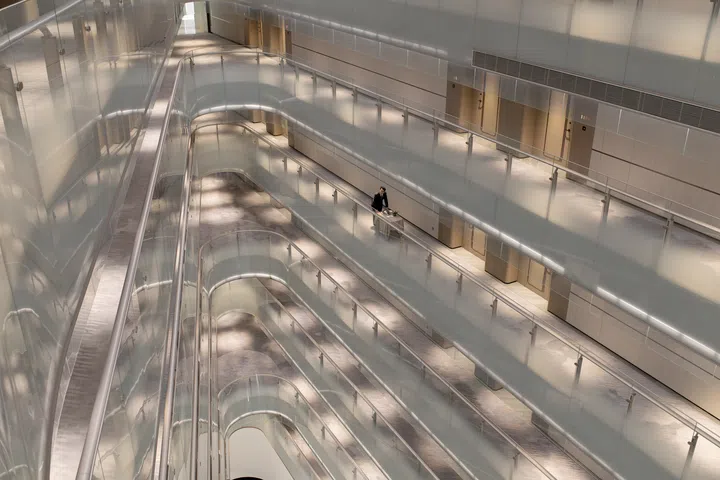
Its clearest architectural idea comes from chief designer Yang Yan, a professor at the Guangzhou Academy of Fine Arts, who described the hotel through an almost obsessive commitment to roundness: curves, complete circles, and the near-elimination of sharp corners, all intended to create comfort and care.
That could easily sound like design rhetoric, but the idea carries through with unusual consistency, from the building’s rounded ends and continuous balcony bands to its ceilings, furniture, mirrors, and bathtubs.
Space, air, and outlook
At its best, the curve does real work. It softens circulation, eases sightlines, creates privacy between balconies, and reduces the visual weight of a very large building.
At other moments, it edges toward mannerism, because a rounded table doesn’t become more meaningful simply because the facade is curved, too. The interesting part lies in that tension between architecture as problem-solving and architecture as motif.
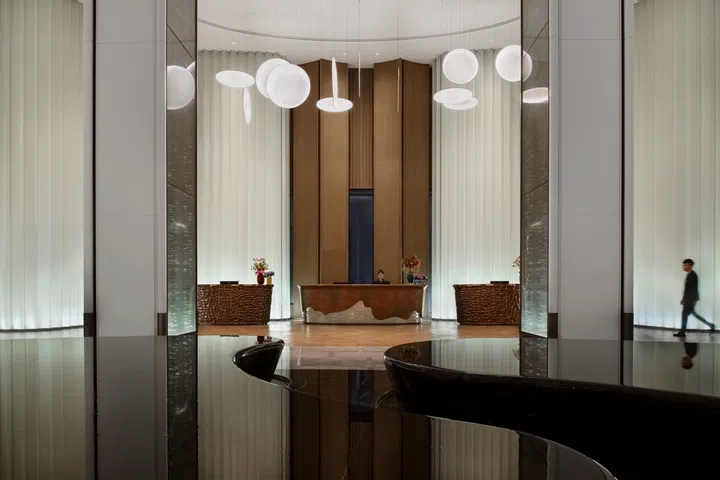
The interiors themselves are less radical, drawing on a familiar contemporary luxury palette of polished stone, cream upholstery, metallic accents, and diffused lighting. What elevates them is the landscape. Every room and suite opens onto a balcony with river views, allowing the horizon to become part of the interior composition.
The pool develops the same relationship, placing constructed water against the Pearl River beyond, while the balconies make the building’s perimeter feel inhabitable rather than merely scenic.
This gives Xanadu a form of luxury that depends less on ornament than on space, distance, air, and outlook.
The architecture repeatedly creates enclosure, then opens that enclosure back towards the river, producing a tension between protection and release that is more compelling than the simpler language of serenity usually used to describe it.
IHG’s later involvement complicates the story further because, by its own account, the repositioning did not introduce a new design language. The group told The Peak Singapore that the hotel’s established identity remained central, and confirmed that Yang Yan was not involved in the conversion. What changed more decisively was how the property was interpreted.
A new language for health
The original Xanadu spoke the language of science, biomedical research, and health systems. Vignette Collection speaks of restoration, serenity, wellness, and emotional comfort.
Asked how it interpreted the Bio Island context, IHG shifted away from the scientific history towards a guest experience centred on calm and recovery. The underlying subject remains health, but its meaning has moved from institution to sensation.
Locality undergoes a similar translation. Rather than adding conspicuous Lingnan motifs, IHG locates Guangzhou through Cantonese food and a weekend ritual of Guangdong herbal tea. There is something intelligent about that restraint. Whether this amounts to sensitive stewardship or astute branding depends on how sceptically one approaches collection hotels.
Vignette Collection benefits from Xanadu precisely because the property arrived with a fully formed identity. IHG did not need to invent distinctiveness so much as recognise, edit, and reframe it.
Xanadu can feel overdetermined, and the curve occasionally becomes a tic, but its central proposition remains durable.
What IHG changed most successfully was not the building itself, but the vocabulary through which it is understood, recasting a project once associated with science and institutional health as one centred on restoration and wellbeing, without disturbing the architecture that made both readings possible.