%22%3E%0A%3Cpath%20d%3D%22M412%20101.2H393.7C393.1%20101.2%20392.3%20100.9%20391.8%20100.5C377.3%2087.6004%20362.9%2074.6004%20348.4%2061.6004C344.8%2058.4004%20341.3%2055.2004%20337.7%2052.0004C337.1%2051.5004%20336.2%2051.1004%20335.5%2051.0004C334.2%2050.8004%20333%2051.0004%20331.5%2051.0004V101.1H316.7V0.100391H331.4V44.3004C331.9%2044.3004%20332.2%2044.4004%20332.5%2044.4004C334.9%2044.4004%20337.2%2044.5004%20339.6%2044.4004C340.4%2044.4004%20341.3%2044.0004%20341.8%2043.5004C351.6%2034.4004%20361.4%2025.2004%20371.1%2016.0004C376.5%2010.9004%20381.9%205.90039%20387.3%200.800391C387.9%200.200391%20388.5%200.000390626%20389.3%200.000390626H400.9C384.2%2015.8004%20367.8%2031.3004%20351.2%2047.0004C371.5%2065.0004%20391.8%2082.9004%20412.1%20100.9C412.1%20101%20412.1%20101.1%20412%20101.2ZM180.9%20101.2C184.1%2094.9004%20187.2%2088.9004%20190.3%2082.8004C198.3%2067.3004%20206.2%2051.8004%20214.2%2036.2004C220.3%2024.4004%20226.4%2012.5004%20232.4%200.700391C232.7%200.100391%20233%20-0.0996094%20233.7%20-0.0996094H248.1C248.8%20-0.0996094%20249.2%200.100391%20249.6%200.800391C256%2013.3004%20262.4%2025.7004%20268.8%2038.2004C279.3%2058.6004%20289.8%2079.0004%20300.3%2099.5004C300.5%20100%20300.8%20100.4%20301.1%20101.1C300.5%20101.1%20300.1%20101.2%20299.7%20101.2H286.5C285.6%20101.2%20285.1%20100.9%20284.7%20100.2C280.1%2091.3004%20275.4%2082.4004%20270.8%2073.4004C270.1%2072.1004%20269.3%2071.6004%20267.8%2071.6004H209.9C208.7%2071.6004%20208.1%2072.0004%20207.5%2073.1004C202.9%2082.1004%20198.2%2091.0004%20193.6%20100C193.1%20101%20192.6%20101.3%20191.5%20101.3C188.4%20101.2%20185.3%20101.3%20182.3%20101.3C182%20101.2%20181.6%20101.2%20180.9%20101.2ZM239.1%2011.4004C230%2029.2004%20221.1%2046.7004%20212.1%2064.3004H266.4C257.2%2046.7004%20248.2%2029.2004%20239.1%2011.4004ZM0%200.000390626H43.4C51.2%200.000390626%2058.7%201.20039%2065.7%204.80039C75.9%2010.0004%2078.9%2018.0004%2078.6%2027.4004C78.3%2034.3004%2076%2040.5004%2071.2%2045.5004C67.3%2049.6004%2062.4%2052.3004%2057.1%2054.3004C50.6%2056.7004%2043.9%2058.0004%2037.1%2058.6004C30.1%2059.2004%2023.1%2059.4004%2016.2%2059.7004C15.8%2059.7004%2015.3%2059.8004%2014.8%2059.8004V101.1H0.1C0%2067.4004%200%2033.8004%200%200.000390626ZM14.8%207.10039V52.2004C23.7%2052.4004%2032.6%2052.3004%2041.2%2050.1004C44.4%2049.3004%2047.6%2048.2004%2050.6%2046.7004C58.4%2043.0004%2062.3%2036.7004%2062.7%2028.0004C63%2019.9004%2059.5%2014.1004%2052.4%2010.5004C47.6%208.00039%2042.5%207.10039%2037.2%207.10039H14.8ZM95.9%20101.1V0.100391H167.3V7.20039H110.7V44.7004H158.1V51.9004H110.8V93.9004H171.1V101C146.1%20101.1%20121%20101.1%2095.9%20101.1Z%22%20fill%3D%22black%22%2F%3E%0A%3Cpath%20d%3D%22M35.0004%2025.7996H42.5004V20.6996H44.8004V33.1996H42.6004V27.5996H34.9004V33.2996H32.7004V20.7996H35.0004V25.7996ZM54.4004%2025.8996V27.2996H48.9004V31.6996H55.9004C55.9004%2032.1996%2056.0004%2032.5996%2056.0004%2033.0996H46.5004V20.5996H55.5004V21.8996H49.0004V25.7996C50.7004%2025.8996%2052.5004%2025.8996%2054.4004%2025.8996ZM25.9004%2033.0996H23.5004V21.9996H17.9004V20.6996H31.6004V22.0996H27.1004C26.2004%2022.0996%2025.9004%2022.2996%2025.9004%2023.1996C26.0004%2026.0996%2025.9004%2028.9996%2025.9004%2031.7996V33.0996Z%22%20fill%3D%22black%22%2F%3E%0A%3C%2Fg%3E%0A%3Cdefs%3E%0A%3CclipPath%20id%3D%22clip0_388_462%22%3E%0A%3Crect%20width%3D%22411%22%20height%3D%22101.2%22%20fill%3D%22white%22%2F%3E%0A%3C%2FclipPath%3E%0A%3C%2Fdefs%3E%0A%3C%2Fsvg%3E%0A)
Rise of third spaces: Meet the Singaporeans making room for community
Why search for a community space when you can create one? These Singaporeans are carving out third spaces for the like-minded and curious to meet and gather.
By Toh Ee Ming /
Share this article
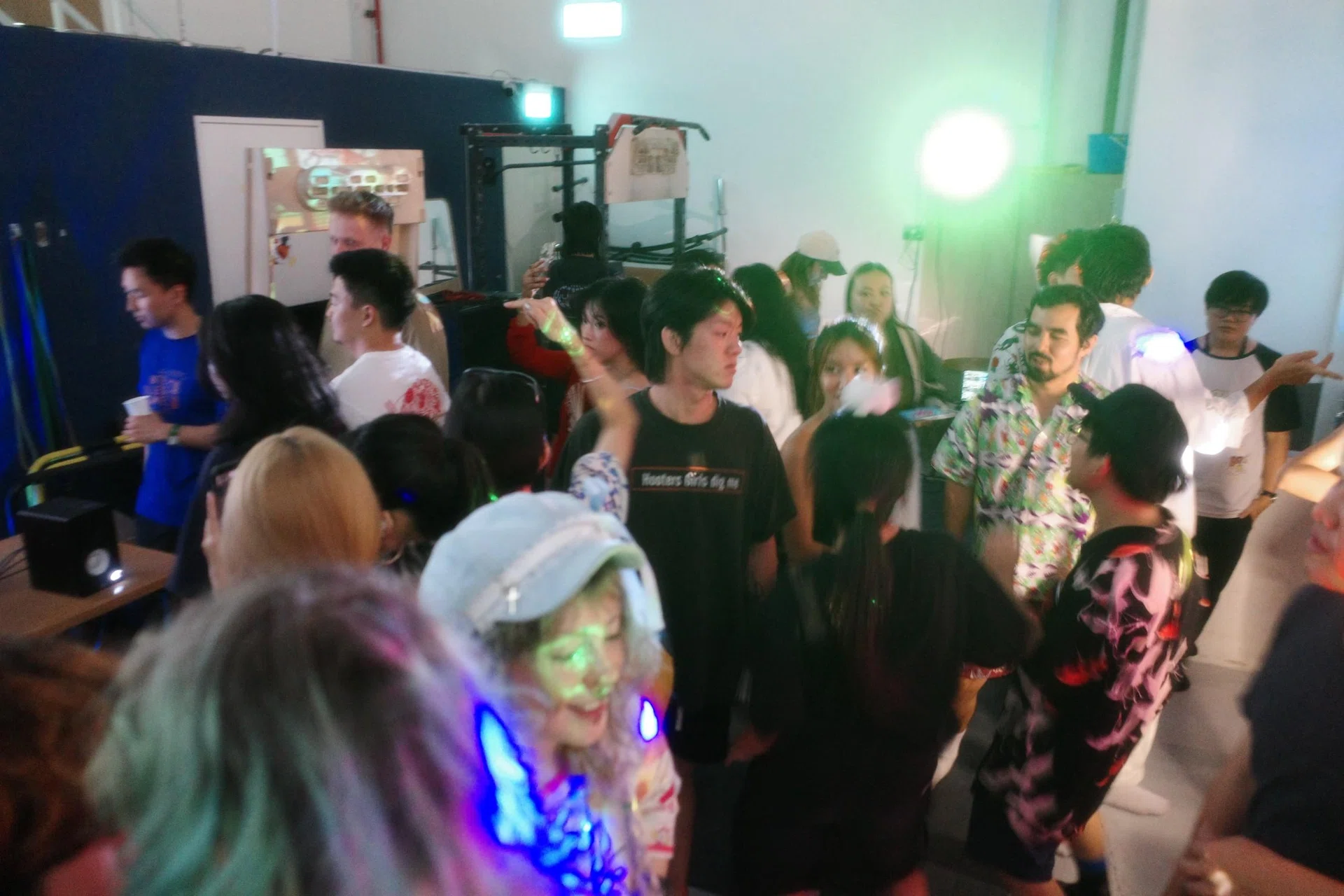
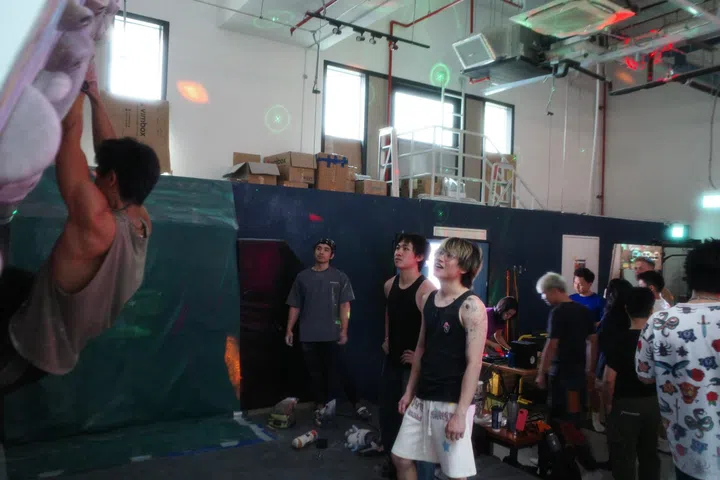
On a Sunday afternoon in the Central Business District, people are nimbly scaling a bouldering wall with art projected onto it, while a live DJ spins. Below them, a crowd of bouldering bros, creatives, millennials and Gen Zs alike bop and bounce to a pulsing live digital doodle wall and a dancefloor that didn’t exist that morning.
This is one vision of Playces’ public life — turning underutilised public spaces into third places which you can call home.
A term coined by sociologist Ray Oldenburg, third spaces are inclusive, accessible spaces that foster community, relaxation, and conversation.
Years ago, my first brush with third spaces came when I found myself in a circle of 30 strangers on the grass one night at Fort Canning Park, at a Stranger Conversations event — structured gatherings designed to push past small talk. Within an hour, we were deep in it: burnout and sabbaticals, the quiet reckonings of adult life. I hadn’t expected people to let their guard down so fast.
Then there was Peace Centre, a forgotten mall waiting for the wrecking ball, but the PlayPan takeover transformed it into one of the most alive places in the city: thrift stores, a bespoke barbershop, second-hand bookstores, rave parties, and a haunted house during Halloween. I roamed its creepy corridors after midnight with strangers, revelling in how the straitlaced city had cut loose.
In recent years, Singapore has seen an explosion of third spaces and ground-up initiatives — not just work, home or school, but new places to gather. The events have been hard to keep up with, all announced via stylishly designed posters.
I’ve found my creative tribe at places like the Singapore Art Book Fair and Creative Mornings, wandered through artist studios in the gritty Kapo Factory in Tai Seng, and sat through Remedial Kids lectures for the intellectually curious.
Cafes and bars such as Hideout, Kizuna, Middle Child Bar, and The Coup quietly draw regulars through film nights and events. And that’s just what I’ve managed to get to.
There are various green communities like Ground-Up Initiative and Woodlands Botanical Garden, tea gatherings, Post-Growth Society meet-ups, cinephiles at the newly reopened Filmhouse, run clubs, LGBT and kink communities, Screaming Pigeons for women, open jams with Ann Siang Sounds and the Sing Song Social Club, and countless others.
Communities and subcultures have always existed here, but something has shifted. They’re more visible now, more porous, open to more walks of life. We used to congregate in the cathedrals of malls. Now people are carving out their own sacred spaces — and welcoming strangers in.
A hunger for connection
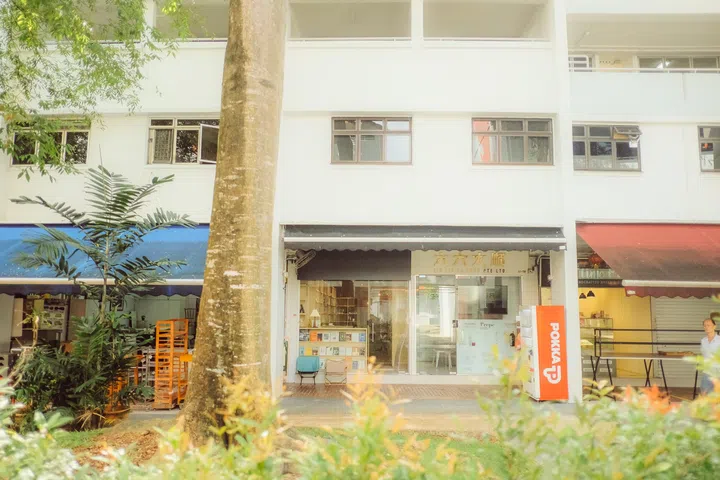
In a ruthlessly pragmatic city run by powerful landlords and big capital, independent grassroots spaces have become a form of radical rebellion. Nowhere is this more felt than at Casual Poet Library, a first-of-its-kind shared community library tucked into a corner of Bukit Merah, founded in 2024 by photographer Rebecca Toh, 40.
The quaint space is lined with walls of irregular wooden nooks crammed with books, plants, pottery and handwritten notes, each shelf curated by someone who rents it. Being here reminded me of something I’d forgotten: the pleasure of slow browsing, the kind I’d barely made time for since childhood.
“There is a hunger for connection, understanding, respite and renewal,” says Toh, who sees the library as a microcosm of society. “While there are many who come with needs, there are just as many who come ready to help and to give. Every day, I bear witness to this moving and beautiful exchange of energy.”
She brought up a past mental health initiative — listening chairs where strangers sit and offer an ear to whoever needs one, nothing expected in return.
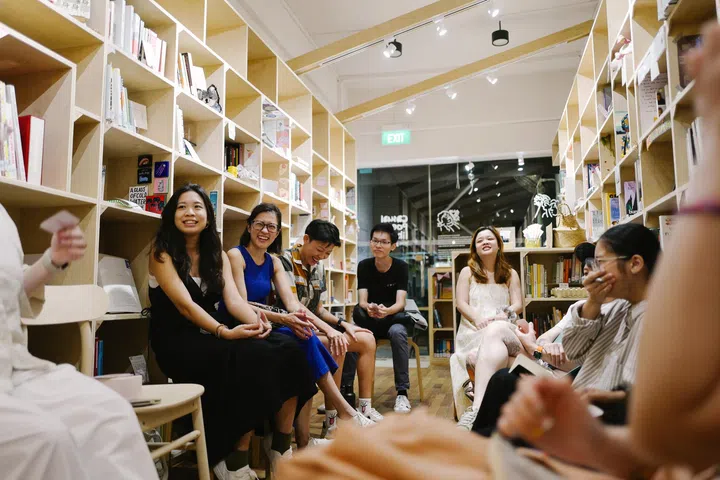
For Toh, the library is also a quiet corrective to how Singapore sees itself. “Singaporeans have a lot of soul. But we battle daily with our larger environment: exorbitant rent, stagnant wages, parental or societal expectations, and the imaginary but quite real pressure to make something of ourselves,” she said.
“Maybe the library exists as a reminder that there are other ways of being and living.”
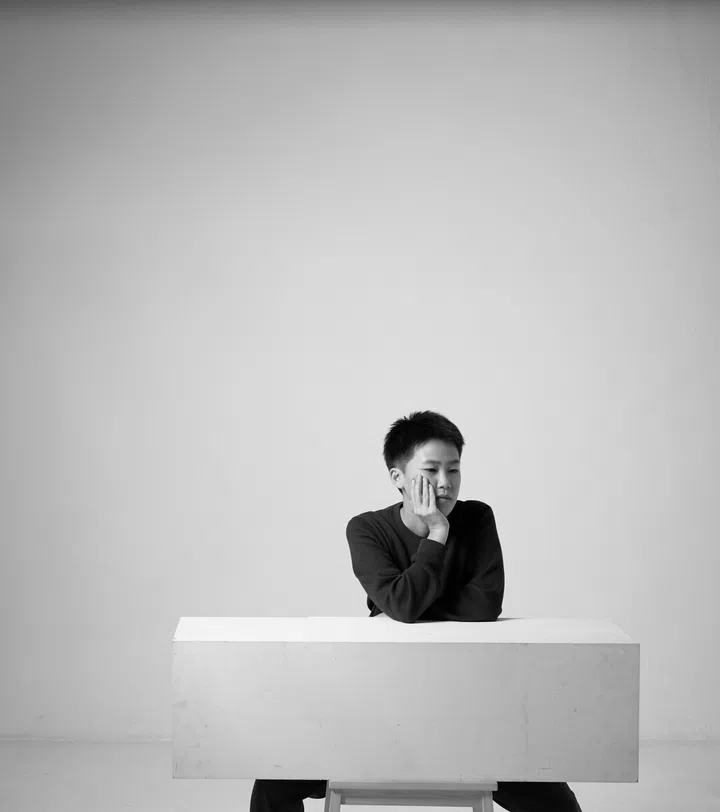
She senses a new energy. Grassroots projects are sprouting everywhere, and the library is just one of many. “People are realising they can take control and build things themselves. The only resources they truly need are conviction, willingness, a few friends and time,” she said.
Community-led spaces are the new pathways forward, part of a worldwide hunger for something more tangible amid technological overwhelm, she believes.
Across generations, across time
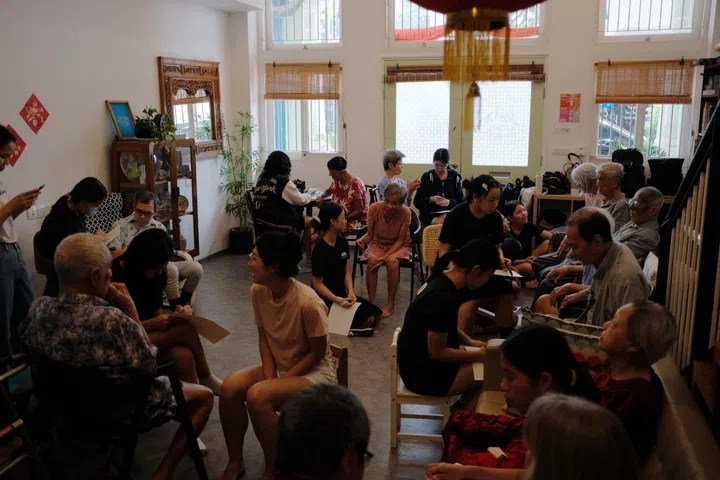
On a Tuesday morning in March, I found myself at Joo Chiat Social Club, watching something unlikely unfold. Its trendy social media posts had caught my eye first.
SOTA students were paired with seniors to learn and sketch out their life stories. The seniors spoke of cooking at the Istana, caring for war veterans in Canada, catching snakes, and travelling the world. The students shared their dreams. It started awkward, as these things do, then slowly warmed.
I overheard a senior dishing out love advice, urging the young to be adventurous while they still can, while the students taught them Gen Z slang in return: 6-7, swag for life. The session ended with a lively sing-along to John Denver’s “Take Me Home, Country Roads”.
Co-founder Mariel Chee, 32, a former arts programmer at National Gallery Singapore, wanted to build an alternative to institutional eldercare — a space that treats seniors not as beneficiaries but as people with stories worth honouring. Many of the elderly here are single, widowed or have their children overseas. Joo Chiat Social Club becomes their extended community instead.
Its programming is just as diverse — neighbourhood workouts, culinary and craft workshops, woodworking and pottery, pet therapy, retro film screenings, games and sing-alongs, and a crowd favourite, social dancing.
Likewise, the partnership approach is deliberately unstructured, relationship-based, and organic, drawing in preschools, after-school programmes, and university students alongside artists and creatives with a heart for social issues.
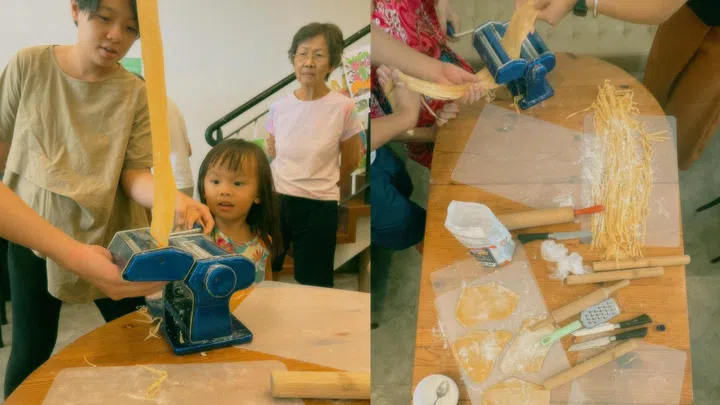
Chee hopes citizen-led initiatives like this become the default. In Singapore, everything tends to be “top-down, paternalistic, mass and catch-all”, she says. Ground-up initiatives allow for greater differentiation and the forging of one’s own unique identity.
Chee likens it to permaculture: when different generations are brought together, they learn to interact across differences, which builds resilience and emotional intelligence in both directions. “It’s in these imperfections and diversity that something genuinely alive can grow.”
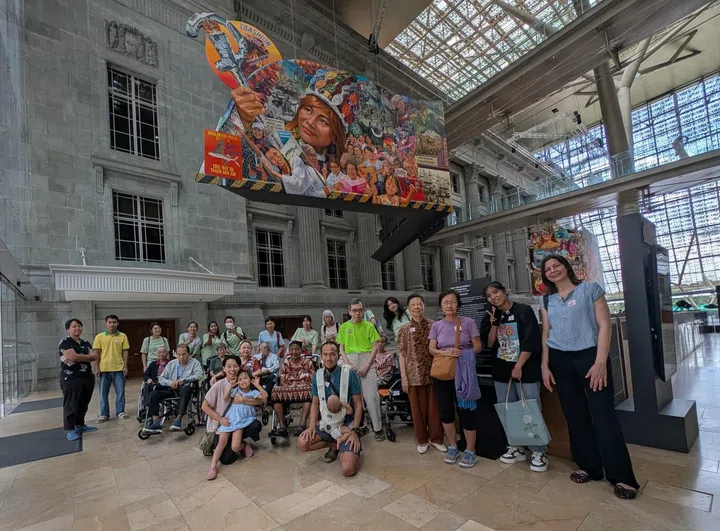
If Joo Chiat Social Club reaches across generations, the citizen-led initiative Our House Downstairs reaches across time. One Sunday, I found myself meandering along Punggol’s shores to their audio heritage trail, the sea breeze at my back. The audio voiceover conjured memories of pig farmers, kelong keepers and the Orang Laut (sea people) community living by the tides.
A community mapping exercise at the end invited us to add our own meaningful spots. Belonging, it turns out, isn’t only about the people around you. Sometimes it’s about reclaiming the ground beneath your feet.
Making space, making room
As third spaces mature beyond their initial novelty, the question of sustainability looms. Nobody knows this better than Gena Soh, 29, a former journalist and founder of Playces. Public life, she believes, should be more interesting, and more people should have a hand in making it so.
Not movements built around founders, but something replicable, flexible, extensible, that anyone can pick up and run with.
From late 2024 to 2025, Playces ran a six-month pilot with Scape, brokering free access to open the space to any community that wanted it. Over 100 groups responded, and some 4,000 people showed up — for everything from large-scale concerts to a coffee rave in a dance studio to a thrift shop, a ballroom dancing session, an amateur theatre group, a bad-ideas hackathon, and an eczema festival.
“I wanted to show that you don’t need so much programming,” Soh says. “The biggest thing that prevents young people from gathering is that space is so guarded and contested in Singapore. What if you made it free and invited people to use it? That’s how community organically forms.”
The barriers are not accidental. In Singapore, gathering has historically been viewed with suspicion, and civic spontaneity has been structurally discouraged. Speakers’ Corner, launched in 2000 at Hong Lim Park, arrived hedged with so many restrictions that it said more about the city’s discomfort with public expression than its appetite for it.
The pattern persists. Recently, mirrors were frosted over along an underground linkway near Gardens by the Bay, cutting off dance groups who had claimed the space as a practice ground for years. The incident illuminated a familiar tension in a land-scarce city where space is perpetually contested: benches sprout “hostile architecture” dividers to deter rough sleepers, secret guerrilla gardens get uprooted. Public space here has always been a negotiation, and the terms have rarely favoured spontaneity.
“Community organising is really not so different from running a company, except that a community is non-profit and exists purely for human connection,” Soh says. “Singapore is very supportive of companies, but not so supportive of communities. The value-add is just not so measurable.”
As a former Yale-NUS College student, Soh watched friends organise freely within an enabling campus environment — then hit a wall in the real world, with uncertainties over finance, security, public permits, and licensing. “The desire and activation energy are there, but the threshold for it to become public is way too high,” she says.
Playces is trying to be the intermediary that lowers that threshold. It encourages crossover partnerships with community-centric business partners — a tech tuition class held in a climbing gym, a booth fair in a Bukit Batok daycare centre. It’s also offering free shelf space in partner venues in exchange for space-minding and for advertising community events at bus stops.
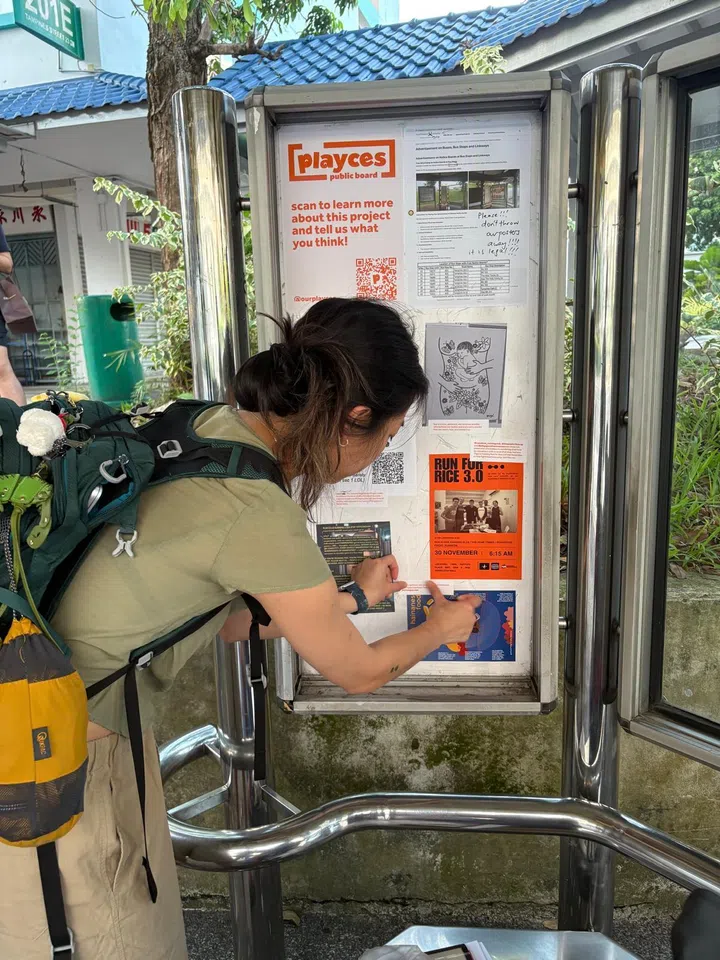
Beyond spaces, Playces also cultivates passionate first-time community organisers, through consultations, marketing and event support, even just someone to call when the fear kicks in.
Soh dreams of more guerrilla furnishings — camper chairs that quietly invite people to linger — small provocations toward a “just do, lor” spontaneity, the kind you see in matchmaking corners in Beijing parks. That spirit is what Singapore’s civic life still lacks, she feels.
Underpinning all of this is a conviction that community organising is real, skilled work, not just volunteerism. The unseen labour of building civic life deserves to be paid, Soh argues.
A fuller way of living
Community gathering has always happened, of course. But it feels more urgent now, perhaps because a generation that inherited this city’s stability is quietly asking what else life is for. As society fractures, as tech takes over our lives, and social isolation and loneliness become a quiet epidemic, the hunger for real human connection has never felt more acute.
I wonder, too, who gets to want this. In Maslow’s hierarchy of needs, belonging and community sit above survival. When you’re shuttling between work and home, hustling just to get by, the luxury of a third space can feel distant.
Soh’s metaphor stays with me. “Communities are like horses; they need a good grazing field. In Singapore, the pens are too narrow. The horses feel trapped.” She’s not calling for a free-for-all — in more laissez-faire “cowboy countries”, community life exists, but scrappily, people are left to fend for themselves in creative ways. She wants something in between: enough structure to enable, enough freedom to breathe.
These unplanned encounters have given me a deeper grounding here — a sense of being part of something bigger, an expansive social circle, a reclaimed sense of agency. These spaces are a chance to do otherwise. To live fully, messily, humanly.
Toh of Casual Poet Library is already dreaming of what comes next — a space called Otherwise, part gathering ground, part school, part experiment. In this broken world, she believes we need dreamers who can remake the world with our thoughts and ideas, not just workers and consumers.
She says, ”Faced with an uncertain future, our little projects, handmade and sincere, give us a way to rely on each other, on human ingenuity, human warmth, human kindness, courage, and tenacity. Hopefully, this will tide us through to a safer future.”