%22%3E%0A%3Cpath%20d%3D%22M412%20101.2H393.7C393.1%20101.2%20392.3%20100.9%20391.8%20100.5C377.3%2087.6004%20362.9%2074.6004%20348.4%2061.6004C344.8%2058.4004%20341.3%2055.2004%20337.7%2052.0004C337.1%2051.5004%20336.2%2051.1004%20335.5%2051.0004C334.2%2050.8004%20333%2051.0004%20331.5%2051.0004V101.1H316.7V0.100391H331.4V44.3004C331.9%2044.3004%20332.2%2044.4004%20332.5%2044.4004C334.9%2044.4004%20337.2%2044.5004%20339.6%2044.4004C340.4%2044.4004%20341.3%2044.0004%20341.8%2043.5004C351.6%2034.4004%20361.4%2025.2004%20371.1%2016.0004C376.5%2010.9004%20381.9%205.90039%20387.3%200.800391C387.9%200.200391%20388.5%200.000390626%20389.3%200.000390626H400.9C384.2%2015.8004%20367.8%2031.3004%20351.2%2047.0004C371.5%2065.0004%20391.8%2082.9004%20412.1%20100.9C412.1%20101%20412.1%20101.1%20412%20101.2ZM180.9%20101.2C184.1%2094.9004%20187.2%2088.9004%20190.3%2082.8004C198.3%2067.3004%20206.2%2051.8004%20214.2%2036.2004C220.3%2024.4004%20226.4%2012.5004%20232.4%200.700391C232.7%200.100391%20233%20-0.0996094%20233.7%20-0.0996094H248.1C248.8%20-0.0996094%20249.2%200.100391%20249.6%200.800391C256%2013.3004%20262.4%2025.7004%20268.8%2038.2004C279.3%2058.6004%20289.8%2079.0004%20300.3%2099.5004C300.5%20100%20300.8%20100.4%20301.1%20101.1C300.5%20101.1%20300.1%20101.2%20299.7%20101.2H286.5C285.6%20101.2%20285.1%20100.9%20284.7%20100.2C280.1%2091.3004%20275.4%2082.4004%20270.8%2073.4004C270.1%2072.1004%20269.3%2071.6004%20267.8%2071.6004H209.9C208.7%2071.6004%20208.1%2072.0004%20207.5%2073.1004C202.9%2082.1004%20198.2%2091.0004%20193.6%20100C193.1%20101%20192.6%20101.3%20191.5%20101.3C188.4%20101.2%20185.3%20101.3%20182.3%20101.3C182%20101.2%20181.6%20101.2%20180.9%20101.2ZM239.1%2011.4004C230%2029.2004%20221.1%2046.7004%20212.1%2064.3004H266.4C257.2%2046.7004%20248.2%2029.2004%20239.1%2011.4004ZM0%200.000390626H43.4C51.2%200.000390626%2058.7%201.20039%2065.7%204.80039C75.9%2010.0004%2078.9%2018.0004%2078.6%2027.4004C78.3%2034.3004%2076%2040.5004%2071.2%2045.5004C67.3%2049.6004%2062.4%2052.3004%2057.1%2054.3004C50.6%2056.7004%2043.9%2058.0004%2037.1%2058.6004C30.1%2059.2004%2023.1%2059.4004%2016.2%2059.7004C15.8%2059.7004%2015.3%2059.8004%2014.8%2059.8004V101.1H0.1C0%2067.4004%200%2033.8004%200%200.000390626ZM14.8%207.10039V52.2004C23.7%2052.4004%2032.6%2052.3004%2041.2%2050.1004C44.4%2049.3004%2047.6%2048.2004%2050.6%2046.7004C58.4%2043.0004%2062.3%2036.7004%2062.7%2028.0004C63%2019.9004%2059.5%2014.1004%2052.4%2010.5004C47.6%208.00039%2042.5%207.10039%2037.2%207.10039H14.8ZM95.9%20101.1V0.100391H167.3V7.20039H110.7V44.7004H158.1V51.9004H110.8V93.9004H171.1V101C146.1%20101.1%20121%20101.1%2095.9%20101.1Z%22%20fill%3D%22black%22%2F%3E%0A%3Cpath%20d%3D%22M35.0004%2025.7996H42.5004V20.6996H44.8004V33.1996H42.6004V27.5996H34.9004V33.2996H32.7004V20.7996H35.0004V25.7996ZM54.4004%2025.8996V27.2996H48.9004V31.6996H55.9004C55.9004%2032.1996%2056.0004%2032.5996%2056.0004%2033.0996H46.5004V20.5996H55.5004V21.8996H49.0004V25.7996C50.7004%2025.8996%2052.5004%2025.8996%2054.4004%2025.8996ZM25.9004%2033.0996H23.5004V21.9996H17.9004V20.6996H31.6004V22.0996H27.1004C26.2004%2022.0996%2025.9004%2022.2996%2025.9004%2023.1996C26.0004%2026.0996%2025.9004%2028.9996%2025.9004%2031.7996V33.0996Z%22%20fill%3D%22black%22%2F%3E%0A%3C%2Fg%3E%0A%3Cdefs%3E%0A%3CclipPath%20id%3D%22clip0_388_462%22%3E%0A%3Crect%20width%3D%22411%22%20height%3D%22101.2%22%20fill%3D%22white%22%2F%3E%0A%3C%2FclipPath%3E%0A%3C%2Fdefs%3E%0A%3C%2Fsvg%3E%0A)
Share this article
If you stopped Tony Soh on the street and asked what problem the National Volunteer and Philanthropy Centre (NVPC) exists to solve, his answer would likely begin with the obvious and end somewhere far deeper. “The name has a very clear idea of what we do: volunteerism and philanthropy,” the chief executive says. “But the deeper question is almost like, why do we exist?”
For Soh, that reason has crystallised over the past few years into something more expansive than tracking volunteer hours or dispensing charity awards. “Our purpose, actually, is nurturing the heart of Singapore,” he explains. “When we say heart of Singapore, we mean the Singapore spirit, the idea that we belong to a collective, the idea that we are not just a collection of individuals who happen to live on this island or city state, but we are a people, a society, a nation.”
That framing — of giving not as a transactional act but as nation-building — runs through every initiative NVPC pursues. The organisation’s work, Soh tells me one Thursday morning at their headquarters at Central, Clarke Quay, is “to enable people to help other people who need help, and in the process, build a stronger Singapore.” It is a vision of progress that is explicitly collective: strengthening shared bonds, deepening trust, and ensuring that as the nation advances, it does so together.
“We look at our history,” he notes. “Over the last 60 years, we’ve had different challenges and crises, and how we have pulled through and emerged stronger is because we had that spirit. But it’s not something that we should take for granted.”
What NVPC is attempting is not simply to grow participation. It is trying to formalise generosity — to take something instinctive, uneven, and deeply personal, and build systems around it. The question is whether something gains strength when it is structured, or whether it begins to lose its meaning the moment it becomes measurable.
A new way of measuring generosity
The latest National Giving Study, released just days before our conversation, offered a snapshot of where Singapore stands. The headline figures are easy to misread: just over one in five people engaged in volunteerism in the past year (21%), while nearly half (45%) contributed through monetary and in-kind donations. These are structured, formal numbers. But the study itself, in its own words, warns that “focusing solely on volunteering and charitable donation risks overlooking quieter forms of giving that are equally vital to social cohesion.”
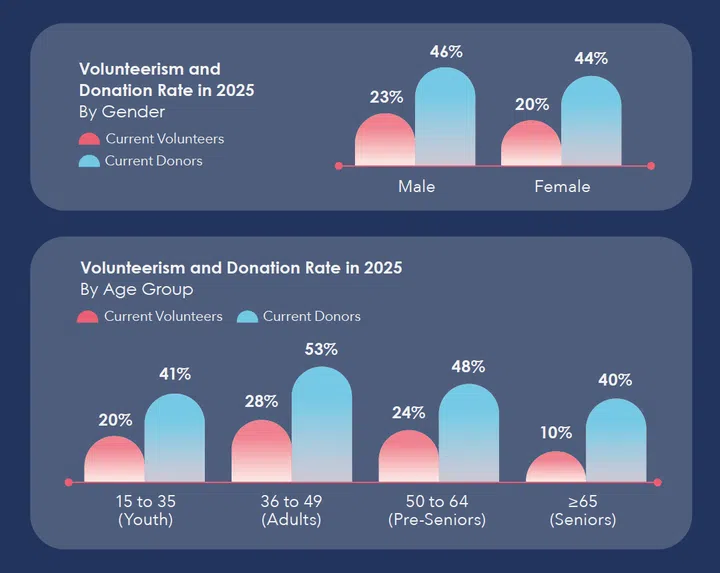
Soh urges caution in reading the data. “We’ve actually used a slightly different methodology,” he says. In the past, respondents were given a list of volunteering behaviours and asked whether they participated. The 2025 study flipped the script: “We say, what have you done? And then, based on those behaviours, we then classify it based on volunteering or not volunteering. It’s more objective, it’s more accurate.”
The shift from a definition-led to a criteria-led approach aligns NVPC with international standards set by the International Labour Organization and UN Volunteers. The trade-off is that the results are “not directly comparable” with previous studies. But as the report notes, “NGS 2025 aims to present a more inclusive view of giving — one that reflects the behaviours people in Singapore engage in.”
What the study does reveal, Soh stresses, is more encouraging than the headline figures suggest. About three in four people in Singapore have engaged in acts of giving at some point, and 68% did so in the past year. These acts span the full spectrum — from personal networks to daily encounters to wider communities. “Some held lift doors open for rushing neighbours. Some extended a helping hand to a stranger who had fallen. Others organised activities for elderly residents, tutored students, cared for animals in the community, helped colleagues move into their new homes, or picked up litter along the beach,” the report states.
The distinction between formal and informal giving matters. Soh offers a simple example: picking up a piece of litter while walking alone is not classified as volunteering because there is no formal structure, but the same act done as part of a charity activity is. “It’s the same act. It’s the same benefit to the community. It’s just whether you classify it as volunteerism or not.”
I push him on the implications. If so much giving is already happening informally, does NVPC’s institutional machinery risk capturing and bureaucratising something that functions perfectly well without it? The report itself acknowledges this tension: “The goal is not to replace informal giving, but to expand the options available, enabling people to express care in multiple ways.” Soh approaches the concern from the other end: “What are the impediments that prevent people from moving from the informal setting into a more formal volunteering setting?” The call, he says, is for employers to consider volunteer leave and corporate volunteering programmes.
From episodic to sustained
Singapore is often described as a generous society, but generosity can be episodic — spiking during crises like COVID-19 or natural disasters, then receding into the background of daily life. Soh is candid about the challenge. “You do see that after COVID, or sometimes when there are natural disasters, people really step forward. But on a day-to-day basis, do we see as much of it? Maybe not.”
NVPC’s response is multi-pronged. At the corporate level, it is pushing for volunteer leave — paid time off specifically for volunteering, much like childcare or annual leave. “NVPC actually has six days of volunteer leave,” Soh says. “You can take leave, like you take childcare leave or annual leave, and go and volunteer with any charity. We want to encourage more companies to do that, because then it shows that the company really values it and wants to encourage employees to do that.”
Beyond policy, there is Project V, an initiative designed to wean companies off ad-hoc volunteering. “Don’t do it once a year. Can you do it on a more sustained basis? Commit to six to 12 months, maybe four times a year. Have five to 10 employees go each time,” Soh explains. “The repetition, the frequency, helps to deepen connections and help people feel more engaged in the organisation as well.”
The strategy also involves embedding giving into the rhythms of everyday life. Through the digital platform Giving.sg, NVPC is experimenting with micro-giving and micro-philanthropy — small amounts, higher frequency, presented at daily touch points. “Rather than ask you to come to our website and do this and that, we go to you,” Soh says. “We present the opportunities where you are in your daily rhythms — how do we offer these opportunities even when you’re dining, shopping, or commuting?”
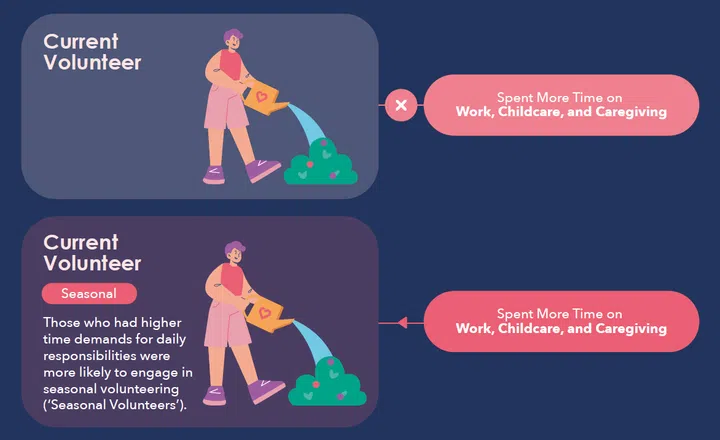
I raise a sharper concern. To move beyond episodic giving, people need time. The NGS 2025 report is explicit on this point: “Individuals who spent more time on work, childcare, and caregiving were less likely to volunteer overall.” Among those who did volunteer, higher time demands made them more likely to engage in seasonal rather than consistent volunteering. Can NVPC truly build a giving culture without first addressing the work-life imbalance that makes sustained giving impossible for the average worker?
Soh’s response reveals the limits of his institutional leverage. “Companies that actually embark on initiatives like Project V already begin to think of themselves as a different kind of employer,” he says, pivoting to the proposition that volunteering itself can restore balance. “Volunteering does help the employees find that balance. That is the purpose of employee volunteer leave — it allows them to take time off to go and do something that enriches them, giving them meaning and purpose.” He cites studies showing that corporate volunteering improves employee engagement, and testimony from a CEO about how volunteering breaks down barriers between management levels. “The company also will then gain a reputation. Colleagues work together, build bonds among their colleagues.”
It is a compelling argument, though one that still has to contend with the reality of burnout: for exhausted employees, corporate volunteering may restore meaning, but it may also risk becoming another obligation in an already crowded calendar. It is easy to champion “meaning” in a boardroom, but much harder to find it on the ground — a reality confirmed by recent findings on the state of corporate giving in Singapore.
But it also raises a harder question. If the same corporate structures that create time poverty are now being positioned as the solution to it, then volunteering risks becoming another managed output of the system, rather than an escape from it.
The corporate purpose gap
The inaugural National Corporate Purpose and Impact Study (NCPIS) 2025, released the previous year, exposed a chasm between rhetoric and reality.
While 79% of companies agreed businesses have a moral duty to support broader societal goals, the Society impact area — corporate volunteering and donations — saw only a 30% adoption rate. Of those, just 14% engaged in corporate volunteering and 26% in donations, although “Companies that engage in corporate volunteering and donations activities stand out for their high level of commitment.” Still, the report is blunt: “Corporate volunteering or donations receive comparatively limited attention and resources.”
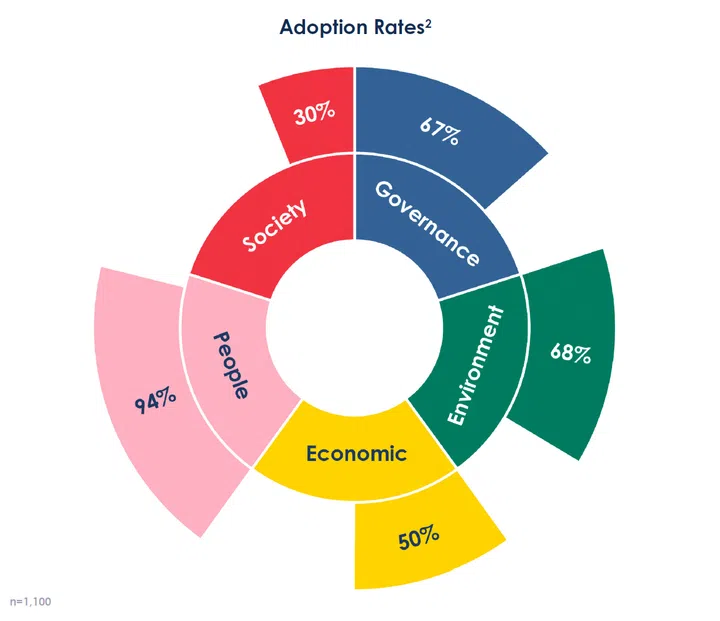
Society impact area — corporate volunteering and donations — saw only a 30% adoption rate.
I put it to Soh directly: do you suspect corporate purpose is becoming a sophisticated branding shift? Are we risking a future where doing good is a social license to operate while actual ground-level impact remains stagnant?
“There’s always a danger of the talk not matching the walk,” he admits. “Companies, from time to time, their comms people are very good. But then they don’t actually do it.” He argues, however, that such inauthenticity is becoming harder to sustain. “With handphones, with all sorts of channels and social media, if you’re not authentic, you will get found out fairly quickly.”
The NCPIS data reveals a telling hierarchy: the People impact area scored highest with a 94% adoption rate, while Society scored lowest at 30%. Soh sees this as an opportunity rather than a dead end. “If you want to take care of your people, actually a very good way is to do corporate volunteering,” he says. “Maybe companies haven’t seen that connection yet. So actually, that’s the opportunity for us — how to make that connection.”
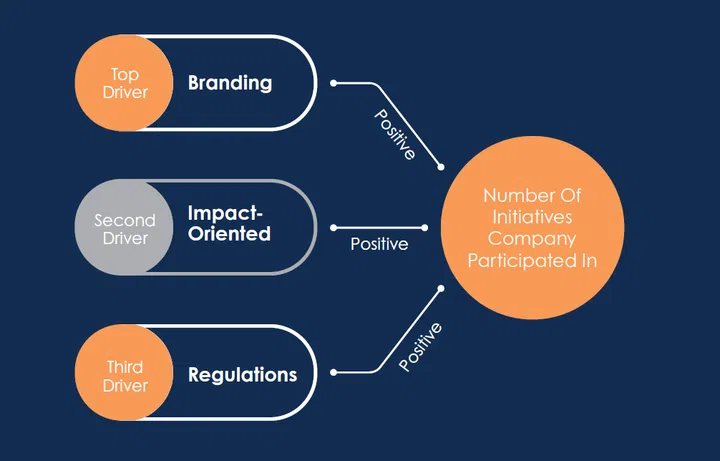
Branding was the strongest driver of commitment to corporate citizenship,” the report states.
But the NCPIS findings complicate this optimism. The study identifies three main motivations driving corporate citizenship: Branding, Impact-Oriented, and Regulatory Compliance. “Branding was the strongest driver of commitment to corporate citizenship,” the report states, “while Regulatory Compliance was only associated with positive business sentiments of corporate citizenship when complemented with Branding objectives.” The conclusion is pointed: “Incentives and recognition, rather than mandates, are more effective in sustaining corporate citizenship.”
I press further. NVPC’s flagship programmes have been running for years, and we are still at 14% corporate volunteering. Is the current model of giving awards to those who are already good failing to reach the masses?
Here, I’m referencing NVPC’s large scale Company of Good program launched in 2016 to empower businesses in Singapore to give strategically and sustainably and integrate doing good with corporate strategy. With 720 companies recognized across four tiers — from “One Heart” to “Champion of Good” — the system is designed to lower the barrier to entry while encouraging upward movement.
“In the past, when we only had ‘Champion of Good,’ most companies looked at it and said, ‘Why is your bar so high?’ and they gave up,” Soh recalls. Today, the entry point is a 15-question Simplified Questionnaire specifically designed for Small and Medium Enterprises (SMEs). By evaluating impact across five areas — People, Society, Governance, Environment, and Economic — the quiz allows companies to assess their “Profit with Purpose” maturity without being overwhelmed by the 55+ questions required for higher tiers.
Earning a “One Heart” recognition transforms a daunting corporate responsibility mandate into a manageable first step. But Soh is not naive about the risk that scale could dilute quality. “If a company has that COG sticker but then they misbehave, we’ll take it off. We have our right to remove it,” he states firmly.
Philanthropy’s image problem
The conversation turns to a word Soh is clearly tired of defending: philanthropy. I mentioned my conversation with a CEO of a quantitative hedge fund, who rejects the term for its elitist connotations — “people who dress up, they go to balls, and then they give money.” A lot of people give money and then disengage, I note. They do not know what problems come after.
Soh responds with etymology. “I’ve tried to convince people that actually, if we look at the root words of philanthropy, it comes from philos and anthropos. Philos is love — love in a brotherly, sisterly way. Anthropos is humanity. So philanthropy actually just means things that you do to express your love and care for your fellow human beings.” Over time, he argues, the word has been colonised by images of “people writing big checks, going to charity galas, black tie gowns and all that,” but in NVPC’s framing, donating, volunteering, and everyday acts of care are all “everyday philanthropy.”
The tension remains. Philanthropy sits in an uncomfortable space between altruism and influence, and NVPC must navigate it daily. I describe it as the risk of a parallel to greenwashing — “virtue washing,” where companies perform goodness for tax breaks and photo opportunities.
Soh acknowledges the risk. “As long as it is clear that what is being contributed has no strings attached, it goes into causes that actually do good in society, and there are proper governance rules,” he says. “We need to navigate that.” He points to NVPC’s work improving charity governance through the Centre for Non-Profit Leadership, ensuring funds are handled properly and undue influence is avoided.
Yet his own tolerance for mixed motivations is pragmatic. “Many companies have mixed motivation. As long as the way you do it, you do it authentically. You do the real work.” The distinction between authentic mixed motivation and strategic performance is left to whether the good work continues when no one is watching. “When people look away, are you still doing it? If you stop doing it, then I think you’re virtue washing.”
The startup blind spot
I raise a concern that has been nagging at me. The NCPIS shows leadership interest is the biggest barrier to giving. In the startup world, leadership is obsessed with scale and speed. Most founders see NVPC’s frameworks as something for mature companies — SMEs and large enterprises made up 77% of 2025’s awards. I wondered if Soh is concerned that by the time a startup is ready for NVPC, its culture is already baked in as purely profit-driven. How do you make doing good a feature of a startup, rather than a bug they fix after IPO?
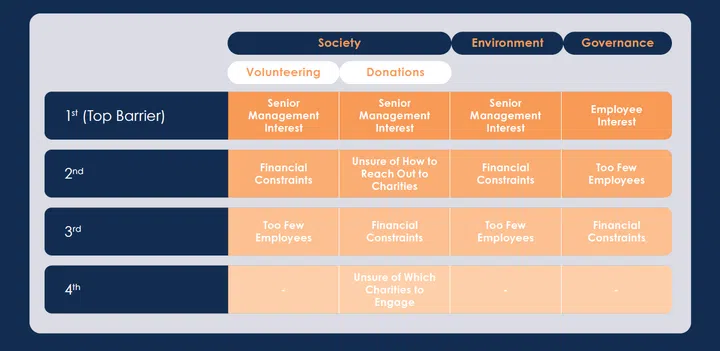
The NCPIS shows leadership interest is the biggest barrier to giving.
“It’s a great point,” Soh says. “Actually, we do have, in our experience, working with many startup founders, those who are purpose-driven from day one. Part of the reason for starting their company is that they want to make a positive difference in society.” The founder, in his view, sets the DNA. “If they set the DNA of the company correctly, then the way forward is much clearer.”
He is optimistic about generational shifts. Millennials and Gen Z, he notes, “overall tend to be more purpose-driven,” and they are now entering leadership positions or founding companies. NVPC is also targeting the next generation directly through institutions of higher learning — polytechnics, ITEs, universities, and junior colleges — exposing students aged 17 to 25 to societal needs and giving frameworks. “They are the ones who become future entrepreneurs. They are the ones who become startup founders.”
It is a long bet. Whether purpose-driven youth will retain those values under venture capital pressure, growth targets, and IPO timelines is a question NVPC cannot yet answer. I do not push him on it further.
Professionalisation vs. authenticity
Soh is clear that charities must evolve beyond the “all heart, no head” stereotype. “It’s not just about heart. It’s also head and hands,” he insists. “Increasingly, charity is also becoming more professional. They’re bringing good expertise.” The big charities and more progressive organisations are professionalising in “a very significant way,” and NVPC wants to move the sector away from the perception that charities are “the poorer cousin of businesses.”
But I probe the cost of this professionalisation for ground-up movements — the Telegram-based groups where someone says “I need help” and the community responds without forms, boards, or impact metrics. One misconception I have encountered, I tell him, is that charities need to be more corporate to be legitimate. But I wonder if bringing these organic groups under the NVPC umbrella risks loving them to death with red tape.
Soh’s response is cautious. “The approach is to be light touch and be sensitive,” he says. “When we step in, we try and step in sensitively, to be able to enable and not to smother or not to crowd out private initiative.” NVPC is setting up bespoke account management, offering support where wanted, stepping back where not. “It is a delicate balance,” he admits. “Not too hot or not too cold.” The subtext is clear: NVPC knows it needs these groups more than they need NVPC, and any heavy hand would drive them further underground.
Structural rigidity
When I ask about the hardest structural challenge facing the nonprofit sector, Soh does not hesitate. “Sometimes you will find that some charities will exist under a certain type of mandate, and they get government funding, and so forth. So the moment you start to see it in a narrow basis, that tends to affect how they operate, the flexibility, the adaptability.”
But the deeper issue is how donors view operational expenses.
“A lot of the funding goes to programs. If I give you $100, I want $100 to go to the beneficiaries,” he explains. “The charity then has to show that. The problem is, who is going to make sure that this thing happens? You need people. You need good capabilities. You need to professionalize the charity.” Yet donors resist funding overheads, IT systems, marketing — “that rigidity of thinking that the funds have to go to the beneficiaries.”
I call it what it feels like: a very Singaporean condition. The efficiency obsession, the demand that every dollar reach the intended recipient with minimal administrative friction.
Soh agrees somewhat, but pushes back gently. “If I want to get this done, I have to make sure the charity that is doing the work is well-run. Then it will get the job done more effectively and efficiently.” But changing donor psychology is slow work.
The non-structural challenge is human capital. “Sometimes there’s a perception that charities don’t get the best talent. That’s changing. We actually get a lot of good people, young people, even mid-career people that actually make a conscious choice to go into the sector. But not enough.” Ultimately, insufficient talent constrains the ability of charities to evolve and professionalise.
Today, the 2005 NKF scandal still haunts the sector more than two decades later, and Soh cites it as a governance cautionary tale. “Rather than let things blow up and then it has such long-term repercussions, how do we help each charity do its work better with the board?”
NVPC’s response is preventive medicine: Board Pulse, a diagnostic tool to assess board dynamics, and Board Match, which pairs executives and professionals with charities as skilled volunteer board members. “The danger with boards is we have group think, or everything’s controlled by the chairman. They end up with a very ineffective board.”
Incentives: Nudge or Trap?
My sharpest challenge comes on incentives. Tax breaks, LinkedIn badges, corporate recognition — do these tools actually change mindsets, or do they simply train Singaporeans to be more efficient at “me-first” transactions? I tell him I have figured out that if I donate to certain IPC charities, I get 250 per cent tax relief. It is a nice benefit. But I wonder if that is the beauty or the downfall of this whole thing.
Soh does not dismiss the concern. “If we didn’t have the incentive, would we still have the same number of givers? Maybe not.” He accepts the trade-off: mixed motivations that grow the overall pie are a net positive. “Society has benefited.”
But he pushes further, arguing that extrinsic motivators can be a gateway to intrinsic ones. “Sometimes to get people started, it may not be because they are so purely altruistic. But if you give them a little nudge, some initial incentive, once they start doing it, and they begin to experience the positive impact that they’re making, the meaning behind their actions, hopefully it changes the perspective.” He cites the “helper’s high,” the feel-good factor that converts transactional givers into committed ones.
The NGS 2025 report offers some support for this, noting that “early exposure may normalise volunteerism and donation as part of everyday life, shaping participation in adulthood.” But it also cautions that “sustaining higher levels of engagement may require more than early exposure alone.” Peer influence, the study finds, appears to shape behaviours “even more” than parental role modelling.
The “We First” Tension
All of this feeds into Singapore’s “We First” narrative, the aspiration to balance individual and collective responsibility. Soh sees the biggest gap as a mindset problem: people still believe they must choose between “me” and “we.” “It’s not either-or. It’s both,” he insists. “If we take care of the we, inevitably we will be taking care of the me.”
But I press the contradiction. The “me” is easy to bridge with incentives — tax breaks, badges, LinkedIn posts. If we bridge that using those instruments, do you worry whether we are actually changing mindsets, or are we just training Singaporeans to be more efficient at me-first transactions?
Soh’s answer is honest about the uncertainty. “You’re saying that the incentives for them to show this can actually be counterproductive?” He returns to his faith in the nudge: “The work we have to do is to move more people from relying on extrinsic motivation to nudging them to begin to unearth that intrinsic motivation.”
Whether Singapore’s giving culture deepens into civic responsibility, or settles into a sophisticated system of mutual benefit, is the open question NVPC cannot avoid.
If the fear is that incentives make giving feel like a transaction, the solution may lie in redefining what “giving” actually looks like. By broadening the definition of contribution, the hope is to move away from high-stakes philanthropy toward a more organic, everyday participation. Soh rejects the idea that giving is the preserve of the wealthy.
NVPC promotes the “Five T’s”: Time, Talent, Treasure, Ties, and Testimony. “We believe everyone has something to contribute. It doesn’t always have to be money,” he says. “If you can cook, you can bake, you can do something. Ties, which is my network. Testimony, which is advocacy, your voice.” It is an inclusive vision, deliberately lowering barriers so that giving is not limited to high-income earners with disposable hours. “Most people can do one of them, for sure.” The bet is that starting with one T leads naturally to the others — that micro-volunteering begets sustained commitment, that advocacy deepens into action.
The NGS 2025 report affirms this breadth: “Giving takes many forms. It can be expressed through one’s Time, Talent, Treasure, Ties, and Testimony, and may be channelled through both formal avenues and everyday acts of care.” But it also notes that “participation is shaped by broader circumstances and constraints as much as goodwill or individual inclination.”
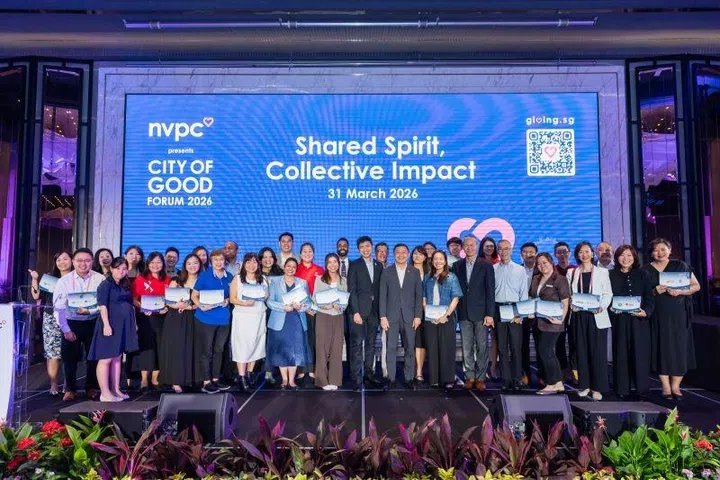
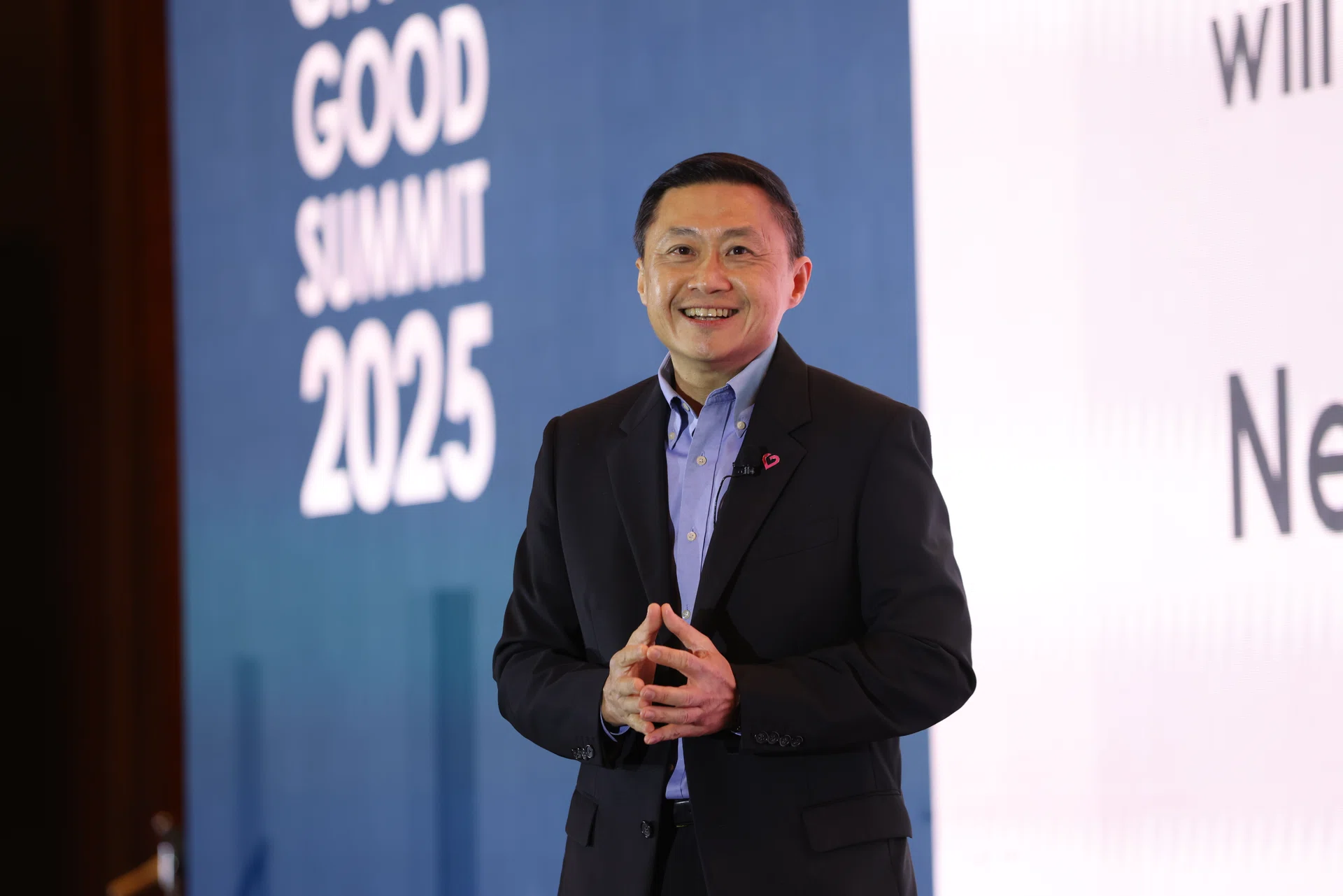
Tony Soh with the recipients of the Project V appreciation ceremony at the City of Good Forum 2026
Altruism and architecture
NVPC’s mission, as Tony Soh tells it, is neither simple charity nor corporate compliance. It is an attempt to inoculate Singapore against the centrifugal forces of globalisation and individualism by strengthening the invisible tissue that binds people together. From rethinking how volunteering is measured to embedding micro-giving in daily routines, from professionalising charities without smothering ground-up groups to nudging companies from episodic photo-ops to sustained commitment, the work is granular and unglamorous.
But the tensions are real and unresolved. The methodology changes that Soh defends also obscure year-on-year comparisons that might show decline. The corporate purpose gap — 79% believing in duty, 30% adopting Society initiatives, 14% actually volunteering — persists despite years of flagship programmes.
The NCPIS identifies “lack of senior management interest” as the most significant barrier, not financial constraints, suggesting the problem is cultural rather than resource-based.
The startup culture remains largely outside NVPC’s reach. The risk of virtue washing grows as the Company of Good network scales. And the fundamental question of whether incentives cultivate genuine mindsets or merely efficient self-interest hangs over every tax break and recognition badge.
Soh is aware of these tensions. He does not pretend they do not exist. “It gets harder and harder,” he admits of convincing the unconverted. “Because you’re going into new territory, you have to go and convert the natives.” Yet he maintains his optimism, anchored in generational change and the multiplication of peer influence. “As momentum builds, they begin to see — all my competitors, my partners are doing this. We get a bit of corporate Fear of Missing Out (FOMO).”
If this FOMO translates into authentic transformation, NVPC will have helped nurture a civic spirit; if it results in better-executed performance, it will have strengthened the machinery without necessarily deepening the instinct behind it. “In giving, you are actually investing and contributing to the we,” Soh says. “As we do that, the community gets stronger. Actually, we also benefit.”
It is certainly a compelling case for mutualism. But the central tension remains: do Singaporeans feel a deepening sense of belonging, or are they just mastering a more sophisticated way to get something back for what they give? Soh has built the architecture. Whether the spirit of the people inhabits it is a question no methodology can yet answer.