%22%3E%0A%3Cpath%20d%3D%22M412%20101.2H393.7C393.1%20101.2%20392.3%20100.9%20391.8%20100.5C377.3%2087.6004%20362.9%2074.6004%20348.4%2061.6004C344.8%2058.4004%20341.3%2055.2004%20337.7%2052.0004C337.1%2051.5004%20336.2%2051.1004%20335.5%2051.0004C334.2%2050.8004%20333%2051.0004%20331.5%2051.0004V101.1H316.7V0.100391H331.4V44.3004C331.9%2044.3004%20332.2%2044.4004%20332.5%2044.4004C334.9%2044.4004%20337.2%2044.5004%20339.6%2044.4004C340.4%2044.4004%20341.3%2044.0004%20341.8%2043.5004C351.6%2034.4004%20361.4%2025.2004%20371.1%2016.0004C376.5%2010.9004%20381.9%205.90039%20387.3%200.800391C387.9%200.200391%20388.5%200.000390626%20389.3%200.000390626H400.9C384.2%2015.8004%20367.8%2031.3004%20351.2%2047.0004C371.5%2065.0004%20391.8%2082.9004%20412.1%20100.9C412.1%20101%20412.1%20101.1%20412%20101.2ZM180.9%20101.2C184.1%2094.9004%20187.2%2088.9004%20190.3%2082.8004C198.3%2067.3004%20206.2%2051.8004%20214.2%2036.2004C220.3%2024.4004%20226.4%2012.5004%20232.4%200.700391C232.7%200.100391%20233%20-0.0996094%20233.7%20-0.0996094H248.1C248.8%20-0.0996094%20249.2%200.100391%20249.6%200.800391C256%2013.3004%20262.4%2025.7004%20268.8%2038.2004C279.3%2058.6004%20289.8%2079.0004%20300.3%2099.5004C300.5%20100%20300.8%20100.4%20301.1%20101.1C300.5%20101.1%20300.1%20101.2%20299.7%20101.2H286.5C285.6%20101.2%20285.1%20100.9%20284.7%20100.2C280.1%2091.3004%20275.4%2082.4004%20270.8%2073.4004C270.1%2072.1004%20269.3%2071.6004%20267.8%2071.6004H209.9C208.7%2071.6004%20208.1%2072.0004%20207.5%2073.1004C202.9%2082.1004%20198.2%2091.0004%20193.6%20100C193.1%20101%20192.6%20101.3%20191.5%20101.3C188.4%20101.2%20185.3%20101.3%20182.3%20101.3C182%20101.2%20181.6%20101.2%20180.9%20101.2ZM239.1%2011.4004C230%2029.2004%20221.1%2046.7004%20212.1%2064.3004H266.4C257.2%2046.7004%20248.2%2029.2004%20239.1%2011.4004ZM0%200.000390626H43.4C51.2%200.000390626%2058.7%201.20039%2065.7%204.80039C75.9%2010.0004%2078.9%2018.0004%2078.6%2027.4004C78.3%2034.3004%2076%2040.5004%2071.2%2045.5004C67.3%2049.6004%2062.4%2052.3004%2057.1%2054.3004C50.6%2056.7004%2043.9%2058.0004%2037.1%2058.6004C30.1%2059.2004%2023.1%2059.4004%2016.2%2059.7004C15.8%2059.7004%2015.3%2059.8004%2014.8%2059.8004V101.1H0.1C0%2067.4004%200%2033.8004%200%200.000390626ZM14.8%207.10039V52.2004C23.7%2052.4004%2032.6%2052.3004%2041.2%2050.1004C44.4%2049.3004%2047.6%2048.2004%2050.6%2046.7004C58.4%2043.0004%2062.3%2036.7004%2062.7%2028.0004C63%2019.9004%2059.5%2014.1004%2052.4%2010.5004C47.6%208.00039%2042.5%207.10039%2037.2%207.10039H14.8ZM95.9%20101.1V0.100391H167.3V7.20039H110.7V44.7004H158.1V51.9004H110.8V93.9004H171.1V101C146.1%20101.1%20121%20101.1%2095.9%20101.1Z%22%20fill%3D%22black%22%2F%3E%0A%3Cpath%20d%3D%22M35.0004%2025.7996H42.5004V20.6996H44.8004V33.1996H42.6004V27.5996H34.9004V33.2996H32.7004V20.7996H35.0004V25.7996ZM54.4004%2025.8996V27.2996H48.9004V31.6996H55.9004C55.9004%2032.1996%2056.0004%2032.5996%2056.0004%2033.0996H46.5004V20.5996H55.5004V21.8996H49.0004V25.7996C50.7004%2025.8996%2052.5004%2025.8996%2054.4004%2025.8996ZM25.9004%2033.0996H23.5004V21.9996H17.9004V20.6996H31.6004V22.0996H27.1004C26.2004%2022.0996%2025.9004%2022.2996%2025.9004%2023.1996C26.0004%2026.0996%2025.9004%2028.9996%2025.9004%2031.7996V33.0996Z%22%20fill%3D%22black%22%2F%3E%0A%3C%2Fg%3E%0A%3Cdefs%3E%0A%3CclipPath%20id%3D%22clip0_388_462%22%3E%0A%3Crect%20width%3D%22411%22%20height%3D%22101.2%22%20fill%3D%22white%22%2F%3E%0A%3C%2FclipPath%3E%0A%3C%2Fdefs%3E%0A%3C%2Fsvg%3E%0A)
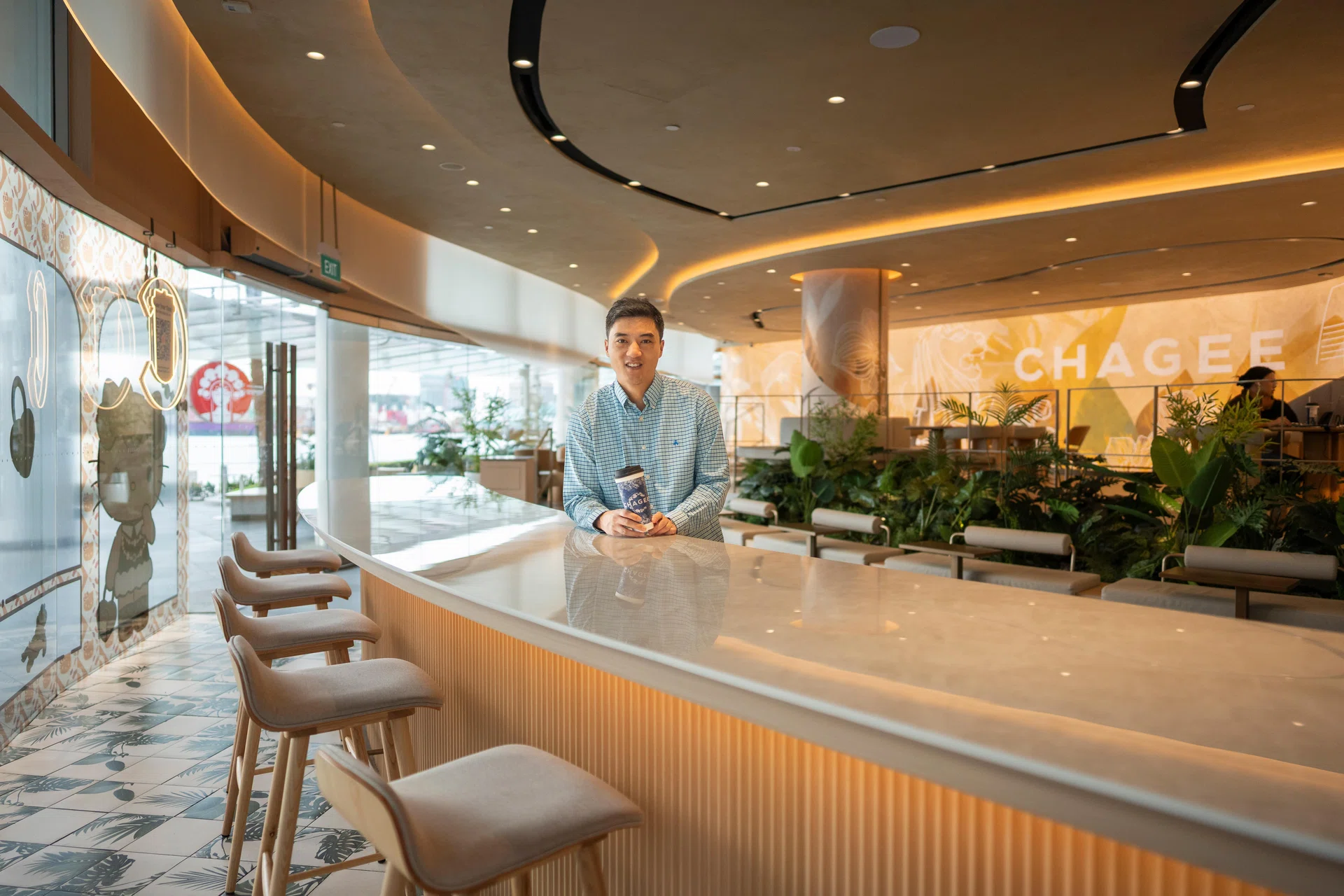
These are not the instincts you expect to encounter in a category built on sugar, speed, and novelty, but they surfaced repeatedly during my conversation with Lawrence Wen: hesitation, restraint, an almost stubborn resistance to immediacy.
Chagee has every reason to move faster. The brand operates in one of Singapore’s most competitive consumer markets, where attention is fleeting, loyalty is thin, and the distance between trend and irrelevance can feel alarmingly short. Expansion, in this context, is often treated as a race — more stores, more flavours, more reasons to stay visible.
And yet, much of Chagee’s internal logic seems to pull in the opposite direction.
Instead of acceleration, there is discipline. Instead of maximal choice, there are constraints. Instead of chasing novelty, there is an insistence — sometimes unfashionably so — on repeatability. “At the end of the day, we can talk about branding,” Wen says, almost dismissively, “but it always comes back down to the product.”
It is a position that feels out of step with the moment. In a market trained to reward spectacle, Chagee behaves like a company more concerned with staying coherent than staying loud. Growth is framed as efficiency, not conquest. Innovation is permitted, but only within limits. Change arrives, surely, but it is rarely celebrated for its own sake.
Spend enough time with the brand, and then with the person overseeing its Singapore operations, and a pattern begins to form. What looks like strategy starts to feel like temperament and what sounds conservative begins to read as intentional. And the pauses — the slight delays before Wen’s answers arrive — start to matter as much as the answers themselves.
The ghost in the kiosk
To understand Wen’s current mission, one must understand the shadow from which Chagee is emerging. In the hyper-competitive ecosystem of Singapore’s beverage industry, brands often flare up and vanish with the speed of a viral TikTok. Chagee was not always the juggernaut of 4,500-square-foot flagship stores. It arrived in Singapore in 2019 under a franchising model, a period Wen describes with diplomatic caution.
“It was quiet before. It was not as ‘wow and boom’ as you see in our stores now,” Wen recalls. The “tainted” history of the brand in Singapore wasn’t due to scandal, but a lack of soul. It was a 1.0 iteration, says Wen — kiosks that blended into the background of shopping malls and severely indistinguishable from the dozen other sugary options.
“It’s why when we initially proposed a bigger space, the business community was not convinced,” Wen recalls, discussing the pivot to the modern 3.0 concept. “Chagee was here before, right? Why do you need such a big space now?,” they questioned. The skepticism was valid. Singaporeans are notoriously fickle; they chase the next shiny object until it loses its luster, then move on. To counter this, Wen didn’t just want to sell tea; he wanted to sell a story of “friendship and togetherness”.
Enter the brand’s signature drink, the BO.YA, named after a piece of Chinese folklore about a musician named Boya who had few friends but found a soulmate in a woodcutter. When that friend passed away, the story became a monument to deep, intentional connection.
“We chose BO.YA as our premium name... because our brand, everything we stand for, is about friendship and beginnings,” Wen explains. It is a lofty narrative for a cup of Jasmine milk tea, but Wen is banking on the idea that in a post-COVID world, Singaporeans are starved for a “Third Space” that offers more than a transaction.
On synergy and migration
Wen’s insistence on “intentionality” and “humility” is a direct inheritance from a childhood defined by upheaval. Born into a war-torn family, his parents fled Vietnam for Hong Kong during a “sensitive period,” eventually migrating to Sydney, Australia. It was a multi-generational household where the margins were thin.
“I grew up poor,” Wen says. “My dad was a shift taxi driver, which literally meant he worked one day, 24 hours, and then he gets the next day off. He had no time to attend to me.” Unlike the stereotypical Asian household where academic excellence is demanded from parental figures, Wen’s drive was internal, fueled by the sight of debt collectors visiting the family home. “It was not a situation that I wanted to grow up in,” he says simply. “I really tried to get out of that”.
This background created a profound synergy with Chagee’s founder, Zhang Junjie, whose own life story reads like a Dickensian struggle. “Our founder also has a very similar upbringing. He grew up as an orphan. His parents passed away when he was ten, and he lived on the streets,” Wen notes. “Nothing was given to us, but we really cherish the people around us that have allowed us to become who we are today”.
This shared “hard knock” pedigree informs Wen’s skepticism of the “transient mall” culture. While other brands are content to be a pitstop for shoppers, Wen is obsessed with the unit economics of the “Third Space” — a concept he admits is evolving. “Everyone actually has a different definition of a third space,” he observes. For Wen, it is a “quiet corner,” a “small nook,” or a “sofa area” where a student can study for hours or an office worker can escape the grind.
The science of the slow-down
There is a deliberate irony in Wen’s tech-heavy business model. He is a veteran of the delivery world, having served as a general manager for GrabFood and FoodPanda and so, he understands the “seamless” efficiency of an app better than almost anyone in the F&B sector.
Yet, at Chagee, he uses technology to force a slower, more tactile experience.
The most curious example of this is the “three-hole straw”. While a standard bubble tea straw is designed for maximum intake, the Chagee variant is a design that restricts the volume of tea reaching the palate.
“By restricting the volume you control, we are forcing you to appreciate it,” Wen explains. The R&D team tested various configurations — one hole, two, five — before settling on three as the optimal number to ensure the tea fragrance is “more dispersed in your mouth”. It is an act of intentionality in a market that usually prioritizes the gulp.
“Actually, the engagement part is very important to us,” Wen insists. “We don’t want it to be very transactional. Just come in, place an order. We want them to know our brand. Know what they’re drinking, what the health content is like and how many calories there are in the drink.”
This push for engagement led to the implementation of the “Guest Experience Leader,” a role designed to bridge the gap between the high-speed “teapresso” machines and the human element. In malls like NEX, where senior citizens might lack credit cards or the digital literacy to navigate an app, these leaders serve as translators for the brand. It is Wen’s way of ensuring that his “perfectionist” systems don’t alienate the very “friends” he is trying to meet.
Singapore as a regional hub
Since Wen took the helm, Singapore has been repositioned as Chagee’s “regional hub” and “testing market”. The shift from franchising to direct ownership was a declaration of permanence. “We moved the direct ownership model because we think Singapore is a long-term sustainable market for us,” Wen says.
This sustainability is being tested by the brutal reality of Singaporean rentals — a topic Wen approaches with the pragmatism of an operator who has seen the price of success. “We have to be more selective of the locations that we go into now in order to make the whole unit economics work,” he admits. “There are a lot of locations that were given to us that I said, ‘No, we can’t open it.’ Being prudent allows us to have a sustainable long-term business.”
The goal is not just ubiquity, but “quality of the store”. Whether it’s the 4,500-square-foot expanse at VivoCity or a Peranakan concept store, Wen wants each location to feel like it has evolved with the neighborhood. It is a gamble on the idea that even in a city as fast as Singapore, people will still pay for the privilege of a quiet, well-scouted room and a tea that requires a special straw to truly taste.
This approach to retail — where a brand ditches the “cookie-cutter” model in favor of local character — parallels the design philosophy of the Australian skincare giant, Aesop.
Since its inception, Aesop has famously rejected the idea of a uniform global storefront. Instead, every location is treated as an architectural dialogue with its surroundings. Whether it is a store in a historic London townhouse or a sleek outpost in a Tokyo subway station, the brand ensures that no two spaces are identical. By using materials, textures, and lighting that reflect the local heritage, Aesop transforms a simple transaction into an immersive cultural experience.
For Wen, applying this “Aesop-esque” intentionality to tea means that a Chagee store is no longer a pitstop for caffeine; it becomes a physical extension of the neighborhood’s soul, grounding a global brand in a specific, local context.
Radical inclusion as a business model
If the “three-hole straw” is Wen’s exercise in micro-mechanical intentionality, the Chagee store at the National University of Singapore (NUS) is his most radical experiment in social engineering. It is what he calls a “signing store,” a concept where the staff — the baristas, the “teapressologists,” the floor managers — are entirely deaf or mute. In a city-state that often prizes hyper-efficiency and frictionless service above all else, Wen’s decision to open a store that necessitates a slower, more deliberate form of communication was, unsurprisingly, met with significant institutional friction.
“When we initially proposed a signing store, the business community didn’t believe that we could open and operate a 100% deaf-mute partner store, because it’s never been done before,” Wen says, his voice maintaining that steady, contemplative register. The pushback wasn’t just from skeptical peers; it came from the very gatekeepers of Singaporean commerce. “Landlords [were] difficult to convince,” he recalls. To the landlords, a store staffed by those who cannot hear or speak sounded like a liability in a high-traffic environment — a bottleneck in the flow of capital.
Wen, however, saw it as a matter of inclusion and opportunity. He wasn’t guessing at the viability of the model; he was leaning on the data from Chagee’s broader ecosystem, which includes 12 signing stores in China and one in Vietnam.
“We know that, both from a CSR point of view, from a productivity point of view, from a profitability point of view, it works,” he notes. Eventually, the skeptics were silenced by the results. The NUS student population proved to be receptive and patient. In this specific corner of the campus, the transaction of buying a tea became a poignant moment of human recognition.
The machinery of fragrance
The “3.0” transformation Wen is spearheading isn’t merely aesthetic; it is deeply technological. In the backrooms of these flagship stores sits the teapresso, a piece of proprietary hardware that functions like a high-end espresso machine but for tea leaves. The leaves are ground very finely and subjected to intense pressure, resulting in a liquid that mimics the body and caffeinated start of coffee without any actual coffee beans.
“It tastes exactly like coffee latte, but there’s no coffee,” Wen tells me, noting that this is his personal favorite for a morning ritual. It is an innovation designed to capture a specific demographic: the health-conscious urbanite who is increasingly wary of the “syrup-trap” of traditional bubble tea.
Wen is direct about the industry’s reputation for sugar-bomb beverages. “What I hear often from our customers is that once they drink Chagee, they can’t drink anything else because everything else becomes too sweet and the tea fragrance is not strong enough,” he says.
By focusing on product innovation and health content, Wen is attempting to de-couple tea from the junk food category and move it toward something more akin to a functional wellness ritual. Every Friday, the brand launches a new product or a limited-time offering to keep the shiny-thing hunters engaged, but the core remains the same: a high-fragrance, low-sugar commitment to the leaf.
An entrepreneurial mindset
To Wen, the business of tea is a “tough industry,” a fact he learned early on from his mother’s siblings in Taiwan, many of whom were in the food business. This proximity to the grind of F&B — the thin margins, the grueling hours — instilled in him a specific entrepreneurial mindset that serves as one of Chagee’s four core values.
When asked what he would add if he could add a fifth value to the company’s internal constitution, Wen pauses for a long time, his eyes searching the middle distance of the Joo Chiat cafe where we sat. He eventually settles on “innovation,” though he qualifies it immediately. “It is about adapting to the current market and having something that is unique... being sustainably unique,” he explains.
This sustainability is Wen’s primary obsession. He is well aware that he is operating in a market with “no loyalty,” where consumers go after the next shiny thing like cats chasing a laser pointer. His strategy to combat this transience is a paradoxical blend of aggressive expansion and selective pruning. In Singapore, he is opening stores at a rate of nearly one per month, yet he refuses dozens of locations that don’t meet his “unit economics” or “third space” criteria.
“We prefer large store formats because of the concept of the third space,” Wen says. This is why Chagee is taking over massive footprints in malls like VivoCity, where the store spans 4,500 square feet and looks out toward Sentosa — a deliberate move away from the “kiosk” identity of the 2019 era.
The bipolarity of the world
As our conversation winds down, the “silent strong” persona Wen projects begins to reveal a more philosophical undercurrent. He speaks about the world as a place that has become increasingly bipolar and negative. It is a surprising observation from a man whose job is to sell tea lattes, but it explains his obsession with the positivity of his stores.
“There’s a lot of negativity in this world... but there’s a lot of positivity in this world,” Wen says. “When you take that and you amplify it to the entire population, you can always find pockets of people that will bring the world forward rather than take the world back”. He sees his stores as these “pockets.” If a student can find a quiet corner at Chagee’s Bishan Junction 8 to finish their homework, or if a customer can look a deaf barista in the eye and share a moment of understanding through a three-hole straw, Wen considers it a success.
In the high-stakes, high-rent theater of Singaporean retail, Wen is betting that a “perfectionist” system — driven by the memory of a taxi-driver father and the folklore of an ancient musician — can create a space that lasts long after the shiny things have faded. Today, Lawrence Wen is building a fortress of positivity in a world he perceives as increasingly loud. And he is doing it one finely ground, highly pressurized, three-hole-straw sip at a time.