%22%3E%0A%3Cpath%20d%3D%22M412%20101.2H393.7C393.1%20101.2%20392.3%20100.9%20391.8%20100.5C377.3%2087.6004%20362.9%2074.6004%20348.4%2061.6004C344.8%2058.4004%20341.3%2055.2004%20337.7%2052.0004C337.1%2051.5004%20336.2%2051.1004%20335.5%2051.0004C334.2%2050.8004%20333%2051.0004%20331.5%2051.0004V101.1H316.7V0.100391H331.4V44.3004C331.9%2044.3004%20332.2%2044.4004%20332.5%2044.4004C334.9%2044.4004%20337.2%2044.5004%20339.6%2044.4004C340.4%2044.4004%20341.3%2044.0004%20341.8%2043.5004C351.6%2034.4004%20361.4%2025.2004%20371.1%2016.0004C376.5%2010.9004%20381.9%205.90039%20387.3%200.800391C387.9%200.200391%20388.5%200.000390626%20389.3%200.000390626H400.9C384.2%2015.8004%20367.8%2031.3004%20351.2%2047.0004C371.5%2065.0004%20391.8%2082.9004%20412.1%20100.9C412.1%20101%20412.1%20101.1%20412%20101.2ZM180.9%20101.2C184.1%2094.9004%20187.2%2088.9004%20190.3%2082.8004C198.3%2067.3004%20206.2%2051.8004%20214.2%2036.2004C220.3%2024.4004%20226.4%2012.5004%20232.4%200.700391C232.7%200.100391%20233%20-0.0996094%20233.7%20-0.0996094H248.1C248.8%20-0.0996094%20249.2%200.100391%20249.6%200.800391C256%2013.3004%20262.4%2025.7004%20268.8%2038.2004C279.3%2058.6004%20289.8%2079.0004%20300.3%2099.5004C300.5%20100%20300.8%20100.4%20301.1%20101.1C300.5%20101.1%20300.1%20101.2%20299.7%20101.2H286.5C285.6%20101.2%20285.1%20100.9%20284.7%20100.2C280.1%2091.3004%20275.4%2082.4004%20270.8%2073.4004C270.1%2072.1004%20269.3%2071.6004%20267.8%2071.6004H209.9C208.7%2071.6004%20208.1%2072.0004%20207.5%2073.1004C202.9%2082.1004%20198.2%2091.0004%20193.6%20100C193.1%20101%20192.6%20101.3%20191.5%20101.3C188.4%20101.2%20185.3%20101.3%20182.3%20101.3C182%20101.2%20181.6%20101.2%20180.9%20101.2ZM239.1%2011.4004C230%2029.2004%20221.1%2046.7004%20212.1%2064.3004H266.4C257.2%2046.7004%20248.2%2029.2004%20239.1%2011.4004ZM0%200.000390626H43.4C51.2%200.000390626%2058.7%201.20039%2065.7%204.80039C75.9%2010.0004%2078.9%2018.0004%2078.6%2027.4004C78.3%2034.3004%2076%2040.5004%2071.2%2045.5004C67.3%2049.6004%2062.4%2052.3004%2057.1%2054.3004C50.6%2056.7004%2043.9%2058.0004%2037.1%2058.6004C30.1%2059.2004%2023.1%2059.4004%2016.2%2059.7004C15.8%2059.7004%2015.3%2059.8004%2014.8%2059.8004V101.1H0.1C0%2067.4004%200%2033.8004%200%200.000390626ZM14.8%207.10039V52.2004C23.7%2052.4004%2032.6%2052.3004%2041.2%2050.1004C44.4%2049.3004%2047.6%2048.2004%2050.6%2046.7004C58.4%2043.0004%2062.3%2036.7004%2062.7%2028.0004C63%2019.9004%2059.5%2014.1004%2052.4%2010.5004C47.6%208.00039%2042.5%207.10039%2037.2%207.10039H14.8ZM95.9%20101.1V0.100391H167.3V7.20039H110.7V44.7004H158.1V51.9004H110.8V93.9004H171.1V101C146.1%20101.1%20121%20101.1%2095.9%20101.1Z%22%20fill%3D%22black%22%2F%3E%0A%3Cpath%20d%3D%22M35.0004%2025.7996H42.5004V20.6996H44.8004V33.1996H42.6004V27.5996H34.9004V33.2996H32.7004V20.7996H35.0004V25.7996ZM54.4004%2025.8996V27.2996H48.9004V31.6996H55.9004C55.9004%2032.1996%2056.0004%2032.5996%2056.0004%2033.0996H46.5004V20.5996H55.5004V21.8996H49.0004V25.7996C50.7004%2025.8996%2052.5004%2025.8996%2054.4004%2025.8996ZM25.9004%2033.0996H23.5004V21.9996H17.9004V20.6996H31.6004V22.0996H27.1004C26.2004%2022.0996%2025.9004%2022.2996%2025.9004%2023.1996C26.0004%2026.0996%2025.9004%2028.9996%2025.9004%2031.7996V33.0996Z%22%20fill%3D%22black%22%2F%3E%0A%3C%2Fg%3E%0A%3Cdefs%3E%0A%3CclipPath%20id%3D%22clip0_388_462%22%3E%0A%3Crect%20width%3D%22411%22%20height%3D%22101.2%22%20fill%3D%22white%22%2F%3E%0A%3C%2FclipPath%3E%0A%3C%2Fdefs%3E%0A%3C%2Fsvg%3E%0A)
The Business of Clarity — What the CEO of Milieu Insight knows to be true about truth
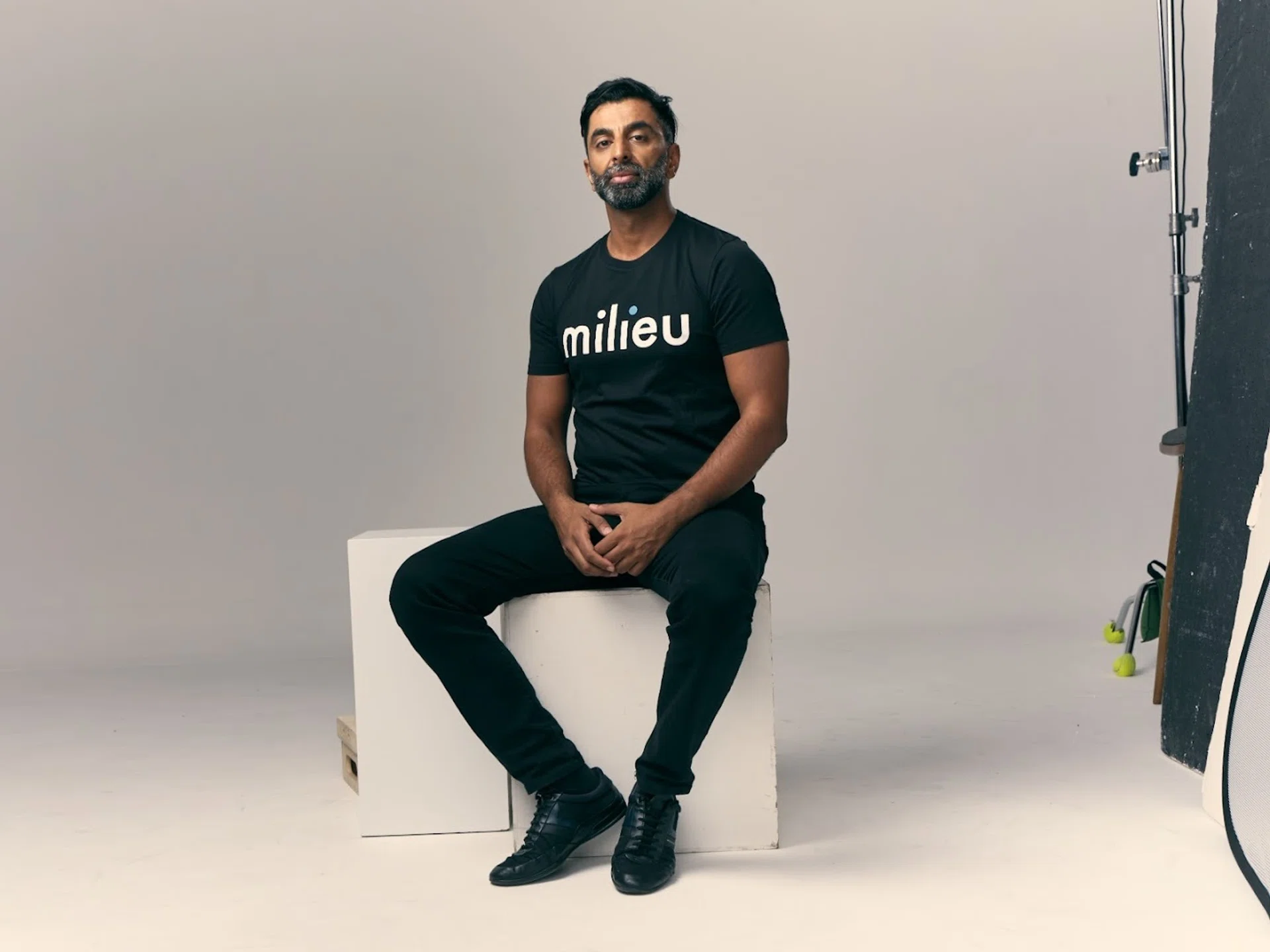
In this long read, Sundip Chahal takes us on a deep dive into his immigrant upbringing in Middlesbrough, career shifts, and mission to revolutionise data and insights for connection, understanding, and empowerment.
By Zat Astha /
Share this article
Born in a small, unassuming northern town, Middlesbrough, Sundip Chahal’s story reflects the classic immigrant tale of graft and grit. His parents, like many who travelled from India, landed in England with dreams tethered by the reality of hard, blue-collar work. His father drove a taxi; his mother worked in a factory. It was work that demanded long hours and physical strain, and that reality stamped itself indelibly on him. “That kind of upbringing instils a work ethic in you,” the newly-minted CEO of Milieu Insight recalls, “you see your parents working hard, manual jobs.”
Growing up alongside an older brother, competition was almost a rite of passage. But unlike the endless rivalry, there was a sense of camaraderie and shared purpose — a yearning to build a better future than the one their parents had sacrificed for. “I don’t think I’ll ever work as hard as my parents did,” he admits. And maybe, he muses, his generation never will. But there’s a resolute drive to provide for his own children, to grant them opportunities that his family could only dream of.
Like many of his generation, Sundip was expected to pursue something traditional — medicine, pharmacy, accounting. He chose biomedical sciences, a field which he found “interesting enough,” but he admits, “I probably didn’t know what I wanted to do for the first 25 years of my life.” And in a circle-of-life moment, today, Sundip tells me he advises his teenage daughter not to worry about having a clear path too soon.
At one point, Sundip even toyed with the idea of academia, even embarking on a PhD. “The Role of Peroxisome Proliferator-Activated Receptor Alpha in Atherosclerosis,” he recalls with a mix of pride and humour. It was serious research, though he never completed the full thesis. “I was still enjoying the student life,” he admits, a knowing smile hinting at the freedom he found in those years. But the lab, with its endless routine, eventually lost its shine, and he knew he needed a way to support himself, to move beyond the limitations of a simple undergraduate degree.
“I always root for the underdog.”
The drive to secure opportunities ran deep, likely planted by his parents’ journey. Sundip’s father had come to England at just 15, part of a wave of young Sikhs drawn to a post-war Britain hungry for labour. Factories needed rebuilding, and recruitment agents scoured Indian villages, calling for young men to help restore a war-battered Britain. “My dad didn’t fully realise what kind of life awaited him,” he says laughing, though his eyes were visibly wet.
“Why does this recollection make you so emotional?” I probe. Sundip pushes his chair away as if retreating into a corner of the room, pausing for a beat before sharing that the thought of his dad being the same age as his son today makes him ponder on the kind of tribulations the former had to endure as a young boy. And if the elder Chahal’s journey to England was challenging, his mother’s journey was, in no small ways, even more harrowing.
Sundip’s mother came to England under difficult circumstances bound by familial duty and loss, navigating a new life far from home. He discovered much later, at around 15, the full complexity of her story, learning of the familial ties and the tragedy that brought her to the UK. “It was a history woven with resilience,” he reflects, “and yet she remained, in her way, endlessly hopeful.”
In Middlesbrough, there was the echo of his family’s story in nearly every corner. His parents eventually achieved their dream of opening a fish and chip shop, a nod to their entrepreneurial spirit and the tenacity it took to build a life in unfamiliar territory. “Fish and chips are still a staple in northern England,” he notes, but he chuckles at the thought of eating them in Singapore’s heat. Back in Middlesbrough, though, queues would stretch from mid-morning to midnight, people craving that hot, battered comfort. Beyond just sustenance, the shop was a marker of his parents’ success in a land far from home.
Today, Middlesbrough remains an indelible part of him, a quiet underdog spirit that persists in the way he views the world. He finds himself drawn to those who challenge the odds, who punch above their weight. “I always root for the underdog.”
The road less travelled
Sundip’s path from science to statistics might sound like an unusual leap, but for him, the trajectory always made sense. Maths had been a favourite subject since school, particularly statistics. “When I was doing my A-levels in the UK, I realised there were different types of maths courses — pure and stats, pure and mechanics, or pure and applied,” he recalls. “I chose pure and applied, like most of my classmates.”
He ended up struggling with the mechanics section, scoring a B while his other grades were all As. In hindsight, he admits, “I could’ve just done pure stats, which might have suited me better.”
Numbers, in their various forms, remained a constant. As he moved into PhD research, there was an analytical side to even the creative process, and by the time he was ready to leave academia, he found himself drawn to market research. “It wasn’t something I’d ever considered,” he explains, “but when I looked into it, the job description made me think, ‘I could actually do that.’”
At 26, fresh out of academia, Sundip was ready to step into the professional world. He had always envisioned a career that melded creativity with analysis, and market research seemed to offer a space for both. He applied to three jobs — two in marketing, including one at Tesco, and another at Nestlé. While the Nestlé program was highly regarded, offering experience across departments like sales and marketing, he recalls the process as “intense, with multiple rounds and assessments.” Ultimately, they offered the job to another candidate.
Ipsos was different. “Getting into Ipsos felt far easier,” Sundip says, as it required only a CV submission compared to the rigour of Nestlé’s process. He joined as a junior research executive in 2001, shortly after 9/11, starting a path in market research that felt like both a choice and an opportunity. Sundip explains that at that time, Ipsos typically didn’t take on postgraduates for entry-level positions, and he recalls some initial frustration.
But it turned out to be a foundation, giving him exposure to the technical aspects of the job — survey design, data cleaning, statistical analysis. “The technical elements were essential,” he says, “but they didn’t excite me.” Presenting data, though, was a different story. His first major presentation was a segmentation study for GSK on indigestion remedies. “Presenting to clients who were eager to understand their audience was a thrill,” he reflects, “it gave me a sense of my place in this field.” Working with clients and interpreting the “why” behind the numbers tapped into something beyond analysis.
It was this role as translator and interpreter of data that affirmed his confidence.
One person, in particular, helped shape those early years. “I worked with an excellent boss who was a significant influence,” he recalls. She offered both guidance and support, encouraging him to step up in ways he hadn’t yet considered. By then, Sundip had moved to London and was sharing a house with four others in the same graduate scheme, each one navigating the challenges of starting salaries, which barely covered rent.
Of grit and opportunity
Then came an opportunity to join YouGov. “Everyone had heard of YouGov because of its polling work,” Sundip explains, “and I thought, ‘Why not?’” He became Sales Director for the daily brand tracker, a product that set a new standard by delivering daily brand perception insights, a major departure from the industry’s monthly data cycle. “At Ipsos, we would wait for monthly data, which meant issues from October wouldn’t be flagged until nearly December,” he explains. With YouGov, brands could gauge public perception in real-time, empowering them with Insight that were fresh, immediate, and actionable.
Sundip remembers the environment working at YouGov as intense, the kind of energy that only a fast-growing, ambitious company can generate. “It was a young, scrappy, and ambitious company,” he says. “We worked hard, played hard, and made real strides in the industry.”
When Sundip joined, YouGov was but a small player worth around £20 million on the AIM stock market. By the time he left, it had swelled to a valuation of £1.5 billion, with 3,000 employees. “Imagine the opportunities and challenges that came with that kind of growth,” he says, reflecting on the evolution of the company from startup scrappiness to global influence which, in no small way, mirrors his 18-year ascend from Sales Director to Chief Operating Officer (MENA) to Group Chief Operating Officer.
When asked, Sundip downplays his success, attributing much of it to luck. “I’d always say I was lucky, but my partner gets annoyed when I say that,” he laughs. “She’ll tell me, ‘Don’t call it luck.’” But Sundip insists that luck plays a role, especially in the things that are beyond one’s control. “I don’t feel sorry for people who don’t work hard; that’s not about luck,” he notes. “But if you’re working hard and just not getting the breaks, that’s different.”
A season of transition and reflection
LinkedIn was a great resource for my research on the man that is Sundip Chahal. Curiously, there was a glaring gap of updates between 2021 and just five months ago, having relinquished his role at YouGove just weeks prior. “There are certain things I can share and others I can’t due to confidentiality,” he begins by way of explanation, hinting at a period marked by internal and professional transformation.
During his tenure at YouGov, where he was the Group Chief Operating Officer, Sundip had become the de facto second-in-command, working closely with the founder, his first boss. There were expectations, even assumptions, that he would eventually take over as CEO. “It eventually came down to two candidates — me and another external one — after a long, public process lasting about two and a half years.”
And as YouGov neared the end of its ambitious five-year plan, Sundip found himself balancing the pressures of corporate life with personal changes, “with my family and ex-wife.” While he doesn’t dwell on the details, it’s clear that this chapter was formative. At the same time, YouGov’s philosophy was to exceed “average” targets, with audacious goals like the “Double-Double,” aiming to double revenue within five years. “In our first strategic plan, we hit it out of the park,” Sundip notes. The second plan fell short of that mark, achieving 80%, yet it still surpassed the industry standard.
But Sundip’s career trajectory took a surprising turn when the CEO role was awarded to an external candidate. “One of the reasons I eventually left was due to the direction the company decided to go,” he explains, a hint of disappointment palpable. Reflecting on YouGov’s current standing, he adds, “If you look at YouGov’s share price now versus when I left, it’s clear that things didn’t go quite as planned.”
The industry has shifted swiftly, he observes, with the rise of new agencies and a need for companies to pivot rapidly to stay relevant. Sundip points to Ipsos as an example of adaptability, forced by the pandemic to pivot from years of scepticism about online research to embracing digital, AI, and synthetic data. “Ipsos handled that pivot well,” he concedes, but he notes the broader challenge: companies grappling with the balance between profitability and reinvestment.
A new chapter begins
Milieu Insight, where he now leads, has been a stark contrast. “We have a fantastic CTO in Feng Yi Chan and an exceptional visionary in Gerald Ang,” he says, admiring the team’s foresight and resourcefulness. “They started on a shoestring budget with friends and family support,” he adds, acknowledging the investors who saw the potential in Milieu’s ecosystem. Built without the technical debt that older companies carry, Milieu’s architecture has been designed for agility, allowing them to deliver everything from traditional surveys to AI-driven insights tailored to the region’s unique demands. Seeing Milieu’s platform for the first time was what Sundip calls a “hello moment.”

Sundip Chahal with Milieu Insight leadership; CTO Feng Yi Chan, COO Gerald Ang, CFO Kelvin Li, and CCO Juda Kanaprach.
Still, Milieu wasn’t a destination Sundip had actively sought. An intermediary reached out just as he was finalising his departure, and the timing aligned. The energy he encountered at Milieu reminded him of YouGov’s early days, but this time, he notes, the challenge is different: “Milieu’s product and technology are already top-notch. Their challenge is marketing — getting people to know about them.”
Sundip’s commitment to Milieu goes beyond professional responsibility. At nearly 50, he’s entering what he sees as the core phase of his career, a period where his name and reputation are on the line. His partnership with Gerald has been one of mutual understanding and transparency. “He’s the visionary, the one who built Milieu,” Sundip says. “I’m here to help realise that vision.”
Reflecting on his years at YouGov, he recognises a shift in his approach. “I spent too much time letting others take credit,” he acknowledges. Over the eight years he helped YouGov build its reputation, many people benefited financially from his efforts. Now, with Milieu, he’s focused on creating something meaningful, not just for the company but for those around him. This time, he’s determined “to make some good people really rich.”
Taking a bet on audacity
Milieu, at this juncture, sits at a crossroads. “We’re at a point where the company could either rise to greatness or plateau.” Both paths are within reach, and for Sundip, the opportunity is one he doesn’t take for granted. “I know Gerald and Juda Kanaprah personally, and they genuinely want to build this business. They didn’t bring me on to just fill a role – they’re putting their faith in me, and I’m here to work alongside them in the trenches.”
That camaraderie is what energises him, and it’s also why people in the industry are choosing Milieu. “I see a team that trusts each other, with the collective intelligence and industry knowledge to succeed,” he notes. “Some people may come in expecting a small, stable, boutique agency,” Sundip says, “but Milieu has never aimed to be just boutique. Gerald always had a bigger vision, and I share that with him now.”

This shared vision is expansive, with plans extending to markets in the US and the UK and through strategic partnerships that are already in motion. It’s a vision Sundip is eager to bring to life, with the awareness that success is never guaranteed, but the journey itself is fueled by purpose and commitment. Asked what Milieu’s ultimate goal would be if profit were assured, Sundip’s answer is revealing. For him, true success would mean creating a world where “everyone can access and understand their own data.” It’s about empowering individuals to interpret their own perceptions and see how they fit into a broader social fabric. “Imagine being able to look at how you think compared to others, to see if you’re alone in your thoughts or if others share the same sentiments,” he envisions. Sundip wants data to become a tool for people to interpret and analyse their world in ways that feel clear, relatable, and accessible.
And it goes beyond individual insights. Sundip envisions a world where organisations — media, corporations, governments — use this data to make thoughtful, well-informed decisions that align with the needs of their communities. “When organisations use this kind of data for better decision-making, they don’t just profit – they also have the potential to do good,” he reflects. It’s data as a source of clarity, a way for people and organisations alike to make choices that contribute meaningfully to society.
In Sundip’s ideal world, people could see what this data means for them personally, understanding their place in the world and using those insights to make informed choices. “Imagine everyone in the world answering our surveys, looking at their results, getting insights back, and sharing in that collective knowledge,” he muses. For Sundip, that’s the kind of success worth building.
Sundip’s approach to accuracy
As someone who’s been in the statistics industry for the better part of two decades, Sundip has had a front row seat to the developments surrounding the business of facts. Today, politicians have impressed on the public the fallible nature of absolute truth — as if truth bears nuances. Most recently, the term ‘alternative facts’ was used by U.S. Counselor to the President, Kellyanne Conway during a Meet the Press interview on January 22, 2017, in which she defended White House Press Secretary Sean Spicer’s false statement about the attendance numbers of Donald Trump’s inauguration as President of the United States.

“How would you define ‘truth’?” I ask against a restaging of a Western administration on the path to more falsehoods dressed up as facts. For Sundip, defining truth in data isn’t as simple as presenting numbers; it’s a layered, nuanced pursuit, a process of working through biases that shape responses and distort the very nature of what we call “truth.” A perfectly crafted survey, rigorously designed for fairness and neutrality, might still deliver skewed results if posted in the wrong context — like asking about love satisfaction on a dating site. “Every element matters — how you craft the survey, who you send it to, and ensuring checks and balances.”
Truth, he notes, is best approached by connecting layers — attitudes, behaviours, repeated engagement. In Milieu’s approach, this means building relationships with respondents, who need to feel their views are accurately represented. “People don’t want to take surveys if they think their views will be misrepresented or used in a partisan way,” he explains. Misrepresentation erodes trust, leading to a cycle where individuals feel alienated from the very processes meant to reflect their realities.
This understanding is something Milieu’s local team leverages. “They understand Southeast Asia’s nuances better than companies from outside the region,” Sundip says, highlighting the cultural sensitivity that shapes Milieu’s surveys. Not every question is life-changing, he admits, sometimes it’s “about dishwashing detergent because it pays the bills.” But too many mundane topics, and respondents will disengage, a balance Milieu consciously maintains.
People, Sundip observes, have an innate desire to compare themselves to others — a universal impulse that transcends culture. “My Indian parents were no exception, always sharing how someone else’s kid was doing,” he chuckles. Milieu taps into this with products like Portraits, giving panellists insights into where they stand within a broader social context. It’s an honest feedback loop, an essential part of what makes data feel relevant and meaningful to those who participate.
For Sundip, achieving “truth” in data is about representing reality as faithfully as possible, understanding that truth isn’t static. “Once you have that baseline, you can measure change,” he says, recognising the broader societal learning curve in interpreting data patterns before they escalate into crises. He brings up Middlesbrough, his hometown, recently in the headline for far-right riots. “To me, those events weren’t surprising,” he says. Living there, he’d noticed a shift in the town’s atmosphere, subtle but telling. “If we were tracking sentiments and shifts in attitudes, these kinds of events wouldn’t come as a shock.” Real, ongoing engagement, he believes, keeps us from being blindsided.
Asked about the surprising lessons data reveals, Sundip sees more confirmation than surprises. “There’s a classic survey question that asks people which races or nationalities they’d prefer not to live next to,” he explains. “In 2024, you’d hope the world has moved on, but you’d be shocked by how often the results still confirm the biases you fear.”
Sundip also reflects on the “interviewer effect,” a phenomenon highlighted back when online research was nascent, about 20 years ago. It was first noticed in a UK election where polls predicted a Labour win, only for Thatcher’s Conservatives to secure victory. “The interviewer effect was at play,” he explains, as voters, reluctant to admit face-to-face that they’d vote Conservative after events like the miners’ strike, privately voted Tory. “People are far more honest when they’re alone, answering privately on a device,” he says, noting how anonymity in online polling has revealed truths that traditional methods couldn’t possibly capture. Sundip finds this anonymity illuminating; data collected in private often diverges from what people reveal in person.
For him, it’s less about disappointment and more about the revelation that, behind closed doors, people’s responses reflect a truth that isn’t always comfortable to confront.
Leadership reflections
As my time with Sundip draws close to the 90-minute mark, I turn to the softer aspects of leadership and lessons learned from his tenure as the man at the top of a food chain. I share that for many business leaders, when asked what has been the hardest thing about their job they’ve kept secret, unilaterally, everyone tells me it’s loneliness.
Sundip ponders on this, his brows furrowed, fingers dancing restlessly on the table before admitting that for him, leadership doesn’t feel lonely so much as it feels weighty. “It’s more about feeling the responsibility of making the decisions,” he says, leaning into the core of his philosophy: there’s no room for indecision at the top. Recently, chatting with a former colleague, Sundip reflected on what it means to make a call when it counts. “I don’t claim to be the smartest,” he admits, “but I’ve worked long enough in this industry to know that a lot of it comes down to judgement and gut feel. You’ve got to back yourself, right?”
Experience has been his greatest teacher, elaborating that “Nine times out of ten, you’re better off trusting your instincts and making the decision when it feels right rather than regretting inaction later.” He’s seen it play out across various scenarios, from strategic decisions to complex HR issues, where hesitation has no place.
Connecting through clarity
As Sundip envisions it, the real value of data lies in its capacity to connect us — not just to facts, but to each other’s perspectives, stories, and truths. And at the heart of this connection is the question itself, the humble yet profound catalyst that shapes how we understand one another.
“A perfect question, for me, is one that people understand instantly, without any room for misinterpretation,” he explains when I ask for the definition of a perfect question. His mother’s words still echo in his mind: misrepresenting someone’s views is one of the worst things you can do. For Sundip, clarity is sacred. If a question leads someone to think, “Wait, that’s not what I meant,” then the mark has been missed entirely.
First and foremost, a question must be clear, unbiased, and, above all, unmanipulative. Sundip has little patience for those polls engineered to nudge respondents toward a particular viewpoint, often to serve a political agenda. “When that’s picked up by the press, it feels manipulative,” he says. Questions should be crafted in plain language, straightforward and direct. “Some people overestimate the power of their words,” he notes, “but simpler is better. Market researchers don’t need to complicate anything — just say it as it is.”
And yet, as Sundip explores the idea further, he finds himself drawn to a more philosophical perspective. “What is the perfect question, Zat?” he muses, acknowledging the complexities and subjectivities that make it so hard to define. The notion of a single question that could transcend boundaries, one that could universally capture the mood of a population, appeals to him.
Imagine, he suggests, if there were a question that, once answered, could connect us to the collective heartbeat of the world. “You’d check your screen, and it would say, ‘People in India are really upset today,’ or ‘People in the UK are feeling hopeful.’” In that way, the perfect question is more than mere words on a page; it’s a bridge to understanding. It makes you feel something, offers a window into collective experience, and lets you see, as he puts it, “how people are genuinely feeling, with no misunderstandings in its interpretation.”
This is where Sundip’s perspective reaches its core. To him, the perfect question is about creating a shared moment of clarity — a pause that resonates, that reminds us of our interconnectedness and the subtleties of human sentiment. In a world awash with noise and data, the perfect question cuts through, offering not just information but insights, a glimpse of our shared humanity distilled into a single, unambiguous thought.
And as Sundip Chahal steps forward with Milieu, his vision reaches beyond metrics to touch on something deeper: the hope that, in truly seeing one another, we find ourselves a little less alone and a little more connected. “That’s the kind of achievement I’d call meaningful – far beyond just profits and revenue.”