%22%3E%0A%3Cpath%20d%3D%22M412%20101.2H393.7C393.1%20101.2%20392.3%20100.9%20391.8%20100.5C377.3%2087.6004%20362.9%2074.6004%20348.4%2061.6004C344.8%2058.4004%20341.3%2055.2004%20337.7%2052.0004C337.1%2051.5004%20336.2%2051.1004%20335.5%2051.0004C334.2%2050.8004%20333%2051.0004%20331.5%2051.0004V101.1H316.7V0.100391H331.4V44.3004C331.9%2044.3004%20332.2%2044.4004%20332.5%2044.4004C334.9%2044.4004%20337.2%2044.5004%20339.6%2044.4004C340.4%2044.4004%20341.3%2044.0004%20341.8%2043.5004C351.6%2034.4004%20361.4%2025.2004%20371.1%2016.0004C376.5%2010.9004%20381.9%205.90039%20387.3%200.800391C387.9%200.200391%20388.5%200.000390626%20389.3%200.000390626H400.9C384.2%2015.8004%20367.8%2031.3004%20351.2%2047.0004C371.5%2065.0004%20391.8%2082.9004%20412.1%20100.9C412.1%20101%20412.1%20101.1%20412%20101.2ZM180.9%20101.2C184.1%2094.9004%20187.2%2088.9004%20190.3%2082.8004C198.3%2067.3004%20206.2%2051.8004%20214.2%2036.2004C220.3%2024.4004%20226.4%2012.5004%20232.4%200.700391C232.7%200.100391%20233%20-0.0996094%20233.7%20-0.0996094H248.1C248.8%20-0.0996094%20249.2%200.100391%20249.6%200.800391C256%2013.3004%20262.4%2025.7004%20268.8%2038.2004C279.3%2058.6004%20289.8%2079.0004%20300.3%2099.5004C300.5%20100%20300.8%20100.4%20301.1%20101.1C300.5%20101.1%20300.1%20101.2%20299.7%20101.2H286.5C285.6%20101.2%20285.1%20100.9%20284.7%20100.2C280.1%2091.3004%20275.4%2082.4004%20270.8%2073.4004C270.1%2072.1004%20269.3%2071.6004%20267.8%2071.6004H209.9C208.7%2071.6004%20208.1%2072.0004%20207.5%2073.1004C202.9%2082.1004%20198.2%2091.0004%20193.6%20100C193.1%20101%20192.6%20101.3%20191.5%20101.3C188.4%20101.2%20185.3%20101.3%20182.3%20101.3C182%20101.2%20181.6%20101.2%20180.9%20101.2ZM239.1%2011.4004C230%2029.2004%20221.1%2046.7004%20212.1%2064.3004H266.4C257.2%2046.7004%20248.2%2029.2004%20239.1%2011.4004ZM0%200.000390626H43.4C51.2%200.000390626%2058.7%201.20039%2065.7%204.80039C75.9%2010.0004%2078.9%2018.0004%2078.6%2027.4004C78.3%2034.3004%2076%2040.5004%2071.2%2045.5004C67.3%2049.6004%2062.4%2052.3004%2057.1%2054.3004C50.6%2056.7004%2043.9%2058.0004%2037.1%2058.6004C30.1%2059.2004%2023.1%2059.4004%2016.2%2059.7004C15.8%2059.7004%2015.3%2059.8004%2014.8%2059.8004V101.1H0.1C0%2067.4004%200%2033.8004%200%200.000390626ZM14.8%207.10039V52.2004C23.7%2052.4004%2032.6%2052.3004%2041.2%2050.1004C44.4%2049.3004%2047.6%2048.2004%2050.6%2046.7004C58.4%2043.0004%2062.3%2036.7004%2062.7%2028.0004C63%2019.9004%2059.5%2014.1004%2052.4%2010.5004C47.6%208.00039%2042.5%207.10039%2037.2%207.10039H14.8ZM95.9%20101.1V0.100391H167.3V7.20039H110.7V44.7004H158.1V51.9004H110.8V93.9004H171.1V101C146.1%20101.1%20121%20101.1%2095.9%20101.1Z%22%20fill%3D%22black%22%2F%3E%0A%3Cpath%20d%3D%22M35.0004%2025.7996H42.5004V20.6996H44.8004V33.1996H42.6004V27.5996H34.9004V33.2996H32.7004V20.7996H35.0004V25.7996ZM54.4004%2025.8996V27.2996H48.9004V31.6996H55.9004C55.9004%2032.1996%2056.0004%2032.5996%2056.0004%2033.0996H46.5004V20.5996H55.5004V21.8996H49.0004V25.7996C50.7004%2025.8996%2052.5004%2025.8996%2054.4004%2025.8996ZM25.9004%2033.0996H23.5004V21.9996H17.9004V20.6996H31.6004V22.0996H27.1004C26.2004%2022.0996%2025.9004%2022.2996%2025.9004%2023.1996C26.0004%2026.0996%2025.9004%2028.9996%2025.9004%2031.7996V33.0996Z%22%20fill%3D%22black%22%2F%3E%0A%3C%2Fg%3E%0A%3Cdefs%3E%0A%3CclipPath%20id%3D%22clip0_388_462%22%3E%0A%3Crect%20width%3D%22411%22%20height%3D%22101.2%22%20fill%3D%22white%22%2F%3E%0A%3C%2FclipPath%3E%0A%3C%2Fdefs%3E%0A%3C%2Fsvg%3E%0A)
Why AlphaGeo CEO Dr Parag Khanna believes geography holds the key to the future
The founder of the AI-powered geospatial intelligence platform and renowned geopolitical strategist reveals why navigating geopolitical, climate, and infrastructure shifts is a blueprint for a more resilient, complex future.
By Kenneth SZ Goh /
Share this article
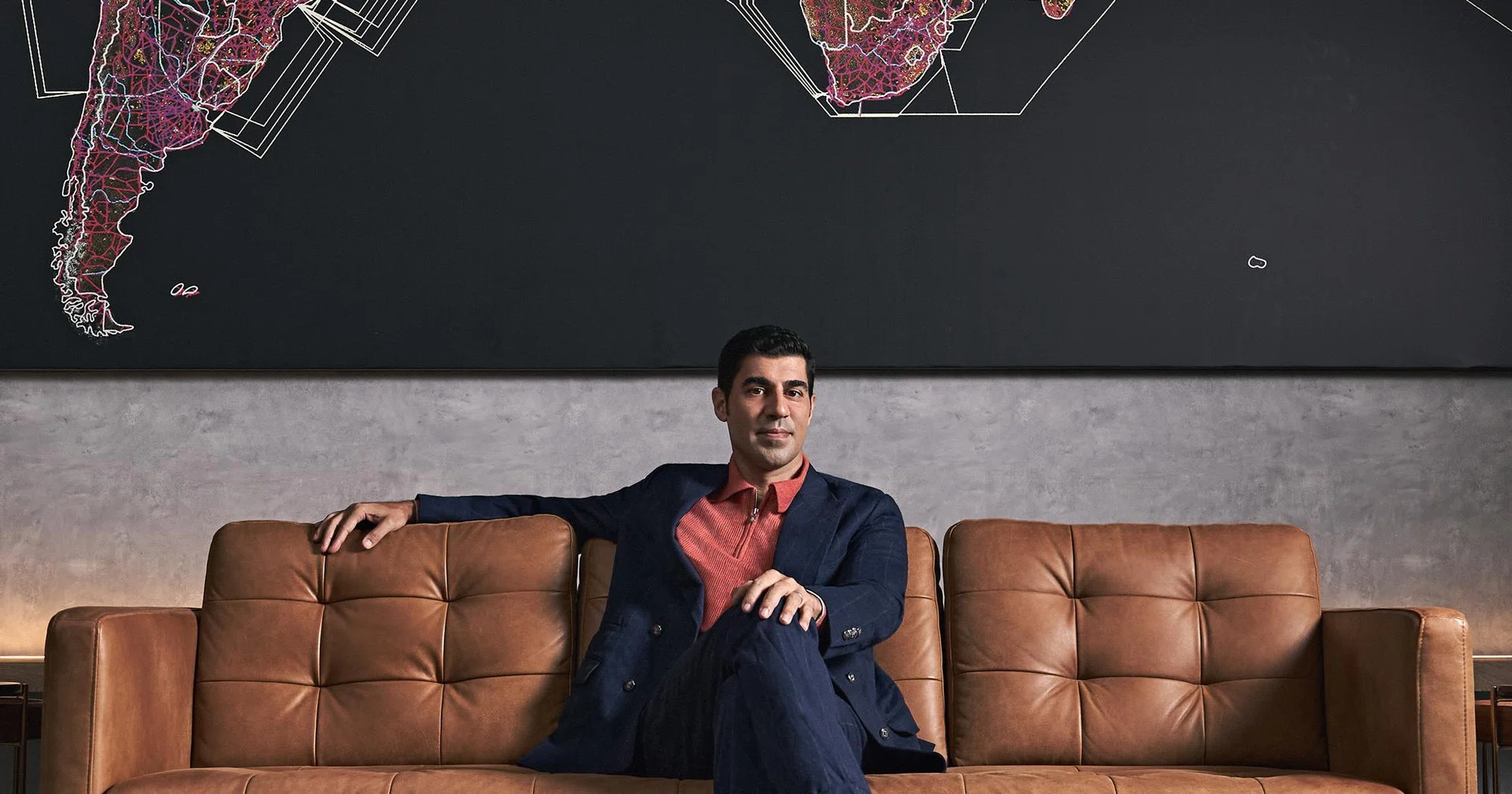
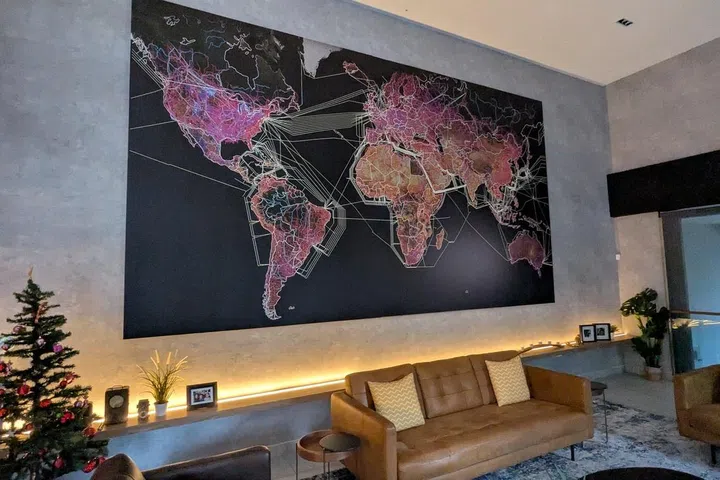
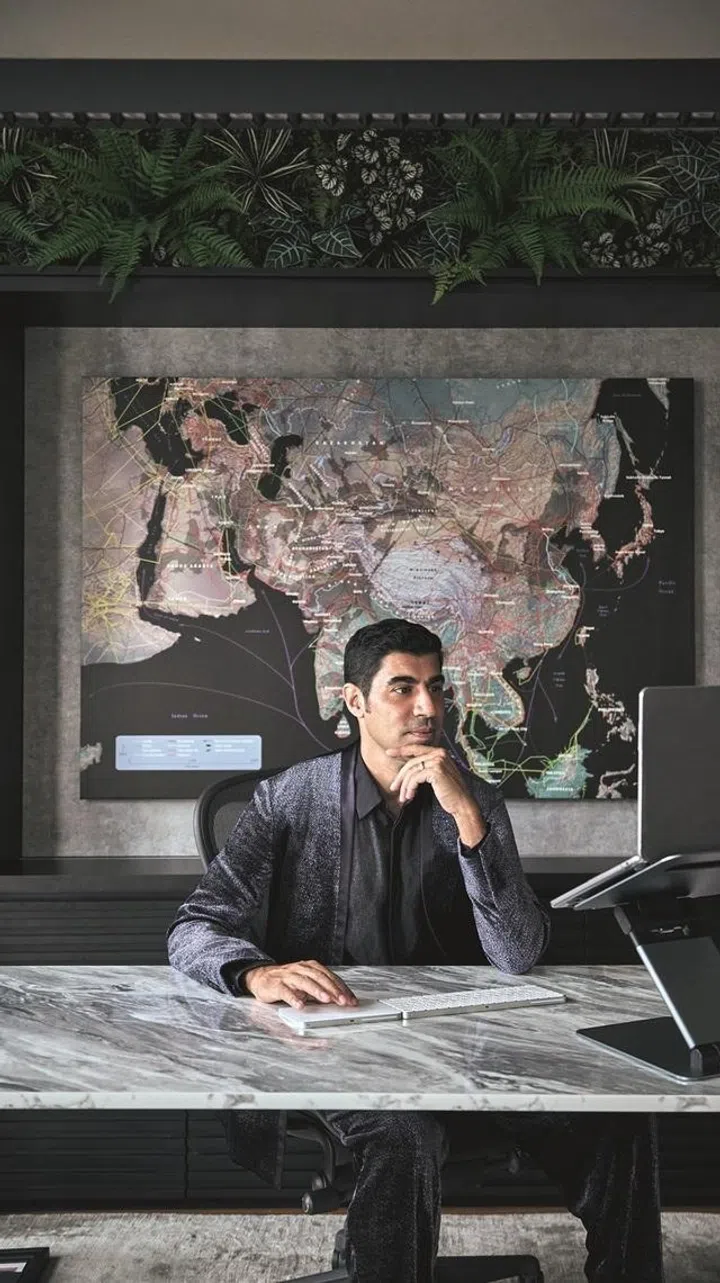
Step into Dr Parag Khanna’s living room and the eye is immediately drawn not to a painting or photograph, but to a five-metre-wide map of the world’s infrastructure flow that sprawls across the wall. Streaked with pink, orange, and white lines that intersect, tangle, and fan out across continents, the map visualises transportation links, energy pipelines, telecommunications, and shipping routes.
The gargantuan map is produced based on geo-referenced data points analysed by AlphaGeo, an AI-powered geospatial intelligence platform founded by Khanna, who is also its CEO. Taking pride of place in the living room of his five-storey semi-detached home in Joo Chiat, the map commands attention much like a work of art.
Khanna says: “The relationship between this map and forecasting is that the areas that have more lines intersecting are where rapid urbanisation and market growth take place. Businesses will want to be where there are more intersections.”
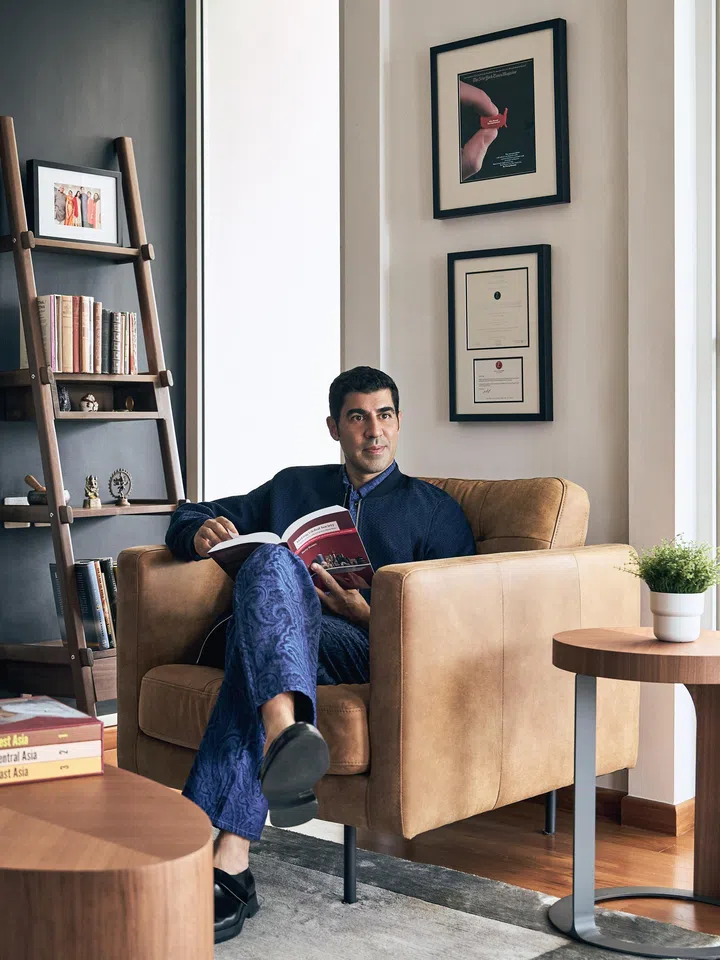
The cartographic theme continues — his home office is decked out in maps depicting global climate change patterns, migration flows and population changes. He recalls staking his claim early. “I told my wife that whatever we do with this house, I want the living room’s wall to be reserved for this map,” says Khanna with a laugh, who is married to AI entrepreneur Ayesha Khanna.
The place-centric instinct underpins AlphaGeo’s approach to forecasting the future of today’s complex world, shaped by the convergence of geopolitics, economics, technology, and climate change. Forecasting, in Khanna’s view, begins with the fundamental question: “Where are you talking about?”
The 48-year-old strongly believes that geography is central to understanding and deciphering today’s unpredictable, polynodal world. “The truth is that things are not the same everywhere — there are places where youth are revolting. There are places where they’re employed and optimistic. Some places are concerned about AI displacement, not about corrupt governments.”
With the world swirling in ongoing wars, trade tensions, climate pressures, and technological disruptions, asking where something is happening is a more accurate starting point of charting the future, he opines.
AlphaGeo ingests tens of billions of geospatial, socioeconomic, and market data spanning climate, real estate, and demographics, and runs them through a proprietary machine learning system to understand their correlations and identify emerging phenomena.
The predictive intelligence platform generates investment forecasts for companies across a wide range of industries, including real estate, insurance, and financial services, as well as for sovereign wealth and pension fund organisations.
A lifelong love for geography
Geography has long fascinated Khanna, who was born to Indian parents and grew up in the UAE, Germany, and the US. The globetrotter has visited over 150 countries as part of his career as a geopolitical strategist and for vacations.
The epiphanic spark came when he was 12. In November 1989, as images of Germans standing atop the crumbling Berlin Wall flashed across television screens, his father insisted the family witness history firsthand. After seeking permission for an early start to his winter holiday, the family flew from New York City to Berlin to witness the Wall’s collapse.
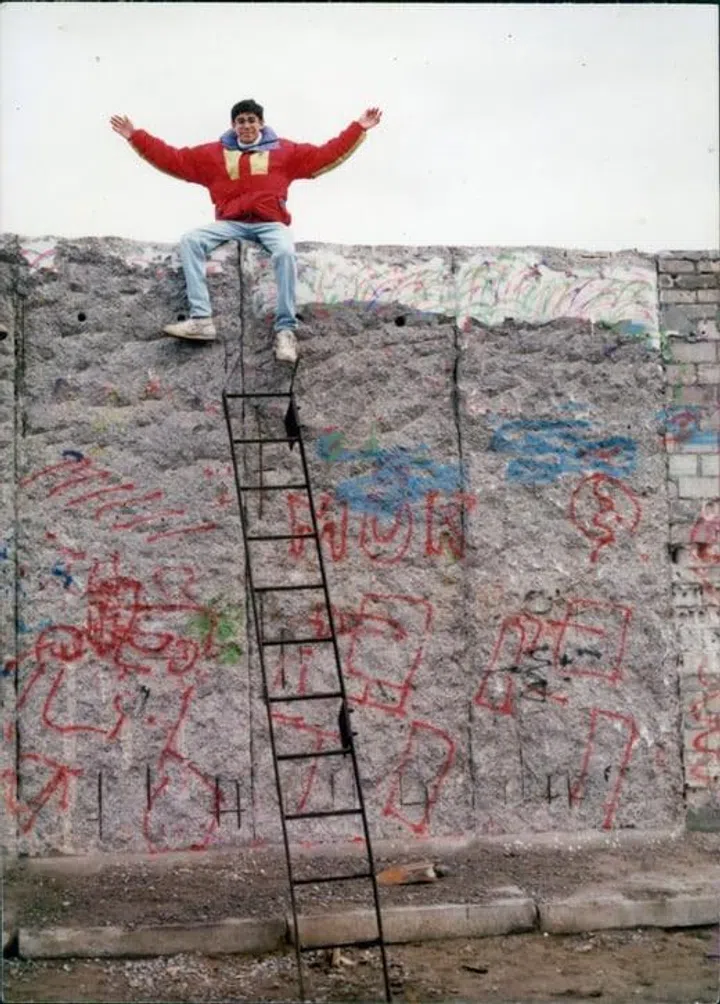
Khanna has photographs of him sitting on the Wall and remembers paying five Deutsche Marks to borrow a hammer and chisel to chip off pieces of the wall, which was a symbol of division during the Cold War. He stuffed Ziploc bags with concrete pieces and brought larger chunks home in a suitcase to share with his classmates back in the US.
Picnic tables were set up beside the Brandenburg Gate, where vendors sold fragments of history as capitalism replaced communism. Recalling the “surreal mix of melancholy and exhilaration”, he reflects, “Reading a book can change your life, but there’s nothing quite as profound as the visceral experience of being there.”
Today, Khanna, who holds a doctorate in international relations from the London School of Economics, is a sought-after speaker on futurism and geopolitics and a regular commentator on international news channels.
He became a Singapore citizen after being based here for 13 years. He was a senior research fellow in the Centre on Asia and Globalisation at the Lee Kuan Yew School of Public Policy at the National University of Singapore.
The past is a poor guide to the future
Khanna believes linear and cyclical projections from historical data cannot keep up with a world defined by sudden surges and reversals. “History does not repeat itself,” the charismatic intellect declares. “The past is a very poor guide to the future.”
An example is the evolving relationship between China and the US, which played out in a full-blown tariff war last year. He dismisses the binary Cold War 2.0 paradigm. “The Cold War logic assumes countries must choose sides. Countries have learned from their experiences and don’t want to repeat them. Instead, they practise multi-alignment, cutting deals with both sides,” he says.
The rise of resilience
In today’s volatile world, what defines a country’s ability to thrive? Resilience, says Khanna. Last October, AlphaGeo partnered global residence and citizenship advisory firm Henley & Partners to launch the Global Investment Risk and Resilience Index.
Instead of relying solely on risk metrics like credit ratings and Debt-to-GDP ratio, the index matches risk to resilience indicators to offer a “more real-world look at a country”. It assesses 150 countries on their exposure to geopolitical, economic and climate risks, as well as their capacity to adapt and recover.
The results were striking. Smaller nations topped the list, based on their ability to adapt effectively. Switzerland, Denmark, and Norway led the index, while Singapore ranked as the top Asian country at fourth place.
“Some of the most resilient countries are smaller ones,” Khanna says, comparing it to Darwinian logic. “Dinosaurs grew too large and vanished; smaller organisms evolved and thrived. Adaptation is the pathway to resilience, which can be measured by indicators such as energy self-sufficiency, quality of governance, and social progress.
“Businesses can anticipate shocks and disruptions, build scenarios to consider all outcomes from a situation, and prepare accordingly, and even invest in multiple redundant options for what might happen,” he advises.
The future is Asia
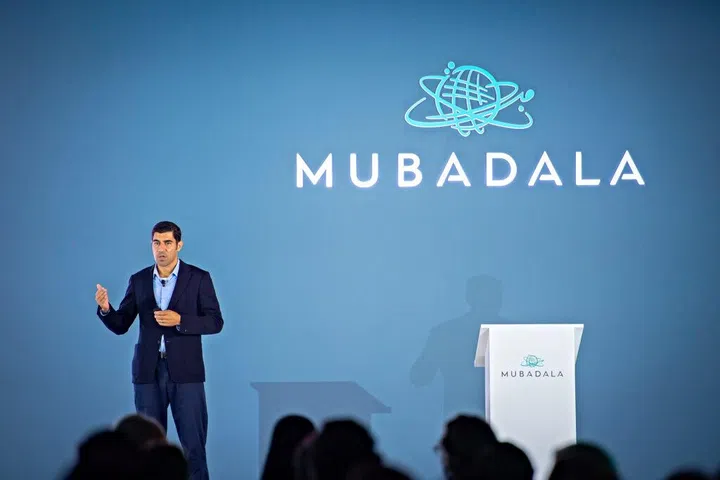
What can businesses in Asia learn from the results of the index? Khanna, who is also an author of seven books, including The Future is Asian: Commerce, Conflict & Culture in the 21st Century, believes Asians should be more confident and self-reliant in telling the Asian story.
Looking back, he observes that after every global crisis, Asian economies have steadily learned to invest in themselves. Asians are travelling more within the region and strengthening business networks that are closer to home. “No one is going to lead investment in Asia for Asians,” he states. “Don’t recycle your capital out into the world to gain validation. Bring the world to Asia.”
And this is something that makes Khanna optimistic about the future. He says, “I am excited by the rise of cultural and political confidence in Asia. I believe that the highest form of government in the 21st Century is Asian, democratic, and technocratic, coupled with a collective and pragmatic sense of preserving social cohesion.”
However, he flags a lack of coordination on climate adaptation and the transition to renewable energy in Asia as a concern. The region leads in solar, nuclear, hydrogen, and battery technologies.
Yet, these innovations are not being deployed fast enough to address climate vulnerability in the area, which was marked by devastating floods in Thailand and Indonesia last December. He stresses that climate change has an indelible impact on inflation, fiscal priorities, and labour productivity, making it impossible to forecast the future without accounting for it.
Looking ahead, Khanna says AlphaGeo will focus on two areas in 2026. First, it is to systematically “code geopolitics”. His team is developing a mathematical framework to quantify geopolitical dynamics — such as tariffs, conflicts, and shifting alliances — and integrate them into complex systems modelling.
He also plans to create the world’s first real-time global migration database, followed by an agent-based simulation modelling the movement of billions of people. He will also launch his eighth book, Philosopher Kings, on governance in a technological age later this year.
He says: “What excites me most about forecasting is taking into account the non-linear dynamics of the world today — the drivers of the future don’t necessarily shape the past. Witnessing the collision of old and new megatrends is what I thrive on.”
What will shape Asia’s business landscape in 2026
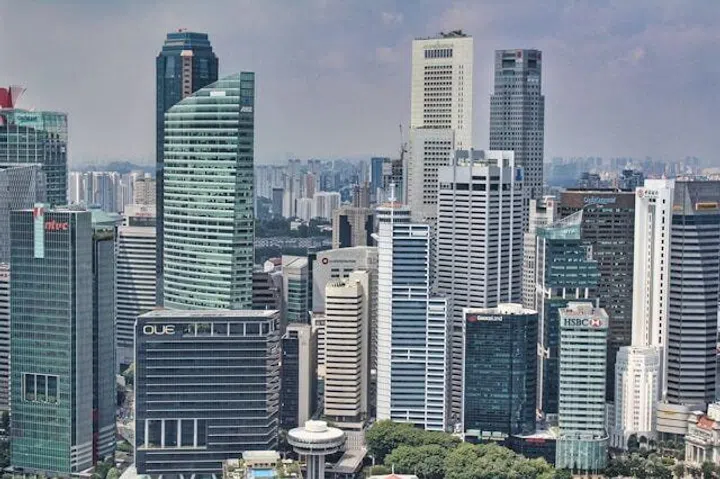
Rise of the underclass youth revolt
Young people across Asia are facing mounting pressure from labour market constraints, housing affordability and inflation. This has fuelled a global wave of Gen Z-led protests, marked by a skull motif inspired by Japanese manga. Some governments will respond by lowering the cost of living; others will fail to do so.
AI-driven labour disruption
Technology-related labour displacement will increasingly affect rank-and-file workers across Asia, as the rapid adoption of AI triggers waves of retrenchment worldwide. Countries like India graduate far more students than the economy can absorb, creating a mismatch between expectations and the economy’s capacity to absorb them. Smaller, technologically advanced countries like Singapore are better positioned to keep pace.
Geopolitical friction
Tensions in the South China Sea, the China-Japan relationship, and China-India border disputes will continue to simmer. Countries in Asia must fully formalise border settlements to secure long-term stability.
For decades, many have said that Asia will be the locus of World War III. Instead, the ignition point of conflict emerged in Europe. Meanwhile, Asia has managed to balance rivalry with cooperation.
Khanna does not expect 2026 to break this streak. He says: “For decades, Asia has done an excellent job of managing geopolitical divergence, while achieving geo-economic convergence. There might have been some serious altercations and tension between major Asian powers, but we have pulled back from the brink — that is an important sign of Asian maturity.”