%22%3E%0A%3Cpath%20d%3D%22M412%20101.2H393.7C393.1%20101.2%20392.3%20100.9%20391.8%20100.5C377.3%2087.6004%20362.9%2074.6004%20348.4%2061.6004C344.8%2058.4004%20341.3%2055.2004%20337.7%2052.0004C337.1%2051.5004%20336.2%2051.1004%20335.5%2051.0004C334.2%2050.8004%20333%2051.0004%20331.5%2051.0004V101.1H316.7V0.100391H331.4V44.3004C331.9%2044.3004%20332.2%2044.4004%20332.5%2044.4004C334.9%2044.4004%20337.2%2044.5004%20339.6%2044.4004C340.4%2044.4004%20341.3%2044.0004%20341.8%2043.5004C351.6%2034.4004%20361.4%2025.2004%20371.1%2016.0004C376.5%2010.9004%20381.9%205.90039%20387.3%200.800391C387.9%200.200391%20388.5%200.000390626%20389.3%200.000390626H400.9C384.2%2015.8004%20367.8%2031.3004%20351.2%2047.0004C371.5%2065.0004%20391.8%2082.9004%20412.1%20100.9C412.1%20101%20412.1%20101.1%20412%20101.2ZM180.9%20101.2C184.1%2094.9004%20187.2%2088.9004%20190.3%2082.8004C198.3%2067.3004%20206.2%2051.8004%20214.2%2036.2004C220.3%2024.4004%20226.4%2012.5004%20232.4%200.700391C232.7%200.100391%20233%20-0.0996094%20233.7%20-0.0996094H248.1C248.8%20-0.0996094%20249.2%200.100391%20249.6%200.800391C256%2013.3004%20262.4%2025.7004%20268.8%2038.2004C279.3%2058.6004%20289.8%2079.0004%20300.3%2099.5004C300.5%20100%20300.8%20100.4%20301.1%20101.1C300.5%20101.1%20300.1%20101.2%20299.7%20101.2H286.5C285.6%20101.2%20285.1%20100.9%20284.7%20100.2C280.1%2091.3004%20275.4%2082.4004%20270.8%2073.4004C270.1%2072.1004%20269.3%2071.6004%20267.8%2071.6004H209.9C208.7%2071.6004%20208.1%2072.0004%20207.5%2073.1004C202.9%2082.1004%20198.2%2091.0004%20193.6%20100C193.1%20101%20192.6%20101.3%20191.5%20101.3C188.4%20101.2%20185.3%20101.3%20182.3%20101.3C182%20101.2%20181.6%20101.2%20180.9%20101.2ZM239.1%2011.4004C230%2029.2004%20221.1%2046.7004%20212.1%2064.3004H266.4C257.2%2046.7004%20248.2%2029.2004%20239.1%2011.4004ZM0%200.000390626H43.4C51.2%200.000390626%2058.7%201.20039%2065.7%204.80039C75.9%2010.0004%2078.9%2018.0004%2078.6%2027.4004C78.3%2034.3004%2076%2040.5004%2071.2%2045.5004C67.3%2049.6004%2062.4%2052.3004%2057.1%2054.3004C50.6%2056.7004%2043.9%2058.0004%2037.1%2058.6004C30.1%2059.2004%2023.1%2059.4004%2016.2%2059.7004C15.8%2059.7004%2015.3%2059.8004%2014.8%2059.8004V101.1H0.1C0%2067.4004%200%2033.8004%200%200.000390626ZM14.8%207.10039V52.2004C23.7%2052.4004%2032.6%2052.3004%2041.2%2050.1004C44.4%2049.3004%2047.6%2048.2004%2050.6%2046.7004C58.4%2043.0004%2062.3%2036.7004%2062.7%2028.0004C63%2019.9004%2059.5%2014.1004%2052.4%2010.5004C47.6%208.00039%2042.5%207.10039%2037.2%207.10039H14.8ZM95.9%20101.1V0.100391H167.3V7.20039H110.7V44.7004H158.1V51.9004H110.8V93.9004H171.1V101C146.1%20101.1%20121%20101.1%2095.9%20101.1Z%22%20fill%3D%22black%22%2F%3E%0A%3Cpath%20d%3D%22M35.0004%2025.7996H42.5004V20.6996H44.8004V33.1996H42.6004V27.5996H34.9004V33.2996H32.7004V20.7996H35.0004V25.7996ZM54.4004%2025.8996V27.2996H48.9004V31.6996H55.9004C55.9004%2032.1996%2056.0004%2032.5996%2056.0004%2033.0996H46.5004V20.5996H55.5004V21.8996H49.0004V25.7996C50.7004%2025.8996%2052.5004%2025.8996%2054.4004%2025.8996ZM25.9004%2033.0996H23.5004V21.9996H17.9004V20.6996H31.6004V22.0996H27.1004C26.2004%2022.0996%2025.9004%2022.2996%2025.9004%2023.1996C26.0004%2026.0996%2025.9004%2028.9996%2025.9004%2031.7996V33.0996Z%22%20fill%3D%22black%22%2F%3E%0A%3C%2Fg%3E%0A%3Cdefs%3E%0A%3CclipPath%20id%3D%22clip0_388_462%22%3E%0A%3Crect%20width%3D%22411%22%20height%3D%22101.2%22%20fill%3D%22white%22%2F%3E%0A%3C%2FclipPath%3E%0A%3C%2Fdefs%3E%0A%3C%2Fsvg%3E%0A)
Audemars Piguet’s first-semester 2026 watches prove it is a force to be reckoned with
From an Art Deco-inspired jumping-hour watch to a new calibre for the Royal Oak and the growing sophistication of Code 11.59, Audemars Piguet’s first-semester 2026 releases reveal how the Le Brassus manufacture is refining its icons while expanding its creative and technical horizons.
By Yanni Tan /

Share this article
Sustaining the momentum of its 150th anniversary milestone last year, Audemars Piguet has been navigating an interesting balance: honouring the legacy of icons like the Royal Oak while expanding the creative and technical scope of its other collections.
The brand’s first-semester novelties for 2026 illustrate this approach impressively. Rather than relying on a single headline release, the manufacture has introduced 12 collections that highlight different facets of its watchmaking philosophy. And here are the winners.
Ode to Art Deco
The Neo Frame Jumping Hour is one of the most intriguing releases of the year, revisiting a rarely explored chapter of Audemars Piguet’s early design history.
The watch draws inspiration from a 1929 timepiece known internally as the pre-model 1271. Its elongated rectangular case and vertical gadroons reflect the Streamline Moderne aesthetic — a late branch of Art Deco associated with the aerodynamic forms of trains and ocean liners during the interwar years.

This modern interpretation preserves these architectural lines in a compact 32.6mm by 34mm pink gold case paired with a black PVD-treated sapphire dial. Instead of traditional hands, time is displayed through two gold-framed apertures that reveal rotating discs for the jumping hour and trailing minutes.
Behind the display lies a major technical milestone: Calibre 7122, the manufacture’s first self-winding jumping-hour movement. Developed from the base architecture used in the Royal Oak “Jumbo”, it introduces an instantaneous jumping-hour mechanism while maintaining a 52-hour power reserve and enhanced shock resistance.
Compact is cool again
After years dominated by oversized sports watches, the pendulum has swung back toward more classical proportions, perfect for Asian wrists. The updated Royal Oak Self-winding Chronograph 38mm reflects this renewed appreciation for compact watchmaking.
The familiar Royal Oak silhouette remains unchanged, but the real story lies inside the watch. The new references debut Calibre 6401, a self-winding chronograph movement developed entirely in-house over five years.

Replacing the long-serving Calibre 2385 introduced in 1997, the new movement retains the hallmarks expected of a high-end chronograph: an integrated column-wheel construction paired with a vertical clutch. Audemars Piguet has refined the clutch mechanism and simplified its architecture, reducing unnecessary components to improve reliability and responsiveness.
The movement also introduces subtle aesthetic refinements. For the first time on a 38mm Royal Oak Chronograph, a sapphire caseback reveals the movement’s architecture, including an openworked rotor and traditional finishes such as Côtes de Genève and polished chamfers.
The watch is available in stainless steel with the signature “Bleu Nuit, Nuage 50” dial as well as two pink gold variations.
Code 11.59 comes into its own
When Code 11.59 first launched in 2019, reactions were mixed. Over time, however, the collection has steadily developed greater depth and refinement — a progression reflected in the latest additions.

The new Code 11.59 Self-winding Flying Tourbillon 41mm introduces an elegant ivory-toned dial engraved with the collection’s signature guilloche pattern, developed with Swiss artisan Yann von Kaenel. The concentric motif creates shifting reflections that interact with the model’s distinctive double-curved sapphire crystal.
Inside beats the self-winding Calibre 2950, featuring a flying tourbillon at six o’clock. Unlike traditional tourbillons, the regulating organ rotates without an upper bridge, offering a clear view of the mechanism in motion.
Complementing this high complication are two new 38mm self-winding references in pink gold. Powered by the slim Calibre 5900, these models emphasise everyday elegance with dials displaying the same mesmerising ripple-like pattern and a 60-hour power reserve.
Monument to high complications
To mark its milestone anniversary last year, Audemars Piguet unveiled a timepiece harking back to the golden age of watchmaking: the 150 Heritage Pocket Watch.
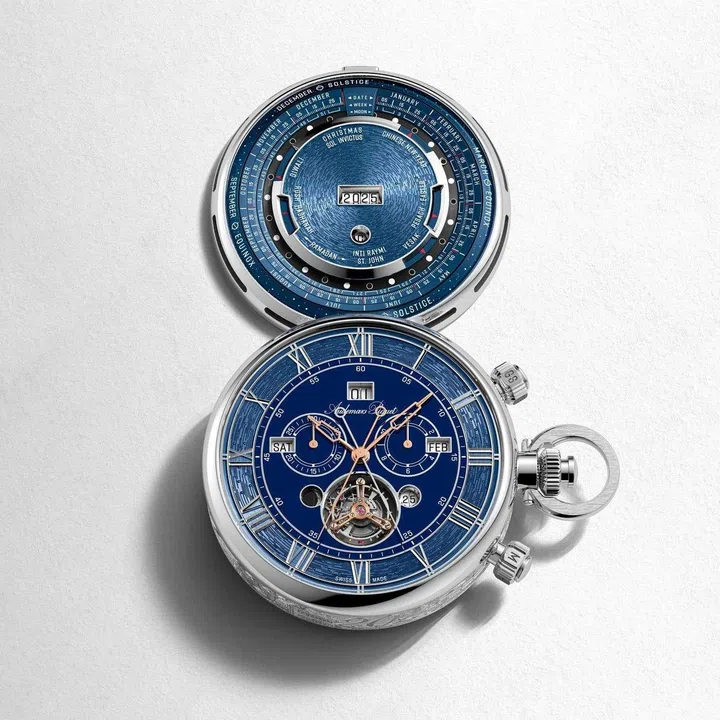
At its heart lies the newly developed hand-wound Calibre 1150. Comprising 1,099 components, the movement incorporates 47 functions and 30 complications, including a grande sonnerie, minute repeater, split-seconds flyback chronograph, and flying tourbillon.
Yet, the most unusual feature sits on the watch’s reverse side. Here, a universal calendar presents a panoramic display combining solar, lunar and lunisolar cycles. Using the Gregorian calendar as its reference, the mechanism integrates astronomical information alongside cultural celebrations such as Easter, Diwali, and Chinese New Year.
The watch itself is crafted in hand-engraved platinum and paired with a hand-made chain, while the dial is decorated with translucent grand feu enamel and engraved Roman numerals.
Produced as two unique platinum pieces, the 150 Heritage pocket watch is a demonstration of the manufacture’s ingenious ability to unite astronomical timekeeping, traditional crafts, and modern mechanical innovation.
The ladies keep winning
While high complications showcase technical mastery, some of the strongest commercial momentum in recent years has come from much daintier watches.

The Royal Oak Mini, introduced in 2024 with a 23mm case, proved that the appetite for miniature luxury watches remains healthy. The new editions build on that success with two new variations featuring striking stone dials.
One version pairs a pink gold case with a mirror-polished black onyx dial punctuated by diamond hour markers. The deep black surface contrasts dramatically with the Royal Oak’s faceted case and bracelet.
The second model takes a softer approach, combining yellow gold with an extra-white mother-of-pearl dial, whose luminous quality complements the Royal Oak’s mix of polished and satin-brushed finishes.
Both are powered by the quartz Calibre 2730, offering more than seven years of battery life and a switch function that deactivates the battery when the watch is unworn.
At just 23mm across, the Royal Oak Mini highlights how Audemars Piguet continues to blur the line between watchmaking and jewellery — and why the smallest watches in its repertoire are becoming some of its most compelling.