%22%3E%0A%3Cpath%20d%3D%22M412%20101.2H393.7C393.1%20101.2%20392.3%20100.9%20391.8%20100.5C377.3%2087.6004%20362.9%2074.6004%20348.4%2061.6004C344.8%2058.4004%20341.3%2055.2004%20337.7%2052.0004C337.1%2051.5004%20336.2%2051.1004%20335.5%2051.0004C334.2%2050.8004%20333%2051.0004%20331.5%2051.0004V101.1H316.7V0.100391H331.4V44.3004C331.9%2044.3004%20332.2%2044.4004%20332.5%2044.4004C334.9%2044.4004%20337.2%2044.5004%20339.6%2044.4004C340.4%2044.4004%20341.3%2044.0004%20341.8%2043.5004C351.6%2034.4004%20361.4%2025.2004%20371.1%2016.0004C376.5%2010.9004%20381.9%205.90039%20387.3%200.800391C387.9%200.200391%20388.5%200.000390626%20389.3%200.000390626H400.9C384.2%2015.8004%20367.8%2031.3004%20351.2%2047.0004C371.5%2065.0004%20391.8%2082.9004%20412.1%20100.9C412.1%20101%20412.1%20101.1%20412%20101.2ZM180.9%20101.2C184.1%2094.9004%20187.2%2088.9004%20190.3%2082.8004C198.3%2067.3004%20206.2%2051.8004%20214.2%2036.2004C220.3%2024.4004%20226.4%2012.5004%20232.4%200.700391C232.7%200.100391%20233%20-0.0996094%20233.7%20-0.0996094H248.1C248.8%20-0.0996094%20249.2%200.100391%20249.6%200.800391C256%2013.3004%20262.4%2025.7004%20268.8%2038.2004C279.3%2058.6004%20289.8%2079.0004%20300.3%2099.5004C300.5%20100%20300.8%20100.4%20301.1%20101.1C300.5%20101.1%20300.1%20101.2%20299.7%20101.2H286.5C285.6%20101.2%20285.1%20100.9%20284.7%20100.2C280.1%2091.3004%20275.4%2082.4004%20270.8%2073.4004C270.1%2072.1004%20269.3%2071.6004%20267.8%2071.6004H209.9C208.7%2071.6004%20208.1%2072.0004%20207.5%2073.1004C202.9%2082.1004%20198.2%2091.0004%20193.6%20100C193.1%20101%20192.6%20101.3%20191.5%20101.3C188.4%20101.2%20185.3%20101.3%20182.3%20101.3C182%20101.2%20181.6%20101.2%20180.9%20101.2ZM239.1%2011.4004C230%2029.2004%20221.1%2046.7004%20212.1%2064.3004H266.4C257.2%2046.7004%20248.2%2029.2004%20239.1%2011.4004ZM0%200.000390626H43.4C51.2%200.000390626%2058.7%201.20039%2065.7%204.80039C75.9%2010.0004%2078.9%2018.0004%2078.6%2027.4004C78.3%2034.3004%2076%2040.5004%2071.2%2045.5004C67.3%2049.6004%2062.4%2052.3004%2057.1%2054.3004C50.6%2056.7004%2043.9%2058.0004%2037.1%2058.6004C30.1%2059.2004%2023.1%2059.4004%2016.2%2059.7004C15.8%2059.7004%2015.3%2059.8004%2014.8%2059.8004V101.1H0.1C0%2067.4004%200%2033.8004%200%200.000390626ZM14.8%207.10039V52.2004C23.7%2052.4004%2032.6%2052.3004%2041.2%2050.1004C44.4%2049.3004%2047.6%2048.2004%2050.6%2046.7004C58.4%2043.0004%2062.3%2036.7004%2062.7%2028.0004C63%2019.9004%2059.5%2014.1004%2052.4%2010.5004C47.6%208.00039%2042.5%207.10039%2037.2%207.10039H14.8ZM95.9%20101.1V0.100391H167.3V7.20039H110.7V44.7004H158.1V51.9004H110.8V93.9004H171.1V101C146.1%20101.1%20121%20101.1%2095.9%20101.1Z%22%20fill%3D%22black%22%2F%3E%0A%3Cpath%20d%3D%22M35.0004%2025.7996H42.5004V20.6996H44.8004V33.1996H42.6004V27.5996H34.9004V33.2996H32.7004V20.7996H35.0004V25.7996ZM54.4004%2025.8996V27.2996H48.9004V31.6996H55.9004C55.9004%2032.1996%2056.0004%2032.5996%2056.0004%2033.0996H46.5004V20.5996H55.5004V21.8996H49.0004V25.7996C50.7004%2025.8996%2052.5004%2025.8996%2054.4004%2025.8996ZM25.9004%2033.0996H23.5004V21.9996H17.9004V20.6996H31.6004V22.0996H27.1004C26.2004%2022.0996%2025.9004%2022.2996%2025.9004%2023.1996C26.0004%2026.0996%2025.9004%2028.9996%2025.9004%2031.7996V33.0996Z%22%20fill%3D%22black%22%2F%3E%0A%3C%2Fg%3E%0A%3Cdefs%3E%0A%3CclipPath%20id%3D%22clip0_388_462%22%3E%0A%3Crect%20width%3D%22411%22%20height%3D%22101.2%22%20fill%3D%22white%22%2F%3E%0A%3C%2FclipPath%3E%0A%3C%2Fdefs%3E%0A%3C%2Fsvg%3E%0A)
The 15 best new aviation watches to know ahead of the Singapore Airshow 2026
From pioneer pilot wristwatches and military flight instruments to GMT travel companions and space-era icons, these aviation watches trace the evolution of timekeeping alongside flight.
By Yanni Tan /

Share this article
As Singapore Airshow 2026 approaches, our city once again takes centre stage in the global aviation and aerospace calendar. Alongside next-generation aircraft, avionics, and space technologies, the event also highlights an enduring element of aviation culture: precision timekeeping.
Long before glass cockpits and satellite navigation, mechanical wristwatches were essential flight instruments. Pilots relied on them to calculate distance, fuel consumption, elapsed time, and local hours across vast routes.
As aviation progressed from experimental open-cockpit flights to military operations, commercial jet travel, and eventually space exploration, watches evolved alongside it.
The aviation watches featured here reflect that evolution. Rather than forming a single category, they represent a family of timepieces shaped by different eras and the demands of flight.
Some trace aviation’s earliest days, when legibility and ergonomics allowed pilots to read the time hands-free. Others emerged as purpose-built cockpit instruments, defined by high-contrast dials, rotating bezels, and flyback chronographs designed for operational use.
Navigation and calculation watches expanded those functions further, incorporating slide rules, GMT hands, and directional scales to support in-flight decision-making.
With the rise of long-haul air travel, dual-time, GMT, and world-time watches became indispensable for crossing time zones. More recently, aviation-adjacent performance watches have drawn inspiration from aerospace engineering itself, emphasising advanced materials, resilience, and extreme precision.
Here are the 15 best new aviation watches that mirror the past, present, and future of flight, as the Singapore Airshow once again brings the aerospace world together.
Cartier Santos Dual Time

This modern Dual Time traces its lineage directly to the original Santos of 1904, created for aviation pioneer Alberto Santos-Dumont. It retains the distinctive square case with exposed screws, rendered in stainless steel and measuring approximately 40.2mm, with proportions that emphasise comfort and elegance.
Its integrated bracelet and balanced dial reflect Cartier’s enduring design language.
Powering the watch is the automatic calibre 1847 MC, which supports a discreet second time-zone display allowing the wearer to track home time while travelling. While technically restrained compared to later pilot instruments, the Santos Dual Time’s aviation relevance lies in its historical significance as one of the earliest wristwatches designed specifically for flight.
Patek Philippe Calatrava Pilot Travel Time Ref. 5524G-010
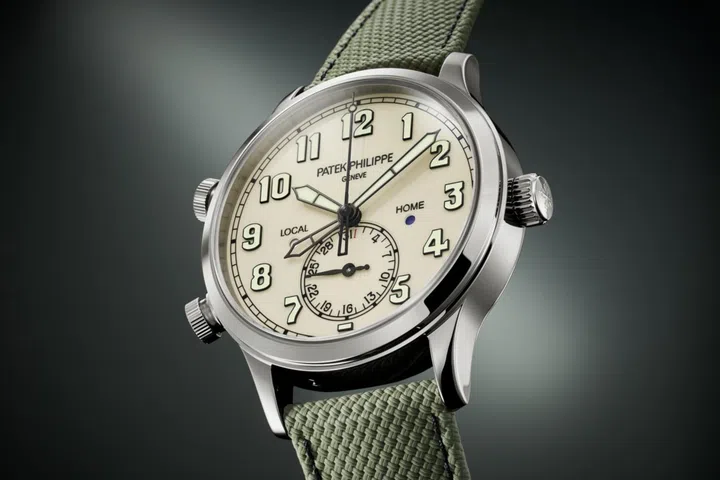
This new reference from Patek Philippe’s Calatrava Pilot Travel Time collection draws inspiration from pilot instruments and siderometers produced in the 1930s. The 42mm white-gold case combines authority with refinement, while the ivory-lacquered dial, oversized Arabic numerals, and sword-shaped hands prioritise legibility in the tradition of cockpit instruments rather than classical dress watches.
Inside, the self-winding calibre 26-330 S C FUS is engineered specifically for travel, displaying local and home time via two central hour hands, supported by day-night indicators for both time zones and a date linked to local time.
Local time is adjusted intuitively using two patented pushers, allowing one-hour jumps without stopping the movement. Finished to the Patek Philippe Seal standards, the 5524G stands as one of the most technically sophisticated and historically grounded pilot travel watches in modern high horology.
Omega Speedmaster Dark Side of the Moon Apollo 8

This updated Apollo 8 tribute extends the story of aviation into spaceflight, commemorating the mission of 1968, when astronauts became the first humans to orbit the moon and witness its far side.
The 44.25mm case is crafted entirely from grey ceramic, celebrating astronaut Jim Lovell’s historic observation that “the Moon is essentially grey”. Its monochromatic palette is punctuated by white accents that reference mission instrumentation and high-visibility flight details.
At its core is the manual-winding Co-Axial Master Chronometer Calibre 3869, with a 50-hour power reserve and exceptional magnetic-field resistance.
The movement is laser-ablated to depict the moon’s surface, with the near side visible through the skeletonised dial and the far side revealed through the caseback. Within this list, the Apollo 8 Speedmaster represents aviation’s technological frontier.
Breitling Navitimer B19 Perpetual Calendar Chronograph

This Navitimer Chronograph represents the most technically elevated expression of one of aviation watchmaking’s most enduring icons. Introduced in 1952 for the Aircraft Owners and Pilots Association, the Navitimer was conceived as a wrist-mounted flight computer, with its circular slide-rule bezel allowing pilots to calculate fuel consumption, airspeed, and distance.
The B19 retains this defining aviation feature at its core.
Housed in a 43mm case with a platinum bezel, the watch is powered by the in-house Breitling Manufacture Calibre B19, an automatic chronograph with a perpetual calendar that displays day, date, month, and moonphase.
The ice-blue dial remains disciplined and legible, reflecting cockpit-instrument logic. In the aviation context, the Navitimer B19 bridges the heritage of professional pilots with contemporary high horology without sacrificing its functional DNA.
IWC Schaffhausen Pilot’s Watch Chronograph 41 TOP GUN Miramar
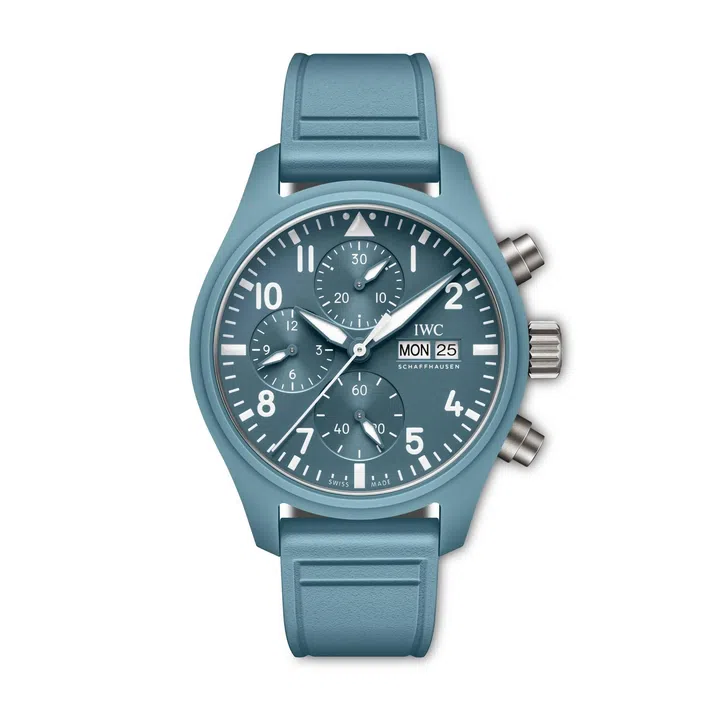
This IWC Pilot’s Watch Chronograph 41 TOP GUN Miramar reflects modern naval aviation rather than historical nostalgia. Its 41.9mm ceramic case, rendered in a light-blue tone inspired by TOP GUN instructor uniforms, offers excellent scratch resistance and a lightweight feel suited to high-performance environments.
The dial layout remains unmistakably IWC, with large numerals and clear sub-dials designed for instant readability.
Inside beats the automatic calibre 69380, a column-wheel chronograph movement built for robustness and reliability. Anti-magnetic protection and a pressure-resistant crystal further reinforce its aviation-ready construction.
This is a pilot’s watch shaped by contemporary jet-age requirements, translating modern military flight culture into a technically resilient wristwatch.
Longines Spirit Pilot Flyback
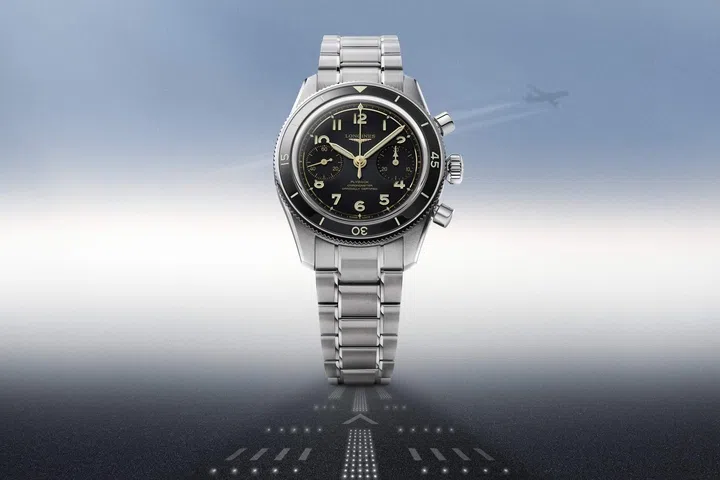
This Longines pilot’s watch draws directly from the brand’s long-standing aviation heritage, expressed through a chronograph designed for practical flight use.
Housed in a 39.5mm stainless steel case, it features a bidirectional rotating bezel with a countdown scale, a functional tool historically used by pilots to time key phases of flight. The dial’s luminous Arabic numerals and box sapphire crystal reference classic cockpit instruments while maintaining a clean, contemporary aesthetic.
Powering the watch is the hand-wound calibre L792.4, a column-wheel flyback chronograph equipped with a silicon balance spring and offering a 68-hour power reserve.
The flyback function allows the chronograph to be reset and restarted instantly, reinforcing its credibility as a true aviation chronograph rooted in operational necessity rather than stylistic homage.
Jaeger-LeCoultre Master Grande Tradition Calibre 948

The Jaeger-LeCoultre Master Grande Tradition Calibre 948 approaches aviation through world time and astronomical perspective rather than cockpit instrumentation. At the centre of the dial, a rotating world map and flying tourbillon complete one full rotation every 24 hours, offering a striking polar view of time passing across the earth.
This global display echoes the standardisation of time brought about by rail and air travel, when coordinating hours across continents became essential.
Housed in a pink gold case, the manually wound calibre reflects Jaeger-LeCoultre’s mastery of high horology, blending mechanical complexity with visual clarity. The dial showcases the manufacturer’s decorative craftsmanship, combining hand-engraving, lacquerwork, and meticulous finishing to create a layered, three-dimensional composition.
Rather than functioning as a pilot’s tool, the Calibre 948 expresses aviation relevance in a poetic, conceptual way.
Oris Big Crown Calibre 113

The Oris Big Crown Calibre 113 is a contemporary interpretation of one of watchmaking’s earliest aviation designs. First introduced in 1938, the Big Crown was designed for airmen who needed a wristwatch that could be easily operated while wearing gloves, and is defined by its oversized crown and highly legible dial.
Those practical origins place it firmly within the pioneer era of aviation watchmaking.
This modern version is housed in a 43mm stainless steel case with a sage green dial with rose pink sub-dials. It is driven by the hand-wound in-house Calibre 113, offering a 10-day power reserve and a patented non-linear power-reserve indicator.
In addition to timekeeping, the movement integrates a full business calendar, all of which is adjusted via a single crown. Within this list, the Big Crown Calibre 113 represents aviation at its most foundational — focused on clarity, usability, and mechanical reliability rather than specialised flight complications.
Bell & Ross BR-03 GMT Compass
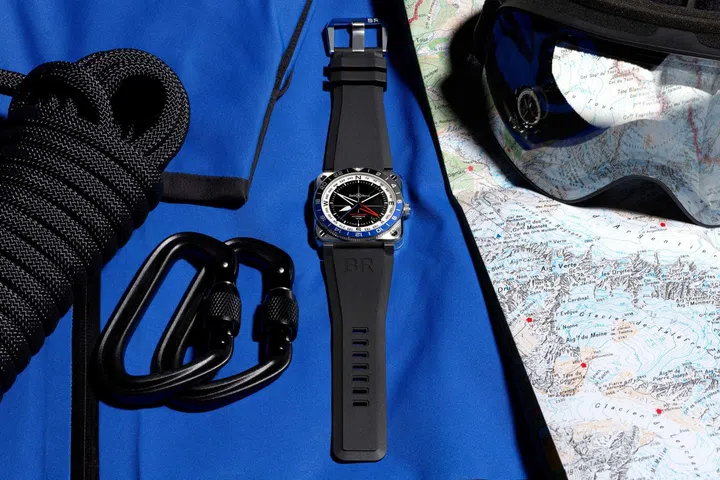
The Bell & Ross BR-03 GMT Compass is built around cockpit ergonomics and navigation logic. Its 42mm square stainless steel case mirrors aircraft instrument housings, framing a round dial with a bi-directional 24-hour bezel and compass rose markings. The red GMT hand, shaped like a compass needle, reinforces its orientation-driven design.
Powered by the in-house BR-CAL.303 automatic movement, the watch allows tracking a second time zone while providing basic directional guidance when aligned with the sun.
Rather than treating aviation as a visual theme, the BR-03 GMT Compass integrates navigation concepts directly into its functionality, aligning closely with Bell & Ross’ instrument-first approach to watchmaking.
Zenith DEFY Extreme Chroma

This snazzy Zenith approaches aviation through performance, resilience, and advanced materials rather than traditional pilot design codes.
Its imposing 45mm case, constructed from microblasted titanium and ceramic, is engineered to withstand demanding environments and is water-resistant to 200m. The angular architecture reflects Zenith’s modern, high-tech design language.
At its heart is the El Primero 9004, a dual-escapement automatic chronograph capable of measuring elapsed time to 1/100th of a second.
While not aviation-specific in function, the DEFY Extreme Chroma embodies the same pursuit of precision and technical innovation that historically drove the development of flight instrumentation, positioning it firmly within the aviation-adjacent performance category.
Hermès Slim d’Hermès Quantième Perpétuel
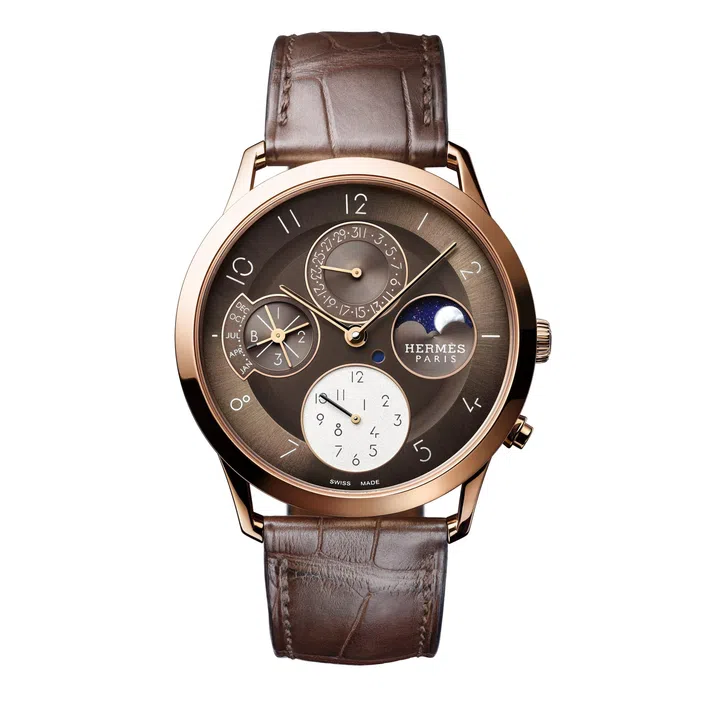
This sporty Hermès approach to aviation centres on refined global travel rather than cockpit utility. Its 39.5mm rose gold case houses an ultra-thin automatic movement that integrates a perpetual calendar, moonphase, and GMT function with day-night indication, all presented with visual clarity and restraint.
Powered by the calibre H1950, the watch prioritises balance and legibility despite its mechanical complexity.
While not a pilot’s watch in the traditional sense, it reflects the evolution of aviation into a civilised, interconnected mode of travel, where time-keeping serves both practical needs and aesthetic refinement.
Frederique Constant Classic Worldtimer Manufacture
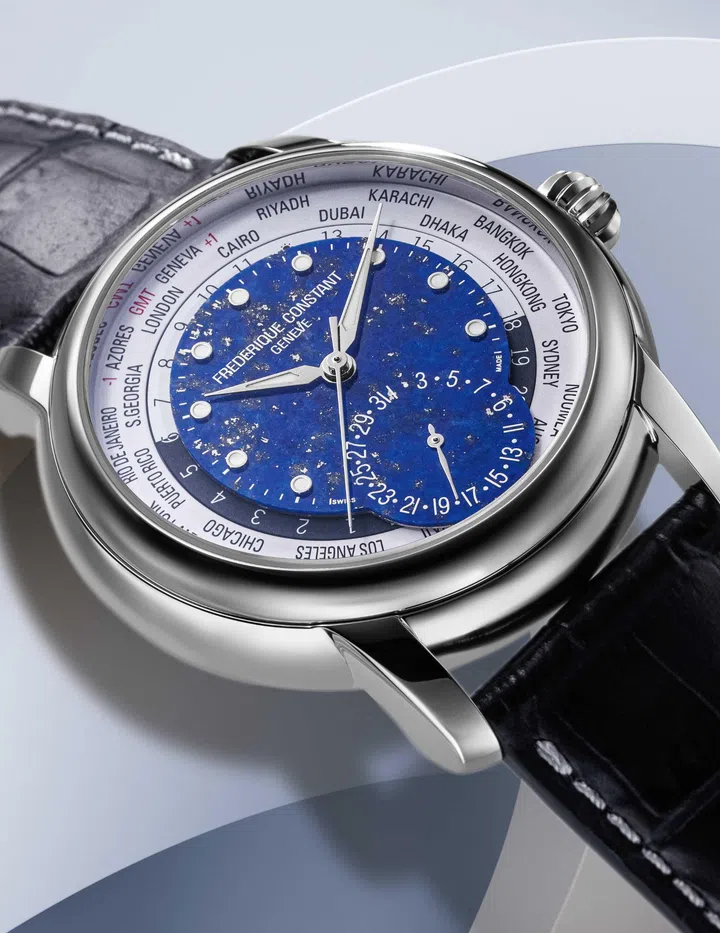
This Worldtimer approaches aviation through the lens of global travel rather than cockpit instrumentation. Housed in a 42mm stainless steel case, the watch features a world-time display that lets the wearer view all 24 time zones at a glance, using a rotating city ring and a 24-hour disc with day/night indication.
All adjustments are made via a single crown, keeping the interface intuitive despite the display’s complexity.
Powering the watch is the proprietary automatic calibre FC-718, which drives the central hours, minutes and seconds, along with the world-time mechanism and date.
In the aviation context, this creation represents the traveller’s watch — shaped by the realities of long-haul flight, where tracking global time zones became essential as commercial aviation connected the world.
Sinn 104 Classic 12
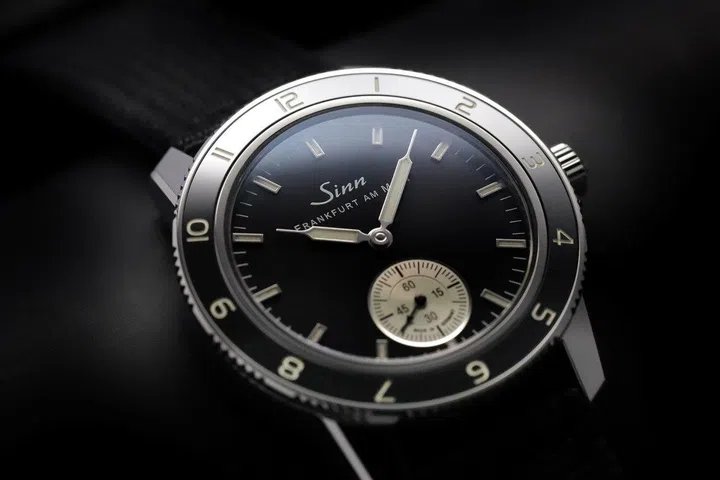
The Sinn 104 Classic 12 represents a pragmatic, instrument-driven approach to aviation watchmaking. Its 41mm stainless steel case features a captive pilot’s bezel with a ceramic insert and a 12-hour scale for tracking a second time zone.
The sunburst black dial, luminous appliques, and small seconds display prioritise clarity without visual excess.
Powered by the automatic Sellita SW 261-1, the watch is anti-magnetic, pressure-resistant to 20 bar, and certified for low-pressure environments.
It embodies aviation watchmaking reduced to essentials, focused on reliability, legibility, and engineering integrity rather than historical embellishment.
Breguet Type XX Chronographe 2075

The Breguet Type XX Chronographe 2075 is a faithful continuation of one of the most important military aviation chronographs ever produced. Measuring 38.3mm and crafted in proprietary Breguet gold, it closely mirrors the proportions of the original civilian Type XX models from the 1950s.
Rendered in black anodised aluminium or 925 silver, the dial with a bidirectional rotating bezel is designed for maximum clarity and operational efficiency.
The hand-wound calibre 7278 or 7279 incorporates a flyback chronograph function developed specifically for pilots, enabling them to time successive manoeuvres.
Caseback engravings referencing the Breguet 19 aircraft and historic transatlantic routes firmly anchor the watch in aviation history, reinforcing its status as one of the most authentic pilot chronographs available today.
De Bethune DB Kind of Two Jumping GMT
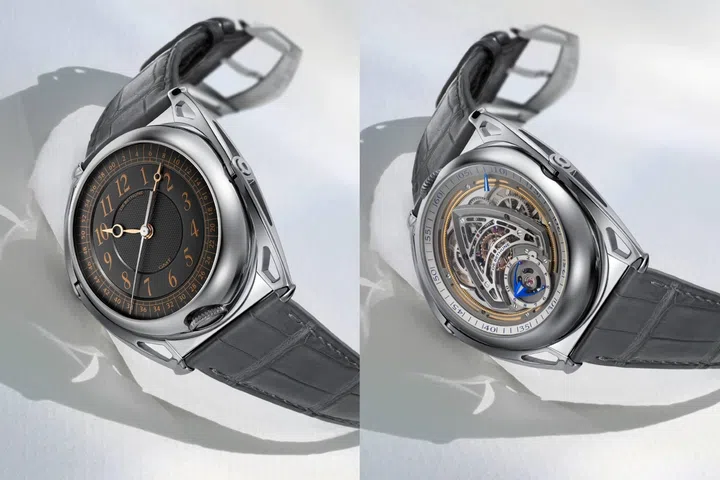
This new De Bethune addresses aviation through advanced travel mechanics rather than overt pilot aesthetics. Its 43mm titanium case houses a reversible double-dial construction, allowing the wearer to switch instantly between home and local time displays without losing synchronisation.
The manually wound in-house movement integrates a jumping-seconds mechanism and an intuitive GMT system designed for long-haul clarity.
In aviation, it reflects the modern traveller’s relationship with flight, where mechanical ingenuity enables seamless global mobility rather than direct cockpit access.