%22%3E%0A%3Cpath%20d%3D%22M412%20101.2H393.7C393.1%20101.2%20392.3%20100.9%20391.8%20100.5C377.3%2087.6004%20362.9%2074.6004%20348.4%2061.6004C344.8%2058.4004%20341.3%2055.2004%20337.7%2052.0004C337.1%2051.5004%20336.2%2051.1004%20335.5%2051.0004C334.2%2050.8004%20333%2051.0004%20331.5%2051.0004V101.1H316.7V0.100391H331.4V44.3004C331.9%2044.3004%20332.2%2044.4004%20332.5%2044.4004C334.9%2044.4004%20337.2%2044.5004%20339.6%2044.4004C340.4%2044.4004%20341.3%2044.0004%20341.8%2043.5004C351.6%2034.4004%20361.4%2025.2004%20371.1%2016.0004C376.5%2010.9004%20381.9%205.90039%20387.3%200.800391C387.9%200.200391%20388.5%200.000390626%20389.3%200.000390626H400.9C384.2%2015.8004%20367.8%2031.3004%20351.2%2047.0004C371.5%2065.0004%20391.8%2082.9004%20412.1%20100.9C412.1%20101%20412.1%20101.1%20412%20101.2ZM180.9%20101.2C184.1%2094.9004%20187.2%2088.9004%20190.3%2082.8004C198.3%2067.3004%20206.2%2051.8004%20214.2%2036.2004C220.3%2024.4004%20226.4%2012.5004%20232.4%200.700391C232.7%200.100391%20233%20-0.0996094%20233.7%20-0.0996094H248.1C248.8%20-0.0996094%20249.2%200.100391%20249.6%200.800391C256%2013.3004%20262.4%2025.7004%20268.8%2038.2004C279.3%2058.6004%20289.8%2079.0004%20300.3%2099.5004C300.5%20100%20300.8%20100.4%20301.1%20101.1C300.5%20101.1%20300.1%20101.2%20299.7%20101.2H286.5C285.6%20101.2%20285.1%20100.9%20284.7%20100.2C280.1%2091.3004%20275.4%2082.4004%20270.8%2073.4004C270.1%2072.1004%20269.3%2071.6004%20267.8%2071.6004H209.9C208.7%2071.6004%20208.1%2072.0004%20207.5%2073.1004C202.9%2082.1004%20198.2%2091.0004%20193.6%20100C193.1%20101%20192.6%20101.3%20191.5%20101.3C188.4%20101.2%20185.3%20101.3%20182.3%20101.3C182%20101.2%20181.6%20101.2%20180.9%20101.2ZM239.1%2011.4004C230%2029.2004%20221.1%2046.7004%20212.1%2064.3004H266.4C257.2%2046.7004%20248.2%2029.2004%20239.1%2011.4004ZM0%200.000390626H43.4C51.2%200.000390626%2058.7%201.20039%2065.7%204.80039C75.9%2010.0004%2078.9%2018.0004%2078.6%2027.4004C78.3%2034.3004%2076%2040.5004%2071.2%2045.5004C67.3%2049.6004%2062.4%2052.3004%2057.1%2054.3004C50.6%2056.7004%2043.9%2058.0004%2037.1%2058.6004C30.1%2059.2004%2023.1%2059.4004%2016.2%2059.7004C15.8%2059.7004%2015.3%2059.8004%2014.8%2059.8004V101.1H0.1C0%2067.4004%200%2033.8004%200%200.000390626ZM14.8%207.10039V52.2004C23.7%2052.4004%2032.6%2052.3004%2041.2%2050.1004C44.4%2049.3004%2047.6%2048.2004%2050.6%2046.7004C58.4%2043.0004%2062.3%2036.7004%2062.7%2028.0004C63%2019.9004%2059.5%2014.1004%2052.4%2010.5004C47.6%208.00039%2042.5%207.10039%2037.2%207.10039H14.8ZM95.9%20101.1V0.100391H167.3V7.20039H110.7V44.7004H158.1V51.9004H110.8V93.9004H171.1V101C146.1%20101.1%20121%20101.1%2095.9%20101.1Z%22%20fill%3D%22black%22%2F%3E%0A%3Cpath%20d%3D%22M35.0004%2025.7996H42.5004V20.6996H44.8004V33.1996H42.6004V27.5996H34.9004V33.2996H32.7004V20.7996H35.0004V25.7996ZM54.4004%2025.8996V27.2996H48.9004V31.6996H55.9004C55.9004%2032.1996%2056.0004%2032.5996%2056.0004%2033.0996H46.5004V20.5996H55.5004V21.8996H49.0004V25.7996C50.7004%2025.8996%2052.5004%2025.8996%2054.4004%2025.8996ZM25.9004%2033.0996H23.5004V21.9996H17.9004V20.6996H31.6004V22.0996H27.1004C26.2004%2022.0996%2025.9004%2022.2996%2025.9004%2023.1996C26.0004%2026.0996%2025.9004%2028.9996%2025.9004%2031.7996V33.0996Z%22%20fill%3D%22black%22%2F%3E%0A%3C%2Fg%3E%0A%3Cdefs%3E%0A%3CclipPath%20id%3D%22clip0_388_462%22%3E%0A%3Crect%20width%3D%22411%22%20height%3D%22101.2%22%20fill%3D%22white%22%2F%3E%0A%3C%2FclipPath%3E%0A%3C%2Fdefs%3E%0A%3C%2Fsvg%3E%0A)
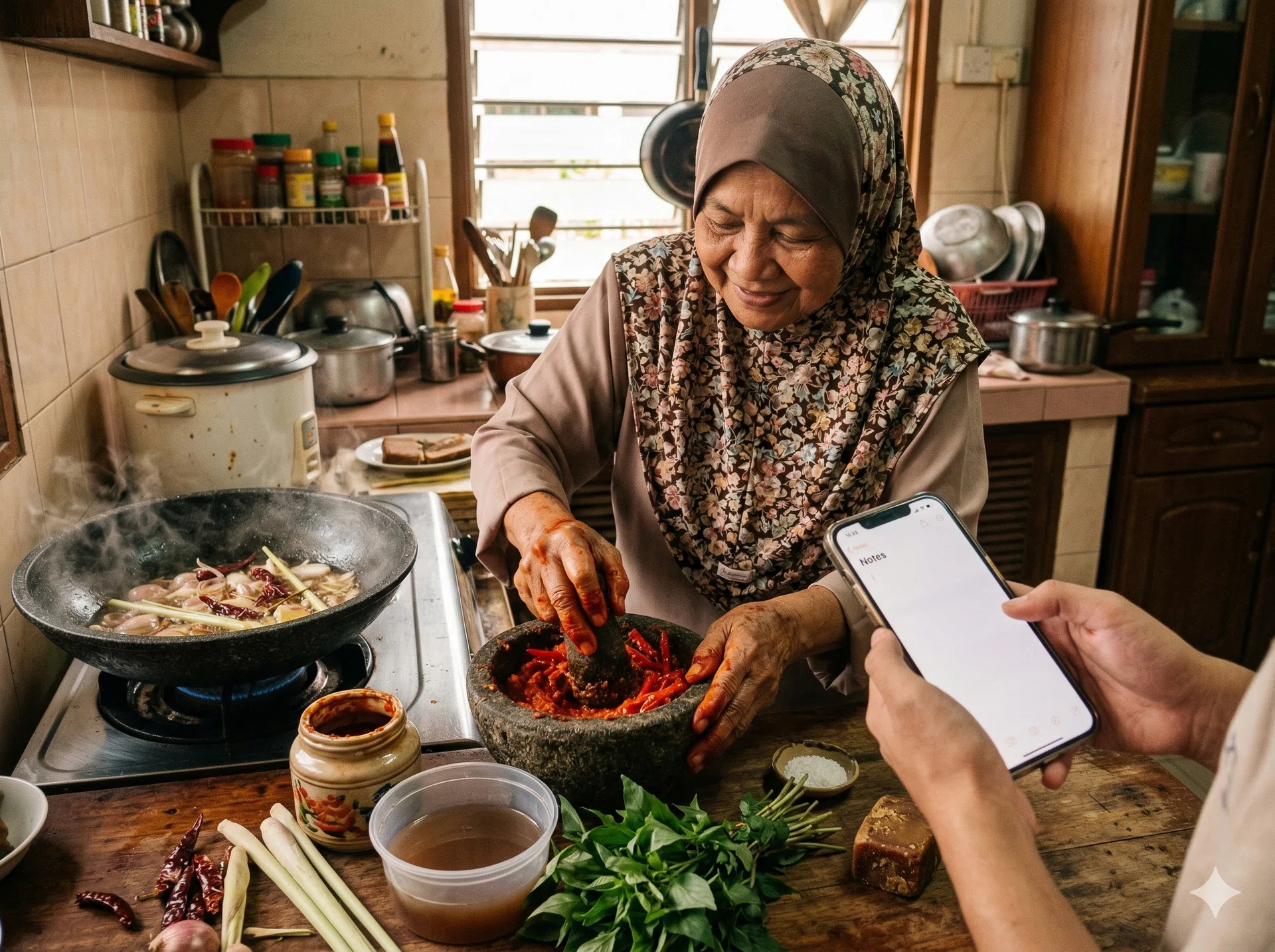
By five in the evening of the 10th day of Ramadhan, the kitchen had already declared its authority.
Oil trembles in the kuali. Shallots collapse into sweetness. The batu lesung thuds in a steady rhythm as Mak grinds chillies into a paste that stains her fingers a faint shade of red, a colour that would follow her for at least a few days, like the inai on a bride’s wedding day. Somewhere behind me, the rice cooker clicks into keep-warm mode, as though quietly acknowledging that it plays but a secondary role here.
I stand beside her with my phone open, notes app ready, determined to extract something measurable.
“Chilli tu berapa sudu?” I ask — how many spoons?
She does not look up. She scoops, levels it against the rim of the jar, tips it into the pan.
“Agak-agak. Kena rasa,” she replies, instructing me to be guided by taste.
Agak-agak. Roughly.
It is the most infuriating instruction in the Malay culinary lexicon. To her, the kuali is a living thing; to me, it is a math problem I am failing to solve.
I watch her tilt a bowl of tamarind water over the pot. I wait for her to stop at a cup, or perhaps two, but she watches the surface of the gravy instead, waiting for the red to break into a specific, translucent garnet. She doesn’t count the seconds. She waits for the pecah minyak — that precise moment the oil separates and rises, signalling the chillies are cooked.
She throws in a bruised stalk of lemongrass and a handful of daun kesum, not by weight, but by the span of her palm. Then, a pinch of salt — but the pinch seems more generous than the one before. Mak doesn’t use a timer; she listens to the broth’s bubble, a liquid clock only she can read. She tastes, pauses, frowns slightly, then shaves a few dark curls of gula Melaka into the steam to round off the sharp edges of the asam.
I try to document the choreography, but every gesture resists quantification. There are no grams, no millilitres, no militant precision. My notes app remains a skeleton of “somewhats” and “abouts”. Yet, when we finally sit down to eat, the Asam Pedas lands with such clarity that I abandon my frustration mid-bite. The heat blooms, then retreats just enough to let the tamarind assert itself. The fish remains tender. The gravy clings. It tastes deliberate.
It is, by all accounts, magic.
How kitchens remember us
During Ramadan, Malay kitchens operate at heightened sensitivity. Fasting sharpens appetite; even the first sip of water at dusk can feel almost electric. Cooks understand this instinctively and thus temper their dishes accordingly. Too much chilli shocks a body that has abstained all day. Too little salt renders the effort underwhelming.
Agak-agak allows them to read the room, to adjust seasoning in anticipation of how hunger will interpret it.
In Malay, agak-agak translates colloquially to “estimate”. The word carries connotations of approximation, even guesswork. But in practice, it functions as embodied knowledge. Older cooks learned through repetition, proximity, and correction. They watched oil separate from rempah and memorised the sheen that signalled readiness.
They inhaled the scent of belacan as it toasted and knew when it threatened to overpower the dish. Their senses became instruments.
Here, the absence of measuring spoons did not signal a lack of rigour. It signalled a different form of precision — one anchored in taste rather than text.
But beyond technique, agak-agak encodes something more intimate. It preserves the ability to cook in relation to the eater.
A nenek preparing sambal for her grandson, who cannot tolerate spice, will reduce the chilli paste without announcing the concession. A father stirring ketupat santan on the eve of Hari Raya will add an extra ribbon of santan because he knows his daughter prefers her rice cakes indulgently creamy. No one drafts a separate recipe card for each family member. The adjustments slip in quietly. Food becomes biography.
Over the years, the cook accumulates a mental archive of preferences: who avoids belacan, who piles on extra sambal ikan bilis, who wants their rendang darker, drier, more uncompromising. The dish shifts subtly depending on who sits at the table. The “correct” version exists not in abstraction but in context gleaned from decades of observation at the dinner table.
Agak-agak permits this elasticity.
Flavour in motion
And in the weeks leading up to Hari Raya, kitchens will begin to swell with activity. Ketupat casings are woven in patient loops. Recipes circulate on WhatsApp, neatly formatted, promising (however valiantly) reproducibility: 250g of this, 500ml of that.
There is comfort in such clarity, particularly for those of us who fear failing to recreate a childhood flavour.
Yet, the dishes we speak about most reverently often defy replication. “It doesn’t taste the same anymore,” someone bemoans after an elder passes. The ingredients remain accessible. The written recipe, if it exists, can be followed meticulously. Still, something feels ever slightly off.
What disappears is not the tablespoon count. It is the reflex to taste midway and think of a particular person. It is the instinct to soften the heat because someone at the table looks tired or the quiet decision to sweeten the bubur slightly more because the day has been long.
Agak-agak also performs another subtle function: it builds space for correction.
Since nothing is locked in by rigid proportions, the cook retains authority at the end. The kuah tastes flat? A squeeze more tamarind. Slightly too fiery? A spoonful of santan to round the edges. A touch thin? Let it simmer until it thickens to a consistency. The final tasting carries weight — a moment of accountability before the dish leaves the stove.
In this way, approximation produces responsiveness. Agak-agak anticipates fluctuation — in ingredients, in weather, in mood. Coconut milk varies in richness, brand to brand. Chillies fluctuate in aggression. Even fasting bodies receive flavour differently from day to day. A flexible method acknowledges these variables and reserves the right to intervene.
A strictly measured recipe can corner you. If the brand of santan runs thinner than expected, your gulai risks dilution with little room to manoeuvre. But a cook operating by instinct never treats the first pour as destiny. She establishes direction, then refines.
Flavour as responsibility
As I stand in my mak’s kitchen, still trying to transcribe her gestures into something resembling coherence, I realise my frustration stems from a modern anxiety: the desire to standardise what was designed to be relational. I want the security of numbers. She trusts her senses.
When I ask again, gently, almost pleasing, “But how much exactly?” she smiles without pausing her stirring.
“Nuh rasa,” she says, handing me the spoon.
The instruction shifts. I am no longer an archivist documenting her process. I am implicated. My palate must participate. I must learn the checkpoints — the smell of rempah once it has pecah minyak, the texture of gravy when it coats the back of the spoon just so, the way salt should sharpen without overwhelming.
Agak-agak I realised refuses automation. It demands presence. In a season defined by restraint, generosity, and communal breaking of fast, perhaps this method feels particularly resonant.
Ramadan asks for attentiveness — to hunger, to gratitude, to the people who share the table. Agak-agak mirrors that ethic. It resists the temptation to treat food as a static product, insisting that flavour live in relation.
When Hari Raya Aidilfitri arrives tomorrow, and guests start to stream in, plates balanced on laps, the dishes will not carry labels explaining their adjustments. No one will know that the chilli was reduced for one cousin or the santan increased for another. The care will remain invisible, as it always has, dissolved into the gravy, folded into the rice.
And perhaps that is the point. Agak-agak becomes an ethic of care. It measures not only ingredients but attentiveness, preserving room for enhancement, for correction, and for generosity at the very end. It recognises that family is not fixed variables, and that love — like seasoning — often requires a final taste before serving.
These days, I still open my notes app when I cook. I still crave the comfort of numbers. But when the dish falters, I hear Mak’s voice: taste again. Adjust. Trust yourself.
Roughly, she says. Agak-agak.
And somehow, it is always exactly right.