%22%3E%0A%3Cpath%20d%3D%22M412%20101.2H393.7C393.1%20101.2%20392.3%20100.9%20391.8%20100.5C377.3%2087.6004%20362.9%2074.6004%20348.4%2061.6004C344.8%2058.4004%20341.3%2055.2004%20337.7%2052.0004C337.1%2051.5004%20336.2%2051.1004%20335.5%2051.0004C334.2%2050.8004%20333%2051.0004%20331.5%2051.0004V101.1H316.7V0.100391H331.4V44.3004C331.9%2044.3004%20332.2%2044.4004%20332.5%2044.4004C334.9%2044.4004%20337.2%2044.5004%20339.6%2044.4004C340.4%2044.4004%20341.3%2044.0004%20341.8%2043.5004C351.6%2034.4004%20361.4%2025.2004%20371.1%2016.0004C376.5%2010.9004%20381.9%205.90039%20387.3%200.800391C387.9%200.200391%20388.5%200.000390626%20389.3%200.000390626H400.9C384.2%2015.8004%20367.8%2031.3004%20351.2%2047.0004C371.5%2065.0004%20391.8%2082.9004%20412.1%20100.9C412.1%20101%20412.1%20101.1%20412%20101.2ZM180.9%20101.2C184.1%2094.9004%20187.2%2088.9004%20190.3%2082.8004C198.3%2067.3004%20206.2%2051.8004%20214.2%2036.2004C220.3%2024.4004%20226.4%2012.5004%20232.4%200.700391C232.7%200.100391%20233%20-0.0996094%20233.7%20-0.0996094H248.1C248.8%20-0.0996094%20249.2%200.100391%20249.6%200.800391C256%2013.3004%20262.4%2025.7004%20268.8%2038.2004C279.3%2058.6004%20289.8%2079.0004%20300.3%2099.5004C300.5%20100%20300.8%20100.4%20301.1%20101.1C300.5%20101.1%20300.1%20101.2%20299.7%20101.2H286.5C285.6%20101.2%20285.1%20100.9%20284.7%20100.2C280.1%2091.3004%20275.4%2082.4004%20270.8%2073.4004C270.1%2072.1004%20269.3%2071.6004%20267.8%2071.6004H209.9C208.7%2071.6004%20208.1%2072.0004%20207.5%2073.1004C202.9%2082.1004%20198.2%2091.0004%20193.6%20100C193.1%20101%20192.6%20101.3%20191.5%20101.3C188.4%20101.2%20185.3%20101.3%20182.3%20101.3C182%20101.2%20181.6%20101.2%20180.9%20101.2ZM239.1%2011.4004C230%2029.2004%20221.1%2046.7004%20212.1%2064.3004H266.4C257.2%2046.7004%20248.2%2029.2004%20239.1%2011.4004ZM0%200.000390626H43.4C51.2%200.000390626%2058.7%201.20039%2065.7%204.80039C75.9%2010.0004%2078.9%2018.0004%2078.6%2027.4004C78.3%2034.3004%2076%2040.5004%2071.2%2045.5004C67.3%2049.6004%2062.4%2052.3004%2057.1%2054.3004C50.6%2056.7004%2043.9%2058.0004%2037.1%2058.6004C30.1%2059.2004%2023.1%2059.4004%2016.2%2059.7004C15.8%2059.7004%2015.3%2059.8004%2014.8%2059.8004V101.1H0.1C0%2067.4004%200%2033.8004%200%200.000390626ZM14.8%207.10039V52.2004C23.7%2052.4004%2032.6%2052.3004%2041.2%2050.1004C44.4%2049.3004%2047.6%2048.2004%2050.6%2046.7004C58.4%2043.0004%2062.3%2036.7004%2062.7%2028.0004C63%2019.9004%2059.5%2014.1004%2052.4%2010.5004C47.6%208.00039%2042.5%207.10039%2037.2%207.10039H14.8ZM95.9%20101.1V0.100391H167.3V7.20039H110.7V44.7004H158.1V51.9004H110.8V93.9004H171.1V101C146.1%20101.1%20121%20101.1%2095.9%20101.1Z%22%20fill%3D%22black%22%2F%3E%0A%3Cpath%20d%3D%22M35.0004%2025.7996H42.5004V20.6996H44.8004V33.1996H42.6004V27.5996H34.9004V33.2996H32.7004V20.7996H35.0004V25.7996ZM54.4004%2025.8996V27.2996H48.9004V31.6996H55.9004C55.9004%2032.1996%2056.0004%2032.5996%2056.0004%2033.0996H46.5004V20.5996H55.5004V21.8996H49.0004V25.7996C50.7004%2025.8996%2052.5004%2025.8996%2054.4004%2025.8996ZM25.9004%2033.0996H23.5004V21.9996H17.9004V20.6996H31.6004V22.0996H27.1004C26.2004%2022.0996%2025.9004%2022.2996%2025.9004%2023.1996C26.0004%2026.0996%2025.9004%2028.9996%2025.9004%2031.7996V33.0996Z%22%20fill%3D%22black%22%2F%3E%0A%3C%2Fg%3E%0A%3Cdefs%3E%0A%3CclipPath%20id%3D%22clip0_388_462%22%3E%0A%3Crect%20width%3D%22411%22%20height%3D%22101.2%22%20fill%3D%22white%22%2F%3E%0A%3C%2FclipPath%3E%0A%3C%2Fdefs%3E%0A%3C%2Fsvg%3E%0A)
Chef André Chiang takes stock of his latest chapter: Hotpot and his plans beyond running restaurants
The Taiwanese chef has earned a reputation for modernising French cuisine in sophisticated and artistic ways. He now sets his sights on hotpot with Bon Broth in Singapore.
By Tan Pin Yen /
Share this article
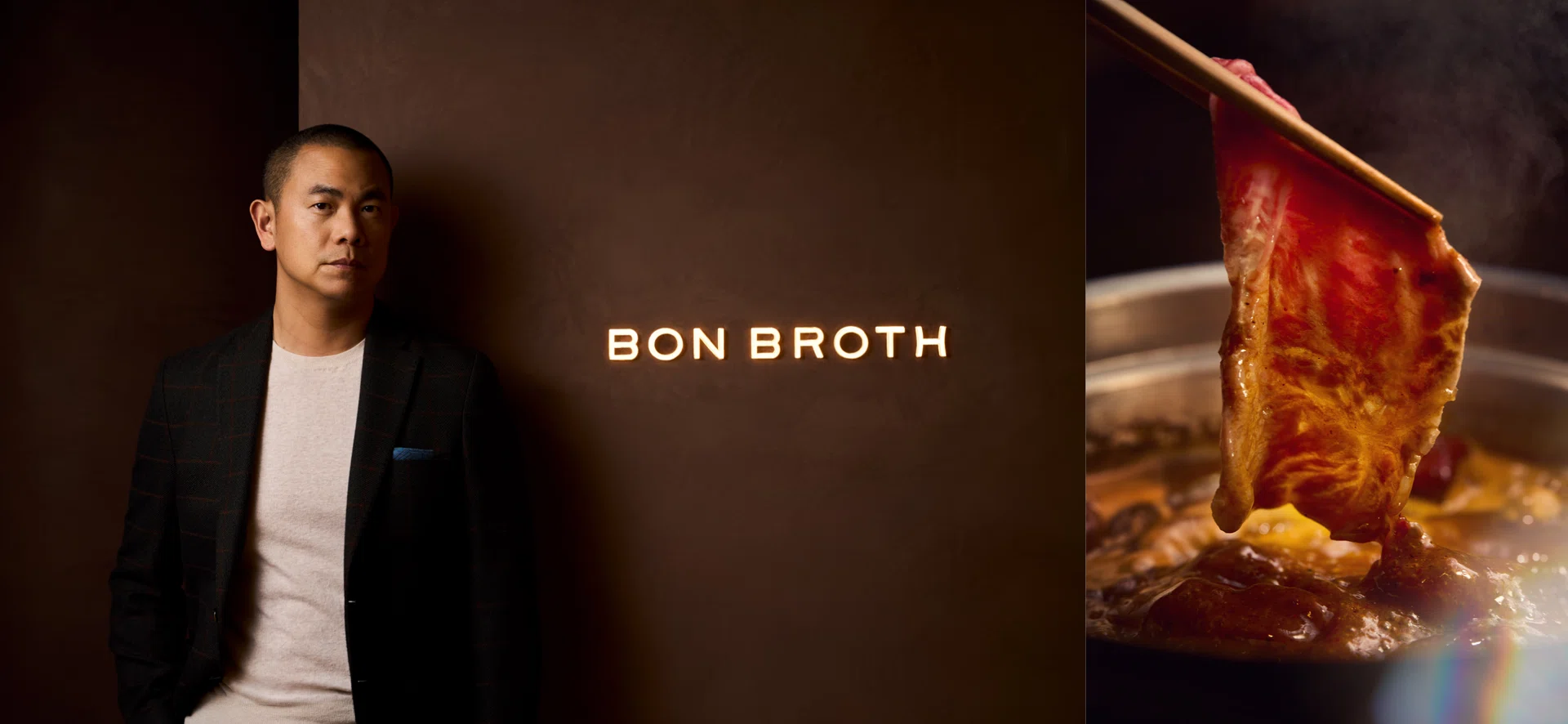
When it comes to culinary innovations or career moves, André Chiang consistently delivers with style and precision.
Sipping the delicate, earthy herbal broth at Bon Broth — Chiang’s latest venture with local F&B and lifestyle firm Surrey Hills Holdings — my mind drifts back to Memory, his signature dish of warm foie gras jelly with black truffle coulis from Restaurant André.
It’s hard not to think of October 10, 2017 — the day Chiang stunned the culinary world by announcing the closure of his two-Michelin-starred restaurant.
Last summer, the Taiwanese chef revealed another bold move: reimagining Raw, his two-starred Taipei restaurant into a culinary institution, which is slated to open by late 2025. Unbeknownst to many, while crafting Raw’s final menu, The Last Dance, Chiang was simultaneously developing Bon Broth, his haute hotpot concept.
This 2,150 sq ft restaurant, which opened in February at Raffles City, is poised for global expansion, with plans to open in Tokyo, New York, and Los Angeles in the second half of this year.
“I’m the type who likes to plan ahead — I plan every move I make,” he confesses.
Moulding the future
After 35 years in the industry, Chiang continues to excite the culinary world with his ever-evolving career, even if it involves closing the chapter of culinary concepts. While many chefs struggle with burnout from the relentless pace of the kitchen, he was spared from “frustration along the way” because he makes it a point to plan ahead.
“I don’t play with instincts,” he clarifies. “Yes, every creation is driven by emotion, but every emotional decision is backed by precise calculation.”
Now, he aims to pass on his knowledge to both professionals and amateurs through a curriculum designed to teach the tools and techniques he’s mastered, when Raw transforms into a full-fledged culinary institute.
“I get a lot of requests from first-line chefs who want to learn something new,” he says. “They want to know what’s happening, but the reality is that running a restaurant, whether big or small, traps you into a daily grind. Over time, you get drained, empty, and nothing new comes in.”
In his generation, aspiring chefs would spend 10 to 20 years working, learning from the masters, and accumulating experience before starting restaurants. In contrast, the younger generation today open restaurants in their twenties. “How much experience can one gain in just two years after graduation?” he questions.
To address this, his institute will come up with everything from week-long retreats to six- or 12-month programmes, to prepare students for careers in culinary world.
“The institute will operate as an actual restaurant, so after you graduate in six or 12 months, when you report to work at any restaurant, everything is just like yesterday,” he says.
For professionals — chefs, restaurateurs, and entrepreneurs — there are intensive retreats designed to recharge their energy and provide fresh perspectives, so they can move forward with renewed drive and insights.
So, what does Chiang believe is the hardest thing to teach?
“The only thing I cannot teach is passion. You can’t teach them to wake up every morning and be excited about what they do.” he admits. “Apart from that, you can teach everything, discipline, technique, skills, knowledge. Just how do we find that passion and keep that alive for five, 10, or even 20 years?”
Take stock
With Bon Broth, Chiang aims to address key issues in hotpot dining habits. In fact, the concept started with a search for healthier dining options that people would keep returning to five years down the line.
“In Asia, hotpot is everywhere, but have you ever thought about the sauces you eat? Are they healthy? Do you taste something pure and natural?” he asks.
“I was exploring Asian food trends — what we enjoy eating — like locally sourced ingredients, healthy options, and dishes that offer flexibility and creativity, concepts with international appeal,” he explains, noting how vacuum-packed bone broths, often marketed for their health benefits, became popular in the United States around a decade ago.
Using his distinctive approach, Chiang is making broths from scratch, elevating hotpot — pot by pot. With precise technique, premium ingredients and layering the broths with storytelling, he plans to turn hotpot into a global sensation.
A fan of soups and stews, Chiang developed a deep appreciation for broth while living in France. Equipped with a strong foundation in French cooking and having studied under renowned chefs like Jacques and Laurent Pourcel, Pierre Gagnaire, Michel Troisgros, Alain Ducasse, and Pascal Barbot, Chiang holds a deep reverence for the art of making a perfect sauce and stock.
Each pot of broth at Bon Broth is crafted with the precision of a fine French sauce. A fresh, aromatic mirepoix base is gently sautéed before infusing Chiang’s signature spice paste.
The mixture is then deglazed with a classic French-style bouillon, made fresh daily using only pure fish, beef, pork, or chicken bones and brewed for 12 to 16 hours. This results in a rich, nourishing broth brimming with marrow and collagen. The broth is further enhanced with fresh herbs, aromatic spices, and condiments before serving.
“It’s so much more complex and fresh, just like what we do in a restaurant,” he quips.
Haute pots
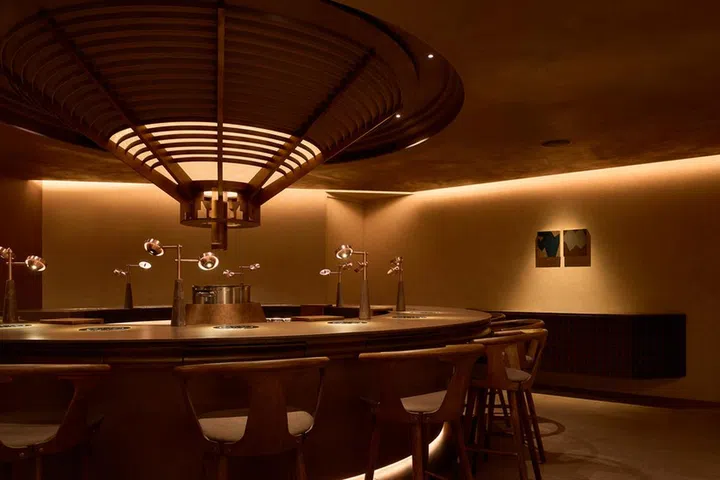
The sleek and contemporary interiors at Bon Broth features two custom-made circular bar counters, each encircling a centerpiece where a mother stock simmers in a large copper pot. Positioning the pots front and center not only saves kitchen space but also creates a captivating focal point while diners enjoy their personal hotpot in style, yet remain part of the lively, communal atmosphere.
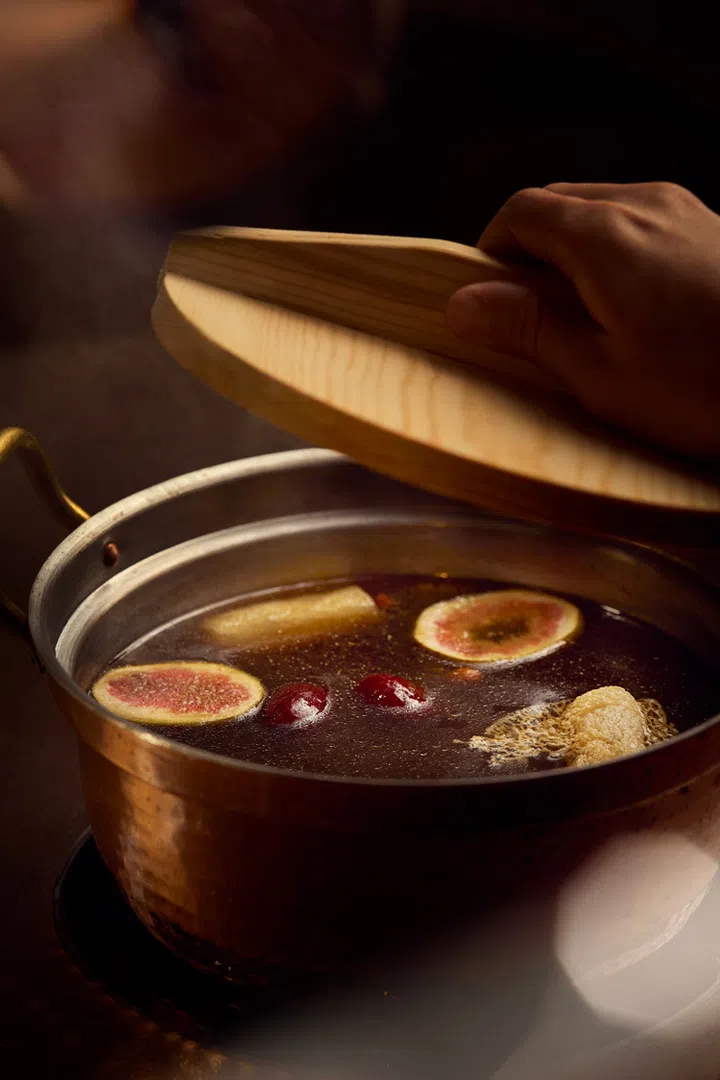
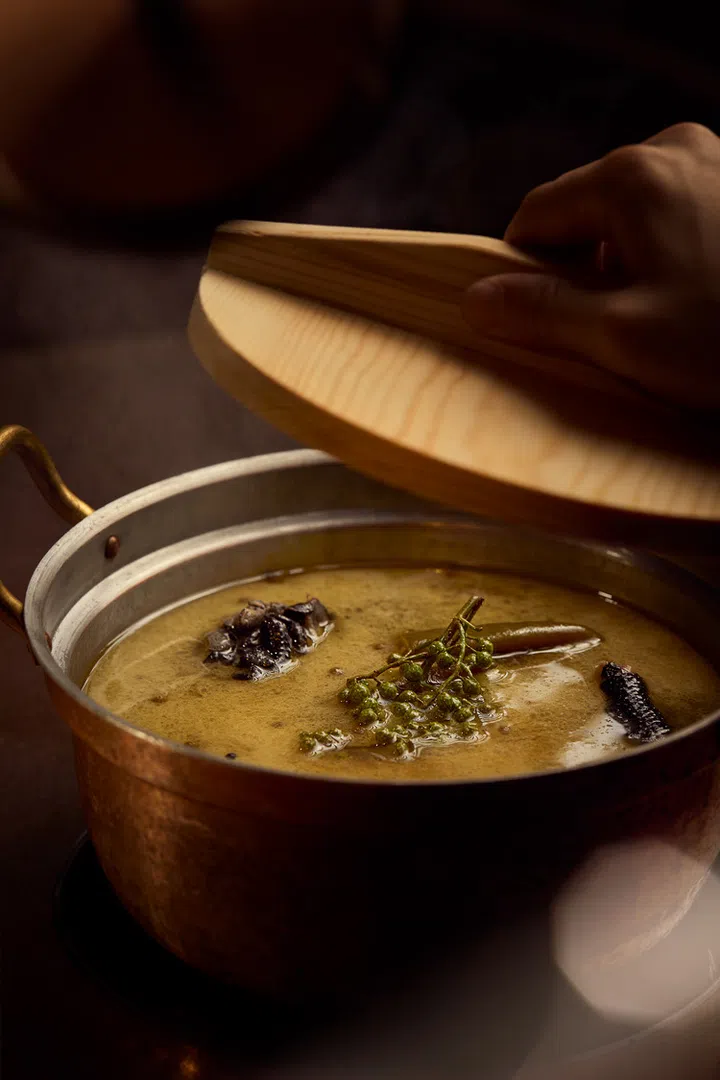
Chiang has even designed a mini ritual at the beginning of the hotpot experience. A broth sommelier introduces various broths-like Laksa, Mala, Sichuan Green Pepper, and Sauerkraut, then helps diners pick one out of eight based on their preferences. The signature Sichuan Green Pepper broth, made with Taiwanese pickled chilli and Sichuan green pepper, was served at his now-defunct restaurant, Sichuan Moon in Macau.
Two menus, priced at $110 and $138, offer a stunning array of seafood, including rock lobster, Hokkaido fan scallops, and South African abalone, alongside meats like Kagoshima A4 wagyu sirloin, duck breast, Duroc pork neck, and a selection of fresh vegetables. Service is meticulous, with staff ready to de-shell prawns or handle ingredients for you, ensuring a seamless dining experience.
“You’ll notice that throughout the entire experience, we don’t focus on highlighting our A4 beef or the origin of our ingredients — it’s just not the point anymore,” Chiang explains.
There are also no condiments on the table — or rather, there’s no need for them as the broth is perfected from the very first sip. However, you can make a request for a chilli powder blend, personally prepared by Chiang.
“No one has asked for condiments yet,” he adds. “I think people wonder about it beforehand, but once they taste the broth, they realise it doesn’t need anything else.”
Creativity is solution
For Chiang, opening lifestyle concepts is just as exciting as it challenges him to find innovative solutions.
“A good chef needs to know how to cook a good meal, whether with wagyu, truffle, or potato and bacon. I don’t limit myself to French or Taiwanese cooking for any of my restaurant projects,” he says. “And even if I were to cook an instant noodle for myself, you’ll still see André’s touch — and that is the whole value of it.”
Diners evolve, and Chiang says chefs should not stay still.
“In fact, we should evolve five or 10 years ahead of our diners. Every 10 years, I ask myself, what is something else that I can do? How can I create a concept needed for this upcoming generation?” says Chiang, whose story inspired Oscar-winning director Régis Wargnier’s new French movie La Réparation. He was invited to work on the set to share his expertise on the movie’s gastronomic scenes, and footage of Raw, has also been included.

“No matter what you create, create something that is needed. Create something no one else is doing and not just for the sake of being there,” he adds pensively, “The most important thing is to be needed.”
“For me, creativity is not something like an inspiration from nowhere; creativity is giving solutions. A better solution.” He says bluntly, “If your creation cannot solve a problem, then that is not a creation.”
Bon Broth is located at 03-01 Raffles City, 252 North Bridge Road.