
The economics of running a laundry business in Singapore
Fancy some passive income? These Singaporeans have been running laundromat businesses. But is it really feasible? We speak to industry experts to find out more.
By Karen Fong /
Share this article
You’ve probably seen them scattered around HDB estates and popping up in areas with heavy footfall. They are both prevalent and often overlooked, yet also a surprisingly fast-growing business — the laundromat industry.
Often operating on the periphery — one of those “you only know when you need it” — the laundromat industry has grown in Singapore over the years. This has largely been driven by rising interest in laundromats as a source of passive income.
Willy Soh, who runs Fresh Laundry, a company that helps people establish and run their own laundromats, noted a huge increase in interest in opening a laundromat since 2022.
“One of the main reasons is that more people are looking for businesses that can provide a relatively passive source of income and are manageable without requiring the owner to be physically present at all times,” he says.
“I definitely believe there is room for expansion,” says Soh, of the industry. “Singaporeans are generally innovative, and I believe operators will continue finding new ways to improve the traditional laundromat concept through technology, convenience and additional services. Ultimately, laundry is an essential service. People will always need to wash and dry their clothes, so the demand itself will not disappear. The opportunity lies in finding the right location, managing costs well and creating a better experience for customers.”
Here we speak to three business owners about their experiences in the laundromat business and the most important things to consider before diving in.
What’re the key considerations of starting a laundromat business?
Rental is one of the biggest factors affecting profitability. “Rental rate, location, expected customer volume, and overall operating costs should be carefully calculated before committing to a site,” says Soh.
“Apart from rent, operators should also account for the initial investment in washers and dryers, utilities such as water, electricity, and gas, equipment maintenance and repairs, cleaning, payment systems, and other day-to-day operating expenses.”
He adds that a typical entry-level investment for a fully equipped self-service laundromat ranges from approximately $130,000 to $150,000, depending on the location, equipment specifications and renovation requirements. An additional $30,000 to $50,000 should also be set aside as a financial buffer during the initial operating period.
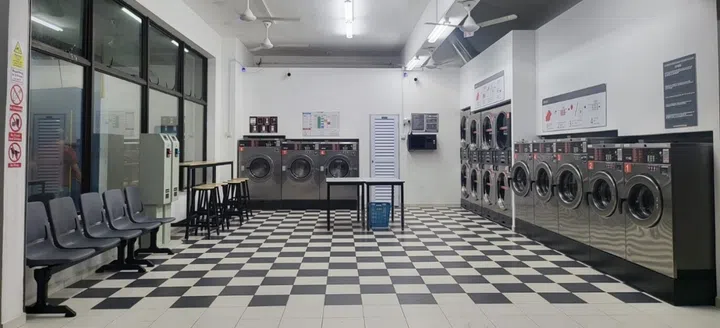
Tan Tiong Peng, who has been in the business since 1984, opened Wonder Wash in April 2010. He owns and operates 40 outlets, with another 40+ outlets franchised. He adds that starting a franchise shop costs between $120,000 and $200,000.
“Nothing remains stagnant; the business world is very dynamic,” he says. “I have to keep innovating my business to stay ahead of competition. We have had many firsts; first 24/7 unmanned self-service laundry, first to franchise this business, first to adopt cashless payment, first to introduce the Combo washer and dryer, saving customer time, but we still have to have new ideas in the pipeline.”
Revenue for an average shop can be between $7,000 and $8,000, with some good locations taking home above $10,000. “But rent can be as high as $6,000, so the profit margin doesn’t necessarily parallel the revenue,” adds Tan.
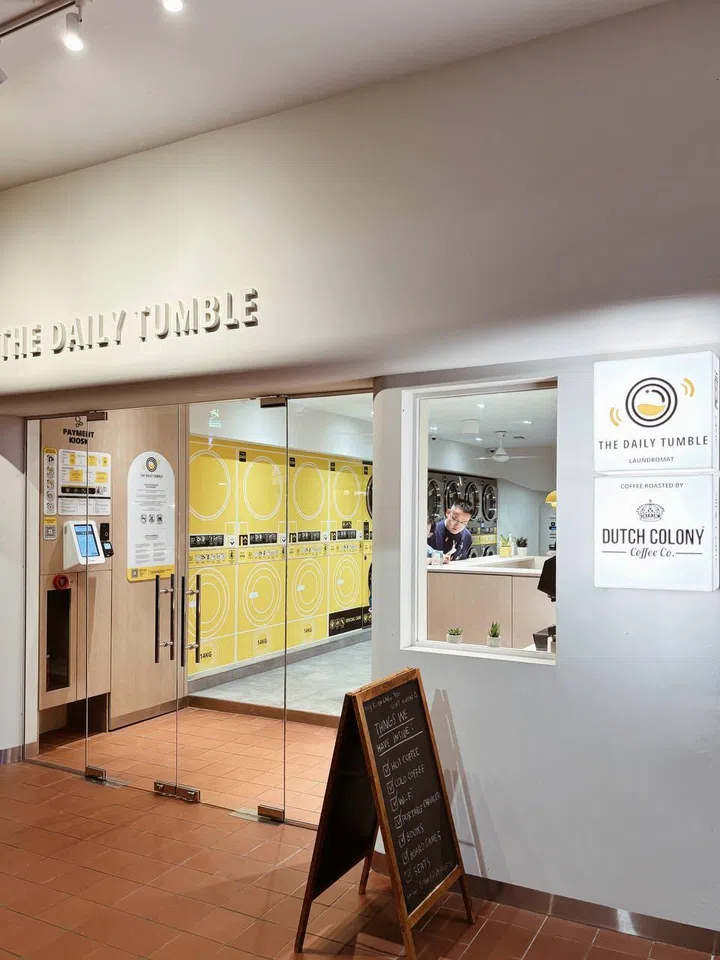
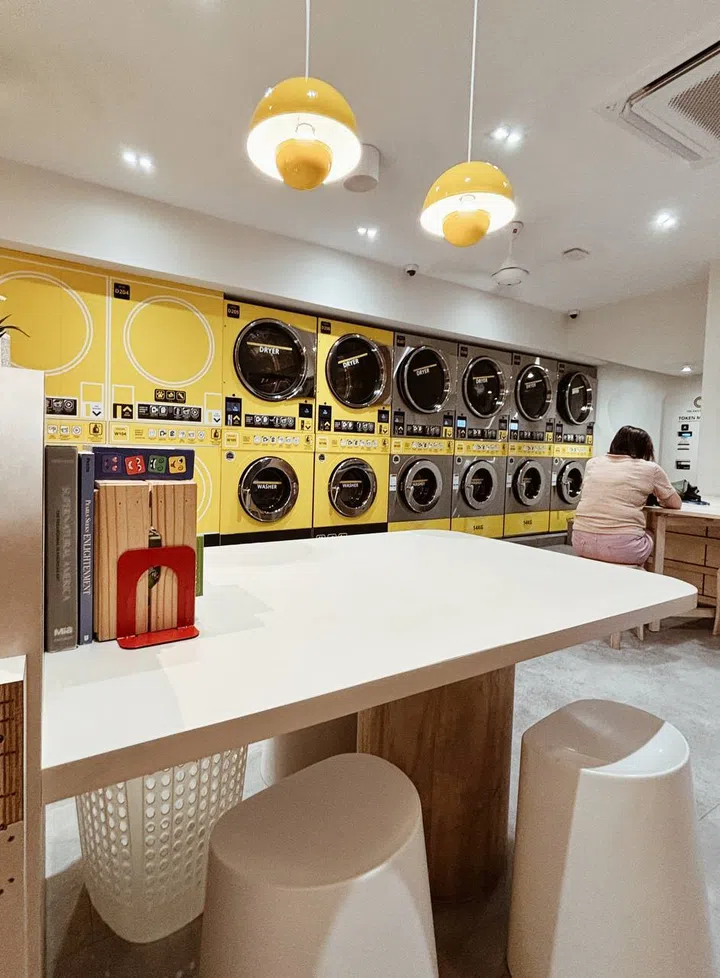
Yasmeen Chan runs The Daily Tumble with her partner James Anderson. They opened the business two years ago, combining a laundromat with a social space where customers can get a coffee or sit and work while they wait.
“A self-service laundromat is often presented as a passive business; this can make it hard to differentiate yourself. A laundromat may be unmanned at certain times, but it cannot be unmanaged,” she says, adding that there is still cleaning, customer support, machine maintenance, stock replenishment, payment troubleshooting, and a long list of small things customers never see.
“Adding coffee or services such as wash-and-fold creates more opportunities, but it also adds another layer of operations. The hard part is making the experience feel simple for the customer, even when quite a lot is happening behind the scenes.”
She adds that while $150,000 is usually the quoted start-up cost, it doesn’t account for items such as lease-related costs, deposits, licenses, and other requirements.
She also stresses that opening a laundromat is not the same as building a sustainable laundromat business. “We’ve seen laundromats earn two to three times more during peak seasons, only to experience sharp drops afterwards. Others maintain consistently healthy revenue throughout the year, with less seasonal fluctuation.”
For The Daily Tumble, revenue has remained relatively stable, with upticks during busy periods.
What are the biggest challenges of running a laundromat business?
Soh notes that maintenance and cleanliness can greatly affect customer experience. “A laundromat is a service business, so customers expect the machines to work properly and the premises to be clean and convenient every time they visit.”
One of the hardest parts was finding the right partners and getting reliable information, says Chan. “The industry can be quite old-school and opaque. There is information online, but it is not always complete, current or relevant to running a laundromat in Singapore.”
She also adds that the highest hidden cost is not having enough buffer. “People often receive a quotation for machines and renovation and assume that is what it costs to start a laundromat. But that only gets you to opening day. It does not account for delays, unexpected site work or the time it takes for customers to discover you and build a new habit around using your business.”
“The single most difficult part of this business is dealing with unreasonable customers,” says Tan, who notes this could be why some franchisees stop expanding after opening one or two outlets. Usually, issues arise when customers are impatient, machines break down, and they demand immediate solutions.
He recalls one customer threatening to smash the washing machine’s glass door if the technician wasn’t on site in five minutes, and another instance when the police were called to find a “stolen” plastic bag.
How do you differentiate your laundromat from others?
For some, offering unmanned, 24-hour self-operated machines is enough. Laundry is a need everyone has, and simply being in the right place at the right price point can be enough.
For others, differentiation is key. The Daily Tumble is built around co-founder Anderson’s experience with laundromats in the United States, where they were a communal experience. “We wanted it to be more than a room full of machines. We wanted it to be a third space — a place where people could work, have coffee, spend time with family or even meet friends,” says Chan.
“And we noticed it as early as a few months in. We have customers whose laundry is finished within an hour, but they stay for another hour or two to finish their work or watch Netflix. Families play board games while they wait. We even had a couple spend Valentine’s Day at TDT, playing games and drinking coffee.”
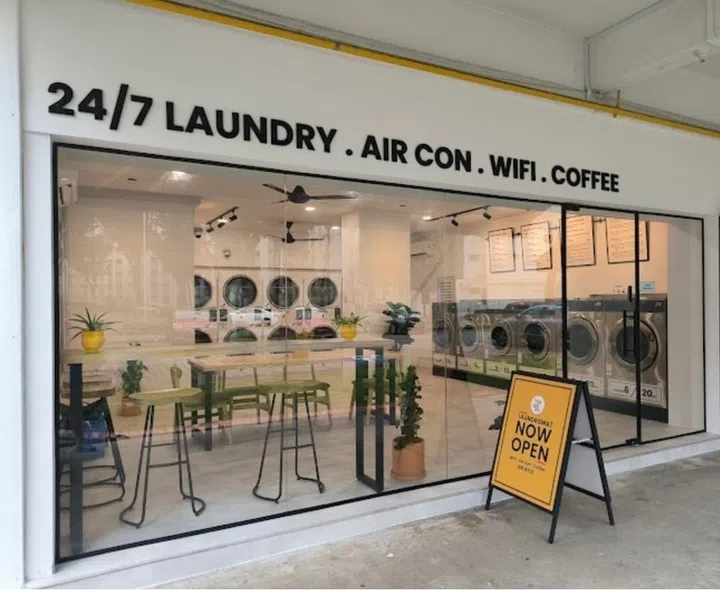
Soh also describes working with a client, Hangout Laundry, who transformed their laundromat into a similar, social space. “They created opportunities for social meet-ups, including events for singles, which received a very positive response. They also incorporated elements of a co-working and community space into the laundromat,” he says.
“I found the concept very impressive because they took something very functional and turned it into a place where people could meet, work, and interact while waiting for their laundry. It was a creative way of adding value to the traditional laundromat model, and they executed it very well.”
Any advice for future laundromat owners?
Having been in the business for over 40 years, Tan is looking to grow and expand Wonder Wash overseas. “Do not rush into this business; do your homework thoroughly. Do not be misled by equipment sellers who promise fast return,” he advises.
“This business can be profitable, but if it is in a bad location, it can also lose money. Only invest in this business if you have disposable cash; do not borrow or use up your retirement funds.”

Chan’s advice is “Location, location, location.” But she says it’s important to understand what that means. “It does not simply mean high foot traffic. You need to understand who lives or works nearby, what laundry needs they have, what competition already exists, whether the unit has the right infrastructure and whether the rent and lease terms make sense for the long term. Do not start by asking, ‘How many machines can I fit here?’ Start by asking, ‘Who am I serving, and what problem am I solving for them?’”