%22%3E%0A%3Cpath%20d%3D%22M412%20101.2H393.7C393.1%20101.2%20392.3%20100.9%20391.8%20100.5C377.3%2087.6004%20362.9%2074.6004%20348.4%2061.6004C344.8%2058.4004%20341.3%2055.2004%20337.7%2052.0004C337.1%2051.5004%20336.2%2051.1004%20335.5%2051.0004C334.2%2050.8004%20333%2051.0004%20331.5%2051.0004V101.1H316.7V0.100391H331.4V44.3004C331.9%2044.3004%20332.2%2044.4004%20332.5%2044.4004C334.9%2044.4004%20337.2%2044.5004%20339.6%2044.4004C340.4%2044.4004%20341.3%2044.0004%20341.8%2043.5004C351.6%2034.4004%20361.4%2025.2004%20371.1%2016.0004C376.5%2010.9004%20381.9%205.90039%20387.3%200.800391C387.9%200.200391%20388.5%200.000390626%20389.3%200.000390626H400.9C384.2%2015.8004%20367.8%2031.3004%20351.2%2047.0004C371.5%2065.0004%20391.8%2082.9004%20412.1%20100.9C412.1%20101%20412.1%20101.1%20412%20101.2ZM180.9%20101.2C184.1%2094.9004%20187.2%2088.9004%20190.3%2082.8004C198.3%2067.3004%20206.2%2051.8004%20214.2%2036.2004C220.3%2024.4004%20226.4%2012.5004%20232.4%200.700391C232.7%200.100391%20233%20-0.0996094%20233.7%20-0.0996094H248.1C248.8%20-0.0996094%20249.2%200.100391%20249.6%200.800391C256%2013.3004%20262.4%2025.7004%20268.8%2038.2004C279.3%2058.6004%20289.8%2079.0004%20300.3%2099.5004C300.5%20100%20300.8%20100.4%20301.1%20101.1C300.5%20101.1%20300.1%20101.2%20299.7%20101.2H286.5C285.6%20101.2%20285.1%20100.9%20284.7%20100.2C280.1%2091.3004%20275.4%2082.4004%20270.8%2073.4004C270.1%2072.1004%20269.3%2071.6004%20267.8%2071.6004H209.9C208.7%2071.6004%20208.1%2072.0004%20207.5%2073.1004C202.9%2082.1004%20198.2%2091.0004%20193.6%20100C193.1%20101%20192.6%20101.3%20191.5%20101.3C188.4%20101.2%20185.3%20101.3%20182.3%20101.3C182%20101.2%20181.6%20101.2%20180.9%20101.2ZM239.1%2011.4004C230%2029.2004%20221.1%2046.7004%20212.1%2064.3004H266.4C257.2%2046.7004%20248.2%2029.2004%20239.1%2011.4004ZM0%200.000390626H43.4C51.2%200.000390626%2058.7%201.20039%2065.7%204.80039C75.9%2010.0004%2078.9%2018.0004%2078.6%2027.4004C78.3%2034.3004%2076%2040.5004%2071.2%2045.5004C67.3%2049.6004%2062.4%2052.3004%2057.1%2054.3004C50.6%2056.7004%2043.9%2058.0004%2037.1%2058.6004C30.1%2059.2004%2023.1%2059.4004%2016.2%2059.7004C15.8%2059.7004%2015.3%2059.8004%2014.8%2059.8004V101.1H0.1C0%2067.4004%200%2033.8004%200%200.000390626ZM14.8%207.10039V52.2004C23.7%2052.4004%2032.6%2052.3004%2041.2%2050.1004C44.4%2049.3004%2047.6%2048.2004%2050.6%2046.7004C58.4%2043.0004%2062.3%2036.7004%2062.7%2028.0004C63%2019.9004%2059.5%2014.1004%2052.4%2010.5004C47.6%208.00039%2042.5%207.10039%2037.2%207.10039H14.8ZM95.9%20101.1V0.100391H167.3V7.20039H110.7V44.7004H158.1V51.9004H110.8V93.9004H171.1V101C146.1%20101.1%20121%20101.1%2095.9%20101.1Z%22%20fill%3D%22black%22%2F%3E%0A%3Cpath%20d%3D%22M35.0004%2025.7996H42.5004V20.6996H44.8004V33.1996H42.6004V27.5996H34.9004V33.2996H32.7004V20.7996H35.0004V25.7996ZM54.4004%2025.8996V27.2996H48.9004V31.6996H55.9004C55.9004%2032.1996%2056.0004%2032.5996%2056.0004%2033.0996H46.5004V20.5996H55.5004V21.8996H49.0004V25.7996C50.7004%2025.8996%2052.5004%2025.8996%2054.4004%2025.8996ZM25.9004%2033.0996H23.5004V21.9996H17.9004V20.6996H31.6004V22.0996H27.1004C26.2004%2022.0996%2025.9004%2022.2996%2025.9004%2023.1996C26.0004%2026.0996%2025.9004%2028.9996%2025.9004%2031.7996V33.0996Z%22%20fill%3D%22black%22%2F%3E%0A%3C%2Fg%3E%0A%3Cdefs%3E%0A%3CclipPath%20id%3D%22clip0_388_462%22%3E%0A%3Crect%20width%3D%22411%22%20height%3D%22101.2%22%20fill%3D%22white%22%2F%3E%0A%3C%2FclipPath%3E%0A%3C%2Fdefs%3E%0A%3C%2Fsvg%3E%0A)
This Singaporean food historian and author has over 1,000 pieces of Nusantara gastronomy ware
Khir Johari, whose book, The Food Of Singapore Malays: Gastronomic Travels Through The Archipelago, won the Best Of All prize at the Gourmand Cookbook Awards 2025, shares the stories behind his formidable collection of kitchen accoutrements and serveware.
By Kenneth SZ Goh /

Share this article
Growing up in the historic Gedung Kuning in the heart of Kampong Glam, food historian and author Khir Johari was accustomed to lavish entertaining at home. His great-grandfather was the prominent merchant Haji Yusoff, who frequently hosted businessmen from Southeast Asia and India, as well as key figures in the local Malay community.
His childhood home, also known as the Yellow Mansion and a former annexe of the Sultan of Singapore’s royal palace, also saw a constant stream of visits from newlywed relatives, who came to pay their respects to the elders in a four-generation household.
A stalwart presence in those convivial gatherings was a long English oak table in the dining room, lined with “proper plates and serveware”. When Gedung Kuning was acquired by the Government in 1999, Khir recalls the astonishing discovery of stacks of food platters, or chargers, from the Meiji era and from Maastricht, Netherlands, some of which he eventually inherited.
This love for serveware laid the foundation for his staggering Nusantara gastronomy ware collection, which comprises over 1,000 antique pieces, ranging from plates and platters to water vessels, utensils, and accessories. Some of them are also featured in his landmark book, The Food of Singapore Malays: Gastronomic Travels Through The Archipelago, an encyclopaedic exploration of culinary history and culture of Singapore’s Malay community.
Published in 2021, the 600-page tome has won awards, including the Best of All accolade at the 31st Gourmand Cookbook Awards 2025. The awards is widely considered to be the Oscars of culinary publishing. It was also awarded the Best of the Best in Food Culture at an earlier edition of the awards this year and the NUS Singapore History Prize in 2024.
Speaking to The Peak Singapore in his home over kueh ambon and tea, he says with a chuckle: “I see myself like a ‘vacuum cleaner’ — If I see something that is related (to the Nusantara era), I will get it. The more dots I have, the better picture I’d have.”
Khir’s “broad and eclectic” collection, which mainly dates from the late 1800s to early 1900s, spans cooking, dining, and ceremonial wares that plied the Nusantara spice route. He considers factors such as historical timelines, multicultural aspects, and socio-economic backdrops before acquiring each item.
Immerse in history
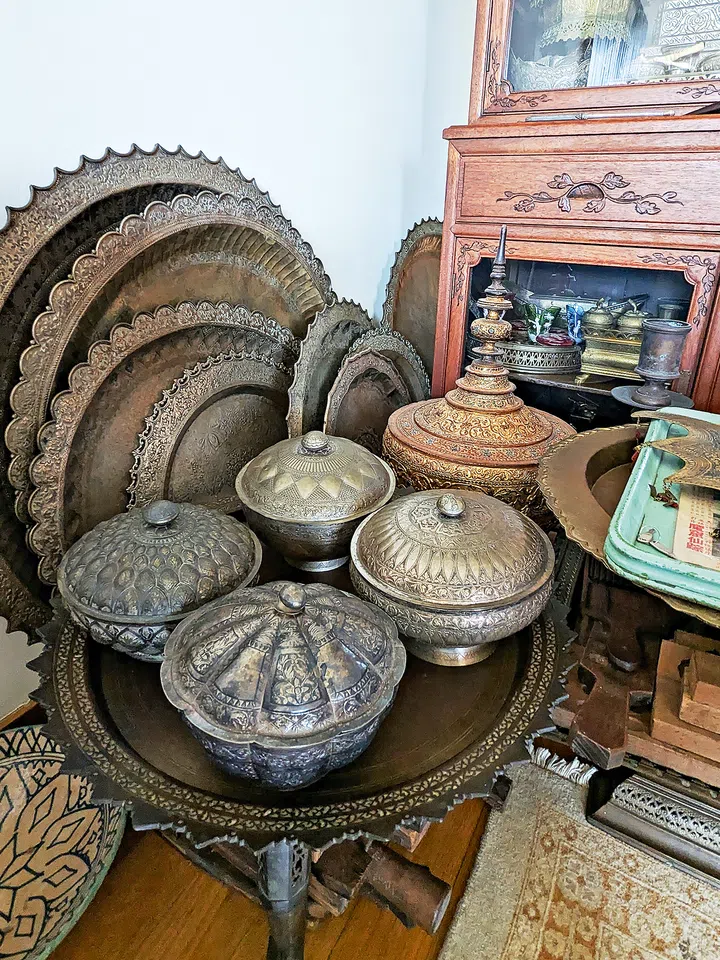
History is omnipresent the moment one steps out of a private lift that leads to Khir’s condominium apartment. A lacquer ceremonial container adorned with lotus flower motifs from Palembang, and a mother-of-pearl inlaid lacquer footed bowl filled with pandan leaves, greet visitors and set the stage for a heritage tour de force.
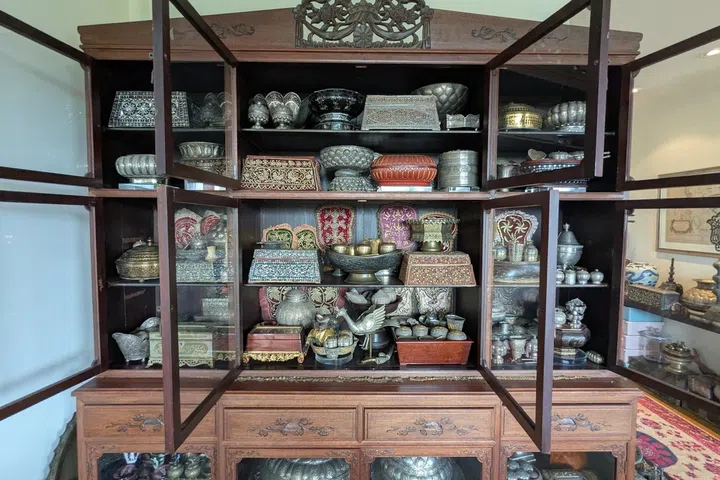
The living room is anchored by a gargantuan wooden cabinet filled with dazzling sireh sets for betel chewing. The exquisite boxes, adorned with Malay chinoiserie designs, are made from mother-of-pearl, coco de mer from the Seychelles, mottled wood, and brass laid with silver and gold.
A bird-shaped incense receptacle “pecks” on a tray of paraphernalia against a colourful backdrop of velvet wedding fans. Spilling out at the side of the cabinet are silver dulang (trays), rice serving bowls and wooden moulds in a cornucopia of zoomorphic shapes.
Basking in the balcony are stacks of brass pots, while a powder room has been converted into a storeroom for his formidable collection, and glazed mixing bowls sit in an unused bathtub. Some of the larger pieces are stored in a warehouse. “Maybe I should do a roving exhibition,” he guffaws before he continues to regale us with anecdotes behind the pieces.
Khir’s most prized find is a resplendent silver ceremonial kueh stand with a dome-shaped cover, presented by Sultan Abdul Rahman Mu’azzam Shah of Riau-Lingga as a coronation gift to Queen Wilhelmina of the Netherlands in 1890.
The eye-pleasing Golden Ratio proportions of the pedestal stand, coupled with the intricate botanical carvings and a serrated-edged tray adorned with chains, caught Khir’s eye, who spent six years teaching mathematics in California.
The 62-year-old says: “The complexity of serveware says something about the importance of kueh in the Malay world — it is in a class of its own and has to be on a pedestal. It is also about honouring and respecting your guests, and serving the best to them.”

A writer’s mission
Khir’s love for collecting also stems from his interest in Islamic art that blossomed while living in the United States. Living abroad made him introspective about his roots as he explored Berkeley’s second-hand book stores for books on the culture of the Malay archipelago.
He also adds to his collection whenever he travels. He recalls trips to Portobello Market in London years ago, where he bought old silverware from the Johor-Riau region, before its popularity spiked after the Silver from the Malay World exhibition at the Victoria & Albert Museum in 2013.
Khir later narrowed down his collection to the Nusantara region. He explains: “There is a Silk Road of sorts in our backyard — the spice route that is part of the region’s maritime trade, which has been under-recognised.”
During the 11-year research process on his seminal book, the former vice president of the Singapore Heritage Society, who returned to Singapore in 2007, zeroed in on kitchen accoutrements to accompany his book’s chapters on Malay cooking techniques, ingredients and tools.
“I started collecting for the purpose of writing my book — looking for objects when there was a gap in understanding a concept. I hunted and built a network of antique dealers,” he shares. For example, while writing about putu piring, he was looking for evidence that the steamed rice cake can be homemade. It led to the discovery of a brass putu piring steamer with six chimneys, intended for home use. He looks out for auctions, markets and sometimes, unexpected places.
“Once, I found a rare brass tudung saji (food cover), which should be a museum piece, in a scrap metal factory,” he deadpans.
What’s the driving force behind his Nusantara gastronomy ware collection? Khir reflects: “Part is memory and beyond that, identity. The food you eat and the types of kitchen tools you use tell your story.”
He still has fond memories of the dishes his mother made, who was a cookery teacher and also taught him to cook. He beams: “Gedung Kunning has always been a repository of many great recipes. For those who grew up in Kampong Glam, the food at Gedung Kuning is almost like a reference point.” Some of her well-known dishes include sambal goreng pengantin and rawon, which he calls his “soul food”.
All about aesthetics
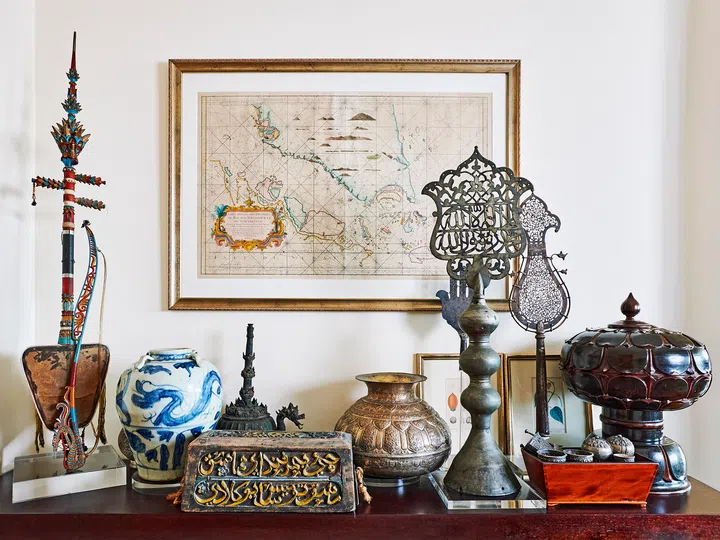
Another aspect that Khir’s collection highlights is the emphasis on aesthetics in Malay food through a play of colours and shapes. Geometry in the Malay world has “a malleable relationship” with food. For example, the Malay word for rhombus or diamond is wajik, which is also the name of a Javanese glutinous rice treat cooked with palm sugar, pandan, and coconut milk.
Far from merely collecting, Khir believes that the value of his pieces is only as good as how they benefit others. He has loaned some of his pieces to exhibitions and uses some of the platters and bowls to serve his guests, and has loaned pieces to friends who want to re-create a traditional wedding.
In the words of his great-grandmother, who also loaned wedding paraphernalia: “Berjasa — let it be of service.”
What’s next after publishing The Food of Singapore Malays: Gastronomic Travels Through The Archipelago? Khir, who also organises Serumpun, an annual symposium on the Nusantara culinary heritage, reveals that his next book will document the forgotten group of people who collected the specimens, created illustrations and taxonomy of native plants, which helped guide the first European directors of the Singapore Botanic Gardens.
What is it like living amid so much history? Khir beams proudly at the end of the hour-long interview: “It is a constant reminder that these items belonged to somebody in the timeline of Nusantara history. Some of these items have been passed from generation to generation, but I don’t really see them as mine. I see myself as a mere custodian. Eventually, I would like the next generation to care for it. Meanwhile, I am here to look after them and celebrate our heritage.”
Collector’s picks
Khir Johari shares some of his favourite pieces from his extensive Nusantara gastronomy ware collection.
1. Ceremonial Silver Kueh Stand with Dome (Wadah Kueh)
1898, Riau
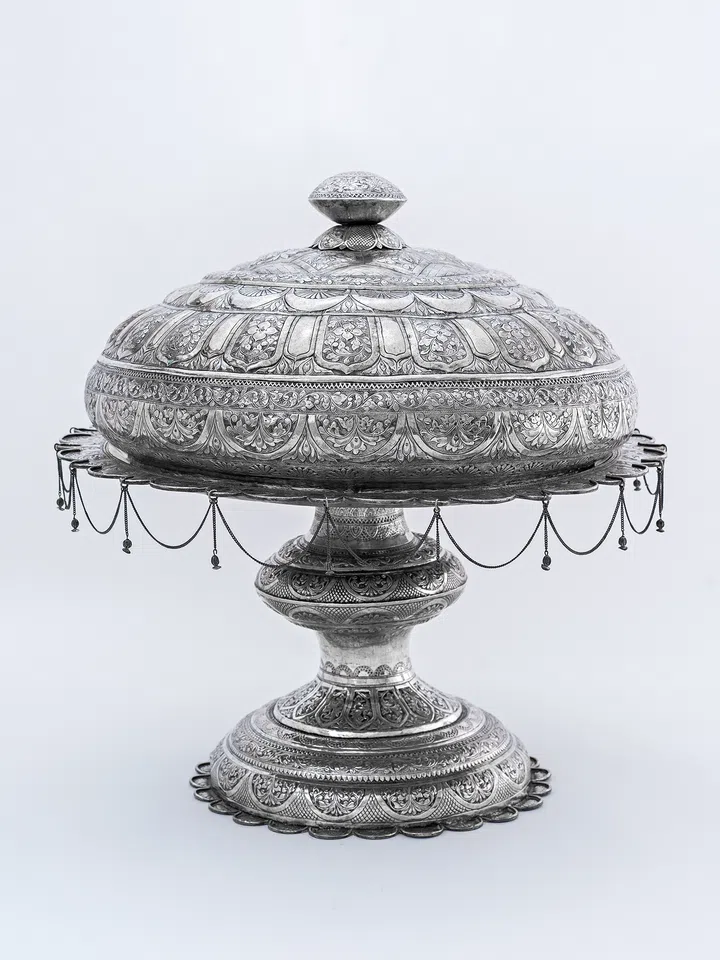
I stumbled upon this piece while visiting the home of a former curator of an important museum in Holland. This was a gift from the Sultan Abdul Rahman Mu’azzam Shah of Riau-Lingga to Queen Wilhelmina of the Netherlands on her coronation in 1890.
A collector had bought this from an auction, and he, in turn, bequeathed it to his goddaughter, the curator. While editing her collection, the elderly curator felt that, in her own words, “the bride needs to come home”. She contacted me, and I almost jumped out of my skin.
I like this elegant silverware for its choice of artwork and the clear negative and positive spaces. The proportion of the piece follows the Golden Ratio — for someone with a mathematics background, it is pleasing to the eye.
2. Terracotta Rice Cake Mould
Late 1800s/early 1900s, East Coast of the Malayan Peninsula
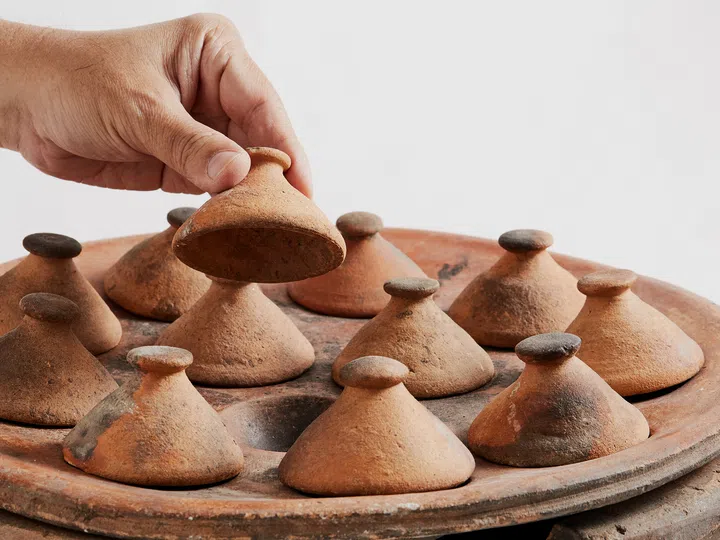
One of the oldest pieces of my collection, this utilitarian tool isn’t just for everyday use; it is also beautifully embellished. I like how this piece tells a story of food preparation and debunks the idea that there are no zoomorphic figures in the Muslim world — the lid features a bird design.
It is really rare for a clay object from the late 1800s to remain intact.
3. Wooden Coconut Scraper (Kukur Kelapa)
Early 1900s, Terengganu
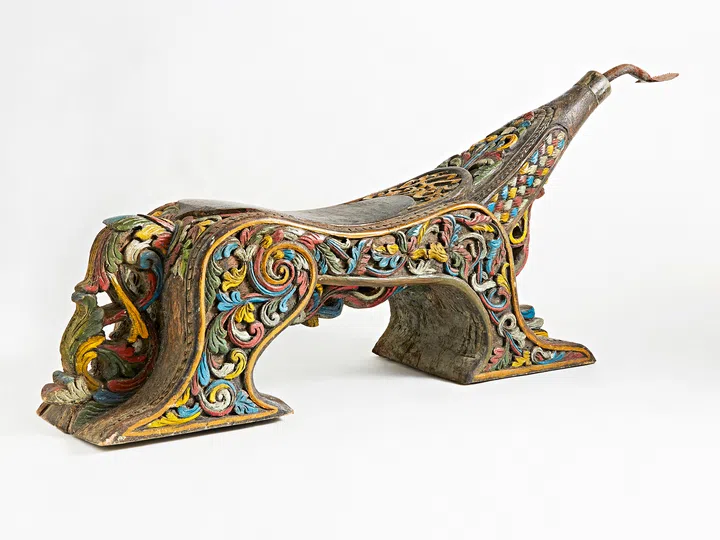
Coconut is the kernel of Nusantara gastronomy. In the Malay world, something utilitarian has to be beautiful, not just a piece of wood with a sharpener to grate a coconut kernel. The design is an abstraction of a zoomorphic form.
One can sit on the coconut scraper like a saddle, which is made of nicely carved and painted Chengal wood. This item is special to me as there’s a whole study on coconut scrapers from the east coast of Malaysia, which has been called the cultural heartland of the Malay world.