%22%3E%0A%3Cpath%20d%3D%22M412%20101.2H393.7C393.1%20101.2%20392.3%20100.9%20391.8%20100.5C377.3%2087.6004%20362.9%2074.6004%20348.4%2061.6004C344.8%2058.4004%20341.3%2055.2004%20337.7%2052.0004C337.1%2051.5004%20336.2%2051.1004%20335.5%2051.0004C334.2%2050.8004%20333%2051.0004%20331.5%2051.0004V101.1H316.7V0.100391H331.4V44.3004C331.9%2044.3004%20332.2%2044.4004%20332.5%2044.4004C334.9%2044.4004%20337.2%2044.5004%20339.6%2044.4004C340.4%2044.4004%20341.3%2044.0004%20341.8%2043.5004C351.6%2034.4004%20361.4%2025.2004%20371.1%2016.0004C376.5%2010.9004%20381.9%205.90039%20387.3%200.800391C387.9%200.200391%20388.5%200.000390626%20389.3%200.000390626H400.9C384.2%2015.8004%20367.8%2031.3004%20351.2%2047.0004C371.5%2065.0004%20391.8%2082.9004%20412.1%20100.9C412.1%20101%20412.1%20101.1%20412%20101.2ZM180.9%20101.2C184.1%2094.9004%20187.2%2088.9004%20190.3%2082.8004C198.3%2067.3004%20206.2%2051.8004%20214.2%2036.2004C220.3%2024.4004%20226.4%2012.5004%20232.4%200.700391C232.7%200.100391%20233%20-0.0996094%20233.7%20-0.0996094H248.1C248.8%20-0.0996094%20249.2%200.100391%20249.6%200.800391C256%2013.3004%20262.4%2025.7004%20268.8%2038.2004C279.3%2058.6004%20289.8%2079.0004%20300.3%2099.5004C300.5%20100%20300.8%20100.4%20301.1%20101.1C300.5%20101.1%20300.1%20101.2%20299.7%20101.2H286.5C285.6%20101.2%20285.1%20100.9%20284.7%20100.2C280.1%2091.3004%20275.4%2082.4004%20270.8%2073.4004C270.1%2072.1004%20269.3%2071.6004%20267.8%2071.6004H209.9C208.7%2071.6004%20208.1%2072.0004%20207.5%2073.1004C202.9%2082.1004%20198.2%2091.0004%20193.6%20100C193.1%20101%20192.6%20101.3%20191.5%20101.3C188.4%20101.2%20185.3%20101.3%20182.3%20101.3C182%20101.2%20181.6%20101.2%20180.9%20101.2ZM239.1%2011.4004C230%2029.2004%20221.1%2046.7004%20212.1%2064.3004H266.4C257.2%2046.7004%20248.2%2029.2004%20239.1%2011.4004ZM0%200.000390626H43.4C51.2%200.000390626%2058.7%201.20039%2065.7%204.80039C75.9%2010.0004%2078.9%2018.0004%2078.6%2027.4004C78.3%2034.3004%2076%2040.5004%2071.2%2045.5004C67.3%2049.6004%2062.4%2052.3004%2057.1%2054.3004C50.6%2056.7004%2043.9%2058.0004%2037.1%2058.6004C30.1%2059.2004%2023.1%2059.4004%2016.2%2059.7004C15.8%2059.7004%2015.3%2059.8004%2014.8%2059.8004V101.1H0.1C0%2067.4004%200%2033.8004%200%200.000390626ZM14.8%207.10039V52.2004C23.7%2052.4004%2032.6%2052.3004%2041.2%2050.1004C44.4%2049.3004%2047.6%2048.2004%2050.6%2046.7004C58.4%2043.0004%2062.3%2036.7004%2062.7%2028.0004C63%2019.9004%2059.5%2014.1004%2052.4%2010.5004C47.6%208.00039%2042.5%207.10039%2037.2%207.10039H14.8ZM95.9%20101.1V0.100391H167.3V7.20039H110.7V44.7004H158.1V51.9004H110.8V93.9004H171.1V101C146.1%20101.1%20121%20101.1%2095.9%20101.1Z%22%20fill%3D%22black%22%2F%3E%0A%3Cpath%20d%3D%22M35.0004%2025.7996H42.5004V20.6996H44.8004V33.1996H42.6004V27.5996H34.9004V33.2996H32.7004V20.7996H35.0004V25.7996ZM54.4004%2025.8996V27.2996H48.9004V31.6996H55.9004C55.9004%2032.1996%2056.0004%2032.5996%2056.0004%2033.0996H46.5004V20.5996H55.5004V21.8996H49.0004V25.7996C50.7004%2025.8996%2052.5004%2025.8996%2054.4004%2025.8996ZM25.9004%2033.0996H23.5004V21.9996H17.9004V20.6996H31.6004V22.0996H27.1004C26.2004%2022.0996%2025.9004%2022.2996%2025.9004%2023.1996C26.0004%2026.0996%2025.9004%2028.9996%2025.9004%2031.7996V33.0996Z%22%20fill%3D%22black%22%2F%3E%0A%3C%2Fg%3E%0A%3Cdefs%3E%0A%3CclipPath%20id%3D%22clip0_388_462%22%3E%0A%3Crect%20width%3D%22411%22%20height%3D%22101.2%22%20fill%3D%22white%22%2F%3E%0A%3C%2FclipPath%3E%0A%3C%2Fdefs%3E%0A%3C%2Fsvg%3E%0A)
Editor’s favourites: The 16 best timepieces from Watches and Wonders Geneva 2026
This annual fair for luxury watches made one thing clear: horology is pushing forward on all fronts — materials, mechanics, and increasingly, emotion. From Rolex’s mastery of materials to Jaeger-LeCoultre’s pursuit of precision, the event balanced variety with crowd-pleasers with sheer technicality.
By Yanni Tan /

Share this article
Watches and Wonders Geneva 2026 is a year where brands are clearly pulling out all the stops. The biggest names are advancing their strengths — from the steady materials evolution at Rolex to Patek Philippe’s mastery of complications, alongside serious technical ambition from Jaeger-LeCoultre and IWC.
It’s a line-up that balances headline-making luxury watches with thoughtfulness and creativity. Here are the standout creations from this year’s edition.

Rolex Oyster Perpetual Cosmograph Daytona
Rolex’s latest Oyster Perpetual Cosmograph Daytona is driven by a clear focus on material mastery, fusing traditional know-how with advanced technology.
Presented in a Rolesium configuration — combining Oystersteel and platinum for the first time on the Daytona — the watch introduces a new anthracite ceramic bezel with a restyled tachymetric scale. The numerals are now displayed horizontally, echoing the original 1963 model, but rendered in a more contemporary font. The bezel itself is made from a specially developed ceramic enriched with tungsten carbide, giving it a distinctive metallic sheen.
The dial is a highlight. Executed in luminous white enamel using the grand feu technique, it is fired at over 800 deg C to achieve its depth and durability. In a departure from tradition, the enamel is applied to ceramic plates for both the main dial and the counters, before being assembled onto a brass base. It’s a technically demanding process that underscores Rolex’s deep expertise in dial-making.
The watch is housed in a 40mm Oyster case, primarily in Oystersteel with platinum used for the bezel surround and caseback ring, and now features a transparent caseback revealing the calibre 4131. The movement, with its cut-out yellow gold oscillating weight and Rolex Cotes de Geneve finishing, continues to deliver the performance expected of the Daytona, alongside the Superlative Chronometer certification.

Patek Philippe Ref. 5249R-001 “The Crow and the Fox”
Patek Philippe surprises with Ref. 5249R-001, an automaton wristwatch inspired by a 1958 pocket watch from its museum. Named “The Crow and the Fox”, it marks the manufacture’s first automaton wristwatch in modern history, built around an unusual concept: displaying the hours and minutes only on demand.
The dial is treated as a stage. Crafted from an 18k gold plate with an opaline “Matara” brown finish, it is brought to life by hand-engraved appliques in multiple shades of gold. The crow, the fox, and surrounding foliage form a detailed tableau, requiring around 150 hours of manual work. Some of these elements are not merely decorative — the fox’s paw and muzzle indicate the hours, while a minute hand shaped like a wedge of cheese drops from the crow’s beak to mark the minutes.
The display is activated via a push-piece at 2 o’clock. Pressing it sets the scene in motion: the fox first indicates the hours, followed by the minute display, before both return to their resting positions. It’s a mechanical sequence that blends storytelling with function, built on a complex system of retrograde displays and levers designed for smooth, precise activation.
Housed in a 43mm rose gold case with an officer-style hinged caseback, the watch is powered by the self-winding Calibre 31-260 PS HMD AU. Comprising 267 components, it combines a platinum mini-rotor with a patented mechanism for on-demand time display. More than a complication, it’s a demonstration of how Patek Philippe continues to treat watchmaking as both technical discipline and artistic expression.
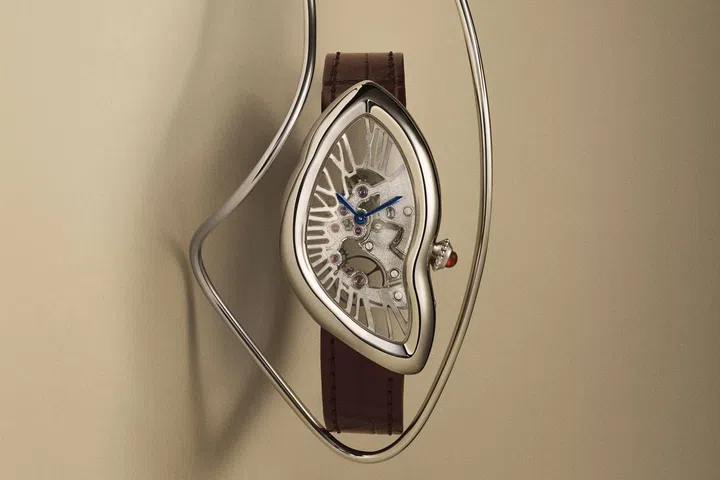
Cartier Prive Crash Skeleton
Few watches draw attention quite like the Cartier Crash, and this Skeleton version introduced for Watches and Wonders 2026 leans fully into that theatricality.
Part of the Cartier Prive programme, now in its 10th opus, this iteration celebrates one of the maison’s most recognisable shapes, reimagined through openworked architecture. The Crash Skeleton transforms the warped, almost surreal case into a structural canvas, where the bridges themselves become the visual language. Cartier’s long-standing approach to skeletonisation — where Roman numerals double as movement bridges — is once again central to the design philosophy .
Housed in platinum and accented with Cartier’s signature burgundy details, the watch balances refinement with irreverence. It’s not about legibility or even practicality; it’s presence. The Crash has always been a collector’s watch, and this version doubles down on that status.
In terms of search and cultural traction, Cartier remains one of the most visible luxury watch brands globally — and the Crash, arguably, is its most talked-about shape. This release ensures that conversation continues.
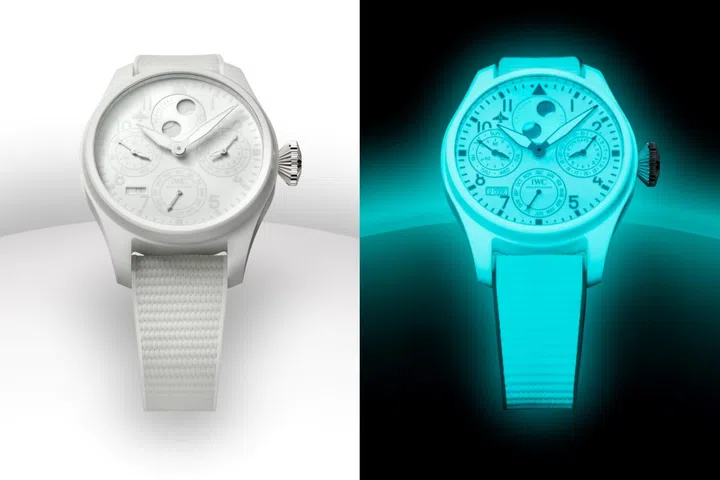
IWC Big Pilot’s Watch Perpetual Calendar Ceralume
IWC’s Big Pilot’s Watch Perpetual Calendar Ceralume is one of the most visually arresting watches of the fair — and arguably one of the most technically interesting.
The headline is Ceralume, IWC’s proprietary luminous ceramic. Unlike traditional lume applications, this material integrates Super-LumiNova pigments directly into the ceramic structure, allowing the entire case to glow. By day, it is a study in white ceramic minimalism; by night, a fully luminous object emitting a vivid blue glow for over 24 hours.
The watch measures 46.5mm and is limited to 250 pieces, housing IWC’s signature perpetual calendar developed by Kurt Klaus. It automatically accounts for leap years and displays the full calendar across subdials, including the brand’s double moon phase.
This is classic IWC — functional complexity paired with material innovation, but the Ceralume execution adds a measure of drama. It’s a Big Pilot, yes, but one that quite literally transforms depending on the light.
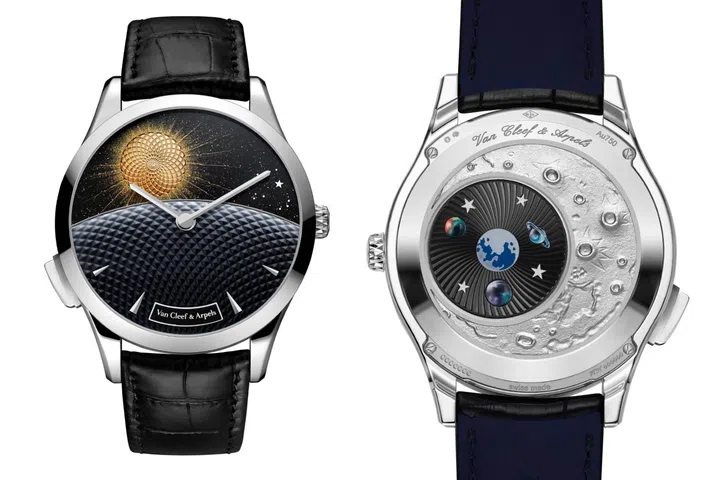
Van Cleef & Arpels Midnight Jour Nuit Phase de Lune
Van Cleef & Arpels continues to approach watchmaking as storytelling, evoking endless wonder and mystique. The Midnight Jour Nuit Phase de Lune is not just an exceptional example of that unconventionally singular philosophy, but serves as a showpiece for the maison’s theme, Poetry of the Heavens.
The 42mm white gold watch combines a day-night display with a moonphase complication, both brought to life across a dial made of sparkling black Murano aventurine glass specially conceived for this piece. The effect is mesmerising: a shifting sky over earth, where the finely guilloched sun and white mother-of-pearl moon emerge and disappear along a 24-hour cycle, while the moonphase display tracks its 29.5-day progression.
Even when the moon is hidden, a push-button activates an on-demand animation to rotate the dial 360-degrees for 10 seconds to unveil it in absolute grace — a detail that underscores the maison’s focus on emotion as much as mechanics.
The maison’s preference to keep its innovative mechanics under wraps extends to the beautiful caseback, which features a panorama of the cosmos, as viewed from the moon, depicted on a guilloched oscillating weight. Why seek out the movement under the sapphire crystal when you could gaze upon an enamel-traced earth, miniature-painted planets, and the stunning engraving of a white gold moon surface?

Vacheron Constantin Overseas Self-Winding Ultra-Thin
Ultra-thin watchmaking continues to evolve, and Vacheron Constantin’s latest Overseas Self-Winding Ultra-Thin is a strong statement that thinness today is about performance, not just aesthetics.
At its core is the new Calibre 2550, measuring just 2.4mm thick while delivering an impressive 80-hour power reserve. That combination is achieved through a clever architecture: a platinum micro-rotor integrated into the mainplate, a suspended double barrel, and a compact single-level gear train.
The watch itself measures 39.5mm and is crafted in an optimised and ultra-durable platinum alloy, maintaining the Overseas collection’s balance between sport and elegance. Despite its slim profile, at 7.35mm thick, it’s built for daily wear — a key point as ultra-thin watches move beyond formal dress watch territory.
Vacheron Constantin has long been a leader in this space, and this piece continues that lineage without overcomplicating the story. It’s highly wearable, restrained, and mechanically brilliant — everything collectors expect.
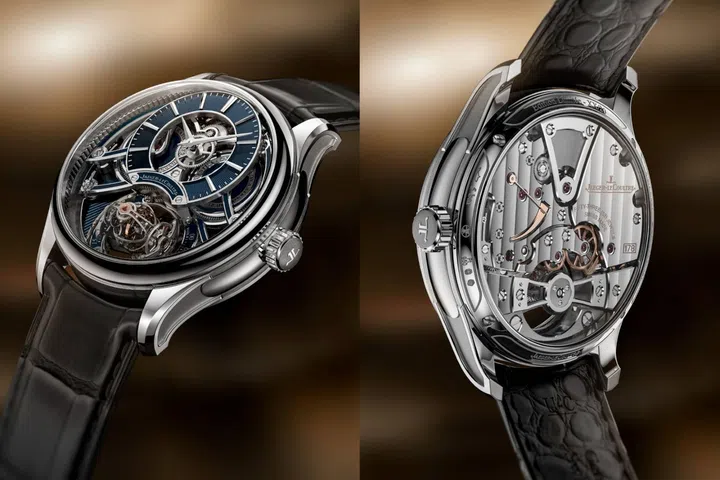
Jaeger-LeCoultre Hybris Inventiva Gyrotourbillon A Stratosphere Cal.178
If one watch defines technical ambition at Watches and Wonders 2026, it’s this. Jaeger-LeCoultre’s Hybris Inventiva Gyrotourbillon A Stratosphere Calibre 178 introduces a triple-axis tourbillon designed to cover 98 per cent of positional variance — a staggering figure that pushes the limits of mechanical precision. The entire tourbillon assembly weighs just 0.78g, which is a feat of extreme miniaturisation.
Housed in a 42mm platinum case, the movement is as much a visual object as it is a technical one. Finishes include guilloche, enamel, and lacquer — part of the maison’s Metiers Rares programme — turning the calibre into something approaching a dial in its own right.
This watch inaugurates the Hybris Inventiva line, a new series dedicated to single, groundbreaking complications. That’s an interesting move; rather than stacking complications, Jaeger-LeCoultre is isolating and perfecting them.
It won’t be widely available, nor widely worn. In terms of horological significance, it’s one of the most important watches of the year.
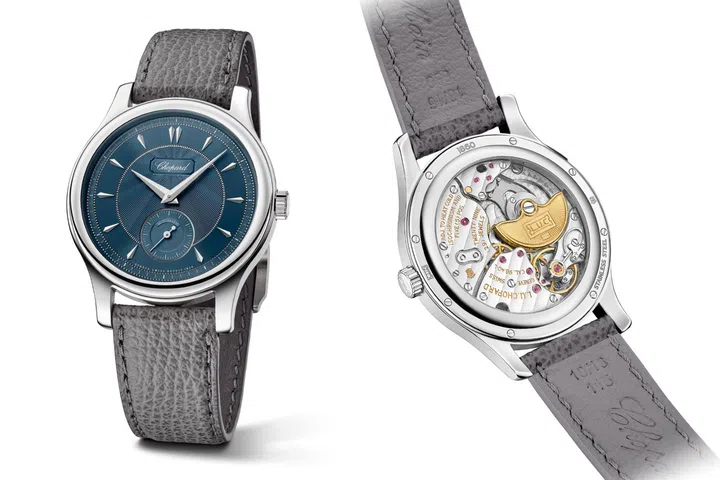
Chopard L.U.C 1860
The L.U.C 1860 returns from the late 1990s, when it marked Chopard’s first true foray into high watchmaking with its inaugural in-house movement. First introduced in 1997, it set the foundation for the L.U.C collection and signalled the brand’s intent to operate at a far more serious level, combining technical credibility with traditional finishing.
This 2026 edition stays close to that original spirit. At 36.5mm, the case looks refreshingly restrained, especially in a market that is only now circling back to more compact proportions. Executed in Lucent Steel, it carries a sophisticated yet understated presence on the wrist, allowing the details to do the work.
The dial is where much of that detail comes through. Rendered in “Areuse Blue”, it takes its inspiration from the river near Chopard’s Fleurier manufacture, with a hand-guilloche sunburst pattern that plays subtly with the light. Applied white gold markers, Dauphine hands, and a small seconds display at six o’clock keep the layout balanced and uncluttered.
Beating within is the L.U.C 96.40-L calibre, an evolution of the brand’s first manufacture movement. At just 3.3mm thick, it uses a micro-rotor and twin barrels to deliver a 65-hour power reserve, while meeting chronometer standards for precision. It’s finely finished to the level expected of the L.U.C line, reinforcing what the 1860 has always stood for — a measured, disciplined approach to fine watchmaking.

Grand Seiko Spring Drive U.F.A. Ushio 300 Diver
Grand Seiko continues to forge its own path, and this year’s showpiece is the all-new Spring Drive U.F.A. Ushio 300 Diver. The SLGB023G and SLGB025G, with a blue and green dial respectively, are powered by the brand’s most precise Spring Drive movement to date, achieving an annual accuracy of ±20 seconds, making them the most accurate mainspring-driven watches in the world.
What also stands out is how this performance is packaged. The textured dial design evokes ushio, meaning “tide” in Japanese. Subtly shimmering, the swirling surface with a gradient effect captures the movement and depth of the waters surrounding the Japanese archipelago. As always with Grand Seiko, the execution is flawless — solid construction, strong legibility, sharply finished hands and markers, and a dial that keeps one mesmerised.
Best of all, the watch is housed in a compact 40.8mm High-Intensity Titanium case, making it one of the more wearable divers in its category. A newly developed locking extension clasp with micro-adjustment adds practical usability, reinforcing its role as a true tool watch.
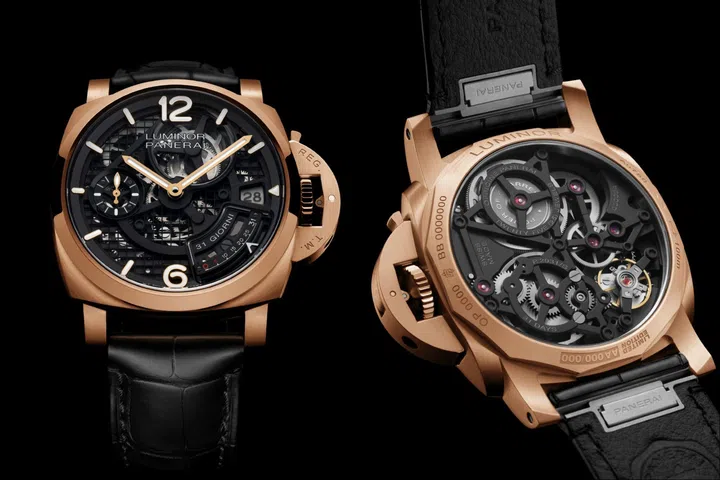
Panerai Luminor 31 Giorni PAM01631
Extended power reserve has long been part of Panerai’s identity, dating back to the oversized Angelus movements used in military instruments of the 1950s. This new watch pushes that legacy further with a remarkable month-long autonomy. Housed in a 4mm Panerai Goldtech case, the watch uses a proprietary alloy of gold, copper, platinum, and silver that gives it a warm red hue while improving durability.
Inside is the newly developed hand-wound P.2031/S calibre, a skeletonised movement comprising 276 components and powered by four barrels containing a combined 3.3m of mainsprings. Developed over seven years by Panerai’s Laboratorio di Idee, it delivers a 31-day power reserve while operating at 21,600vph. A patent-pending Torque Limiter system regulates energy delivery for more consistent chronometric performance, while the movement automatically halts after 31 days to protect the mechanism.
The openworked dial reveals the movement beneath, with a curved power reserve indicator integrated into the calibre’s perimeter and a patented polarised date display visible only through the aperture at 3 o’clock. White Super-LumiNova X2 on the hands and markers also ensures top-notch legibility.

Bvlgari Serpenti Tubogas Studs Capsule
Bvlgari’s strength has always been its ability to move seamlessly between jewellery and watchmaking, and the Serpenti Tubogas Studs Capsule is a clear expression of that dual identity.
At its core is the Serpenti — one of the maison’s most enduring icons — reimagined through a sharper, more graphic lens. The familiar Tubogas bracelet, known for its fluid, coiled construction, is punctuated here with gold studs, introducing a more architectural edge. It’s a subtle shift, but one that changes the entire character of the watch, transforming it from purely sensual to something more assertive.
The key idea is the interplay of materials. Bvlgari revisits its longstanding “Gold and Steel” aesthetic, pairing the warmth of gold with the industrial cool of steel. The contrast is deliberate and technically demanding, but visually it gives the watch a distinct presence. Variations with stone dials, from mother-of-pearl to malachite and sodalite, impart texture and colour.
Mechanically, it remains simple, driven by a quartz movement. But that’s not the point. This is a watch about form, material, and identity — and that not everything at Watches and Wonders needs to be about mechanical complexity to make an impact.

Roger Dubuis Excalibur Biretrograde Calendar
Roger Dubuis returns to one of its defining signatures with the latest Excalibur Biretrograde Calendar, now presented in a striking Cosmic Blue execution inspired by the deepening night sky. Housed in a 40mm 316L stainless steel case, the sport-chic watch continues the maison’s long-standing fascination with biretrograde displays, first patented by Roger Dubuis himself in 1989 alongside master watchmaker Jean-Marc Wiederrecht.
The dial unfolds across seven distinct layers, combining azure, sun-brushed, and circular-brushed finishes with openworked sections that reveal parts of the movement beneath. Skeletonised hands sweep across the retrograde day and date counters, while the Cosmic Blue tone appears across the flange, centre plate, and sub-dials.
Powering the watch is the automatic RD840 calibre, visible through the sapphire caseback and finished to the standards of the Poincon de Geneve. The movement delivers a 60-hour power reserve and incorporates 14 decorative techniques, including Cotes de Geneve, mirror polishing, perlage, and bevelled finishing. Completing the watch is a stainless steel bracelet, with an additional blue rubber strap included for a more casual look.
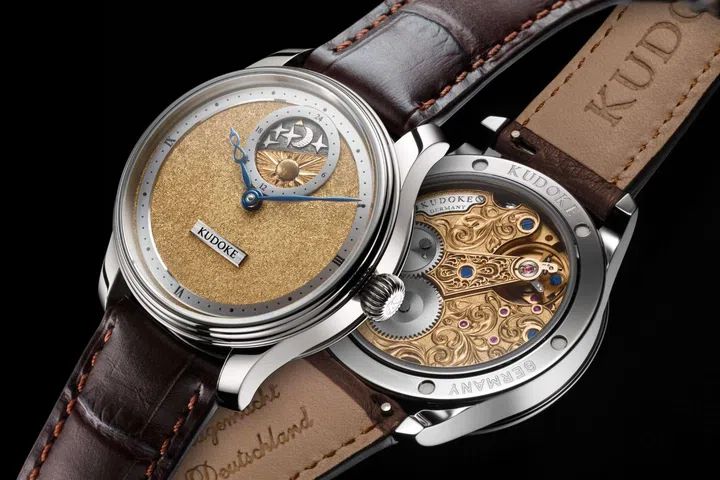
KUDOKE 2 “Tremblage” Rose Gold
Just look at the dial and caseback, and tell us that restraint watchmaking cannot be profoundly captivating? That is because the new KUDOKE 2 “Tremblage” in rose gold showcases one of the most demanding decorative techniques in horology: tremblage engraving.
For this ancient artisanal craft, a hand graver is used to create thousands of tiny cuts that produce a soft, velvety texture across the dial. The effect is subtle and soothing rather than showy, drawing attention to the watch’s signature day-and-night display featuring a sculpted sun, moon, and stars — one of the most beautiful motifs we’ve seen recently. And each dial is engraved and finished entirely in-house, meaning no two examples are exactly alike.
A sapphire caseback reveals the hand-finished Kalibre 1-24H, distinguished by richly engraved bridges and a hand-engraved balance cock bearing the brand’s infinity symbol, showcasing the rigorous craftsmanship for which founder Stefan Kudoke is known. Housed in a compact 39mm rose gold case and boasting a 46-hour power reserve, the watch embodies the independent German watchmaker’s philosophy fusing mechanical soul with sublime handcraft and uncompromising individuality.
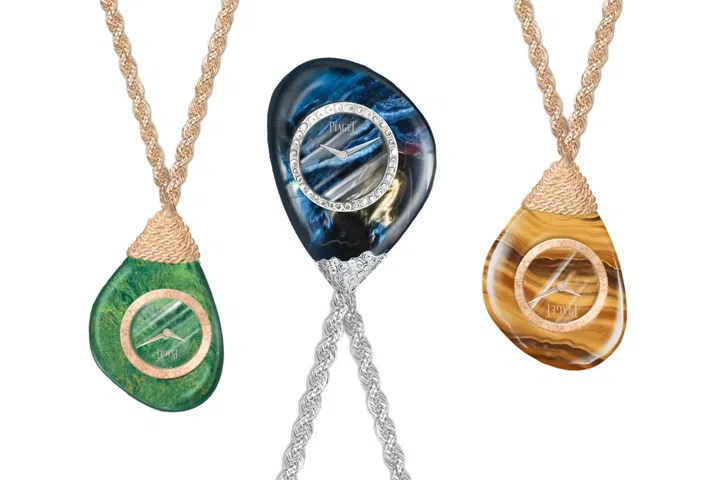
Piaget Swinging Pebbles
Few brands embrace jewellery and watchmaking as instinctively and blithely as Piaget, and the new Swinging Pebbles collection captures that spirit spot-on. Reviving the maison’s flamboyant 1970s creativity, the trio of sautoir watches transforms ornamental stones into wearable sculptures suspended from long hand-crafted gold chains.
Each pebble-shaped watch is carved from a different stone — tiger’s eye, verdite, or pietersite — with the case and dial seamlessly integrated into the material itself. Instead of a conventional timepiece, the watches take the form of a precious object discovered in nature.
The collection also reflects Piaget’s long-standing fascination with decorative stones, an experimental path the Swiss house first embraced in the 1960s when colourful stone dials helped redefine the jewellery watch. The Swinging Pebbles pieces draw inspiration from the 1972 Kimono pocket watch while embodying the playful glamour of the Piaget Society era.
Their organically asymmetrical forms and tactile surfaces encourage interaction, inviting the wearer to handle and wear them as personal talismans rather than simply read the time. In a fair dominated by technical achievements and complicated movements, the collection reminded visitors that emotional appeal and a unconventional sense of identity remain just as important in modern watchmaking.

A. Lange & Söhne Saxonia Annual Calendar
This German high horology manufacture has a reputation for making complicated watches appear deceptively simple, and the new Saxonia Annual Calendar may be one of its best examples yet.
This pink gold version paired with a grey dial was among the most elegant releases of the fair, combining day, month, big date and moon-phase indications within a remarkably clean layout. Despite the amount of information on display, the dial remains balanced and highly legible, a hallmark of the Saxonia collection.
The annual calendar automatically distinguishes between months with 30 and 31 days, requiring correction only once a year at the end of February. Lange has also engineered the display to be unusually user-friendly, with all calendar functions adjustable either individually or together via a pusher at 10 o’clock.
Beyond the mechanics, the watch impressed for its proportions. Measuring just 36mm in diameter and 9.8mm thick, it feels refreshingly elegant in an era of larger complicated watches. Power comes from the new self-winding calibre L207.1, featuring a platinum rotor and a 60-hour power reserve, while the moon-phase display remains accurate for 122.6 years before requiring correction.
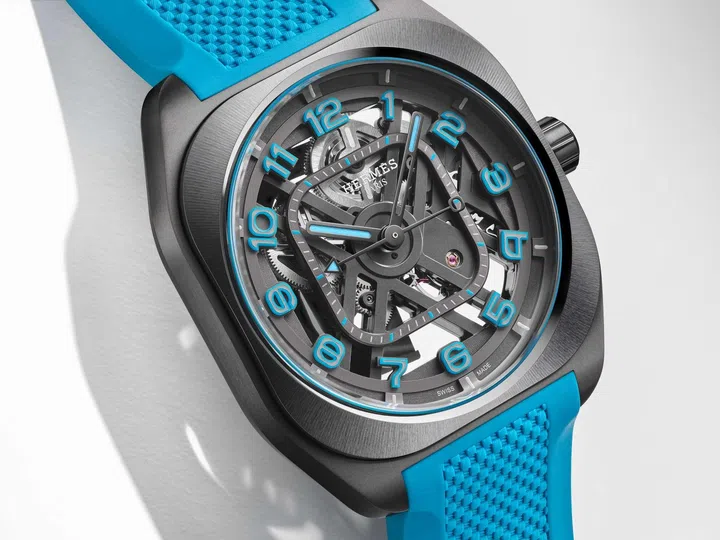
Hermès H08 Squelette
Hermès gave its sporty H08 a more technical personality this year by stripping away the dial and revealing the architecture beneath through a skeletonisation quite unlike anything we’ve seen.
The new H08 Squelette houses the manufacture H1978 S automatic calibre within a 39mm satin-brushed titanium case, allowing the movement’s bridges, gears and structural elements to become part of the watch’s visual identity. The skeletonised movement is not treated merely as an engineering showcase, but as a uniquely composed design element that balances transparency, depth, and geometry.
The standout version pairs vivid blue Super-LumiNova numerals and hands with a matching Bleu Zanzibar rubber strap, creating a striking contrast against the darkened movement and DLC-treated titanium case. Hermès describes the movement as a constantly changing landscape of light and shadow, and the watch rewards closer inspection with its layered architecture and carefully arranged bridges.
The H1978 S calibre comprises 168 components and delivers a 60-hour power reserve, while the 100m water resistance ensures it remains a genuinely practical sports watch. Technical without being intimidating and contemporary without feeling trendy, the H08 Squelette demonstrates how Hermès continues to approach watchmaking through an aesthetic lens, turning mechanics into a visual experience as much as a functional one.