
Celebrating its 30th anniversary, Chopard L.U.C claims its place among the greats of high watchmaking
From its cult 96.01-L calibre to the new L.U.C 1860 Chronometer and Grand Strike, Chopard marks three decades of exceptional movement-making, technical innovation, and craftsmanship.
By Yanni Tan /

Share this article
To appreciate a watch with a rich history, you must understand its past. Few brands make that case more compellingly than Chopard, whose latest launches at Watches & Wonders this year reach back to the maison’s very origins.
The story begins in 1860, when 24-year-old Louis-Ulysse Chopard established his first workshop in Sonvilier, in the Swiss Jura, producing precision pocket watches and chronometers.
More than a century later, his great-great-grandson Karl-Friedrich Scheufele would return Chopard to those roots with an ambitious undertaking of his own. In the early 1990s, as mechanical watchmaking was undergoing a renaissance, the heir set out to develop Chopard’s first modern in-house mechanical calibre.
The project culminated in 1996 with the opening of Chopard Manufacture in Fleurier, in the Val-de-Travers, and a new collection bearing the initials of the company’s founder: L.U.C.

An open secret
Thirty years later, L.U.C occupies a curious position in fine watchmaking. Mention Chopard to the average luxury buyer and the conversation is still more likely to turn to Happy Diamonds, Mille Miglia or, more recently, Alpine Eagle. Among knowledgeable watch collectors, however, L.U.C has long commanded considerable respect.
The reason: Chopard is one of only a handful of Swiss watchmakers able to claim comprehensive, vertically integrated production, with its Fleurier and Geneva workshops developing, producing, decorating, assembling, and testing movements and their components.
Over three decades, that expertise has extended from elegant three-hand calibres to tourbillons, perpetual calendars, integrated chronographs, and some of watchmaking’s most sophisticated striking mechanisms.
Birth of an icon
At the root of it all is the L.U.C 96.01-L. Just 3.3mm thick, the self-winding movement combined a micro-rotor with Chopard’s patented Twin technology, using two stacked barrels to provide an unusually generous power reserve within a remarkably slim architecture. It would become the foundation upon which the L.U.C family of movements was subsequently developed.
Its pedigree makes the story more interesting. The calibre’s early development involved the then-independent Michel Parmigiani, years before he founded Parmigiani Fleurier, while the fledgling L.U.C manufacture was led by Jean-Frédéric Dufour, who would later become Rolex CEO. The project reads like a who’s who of modern Swiss watchmaking.
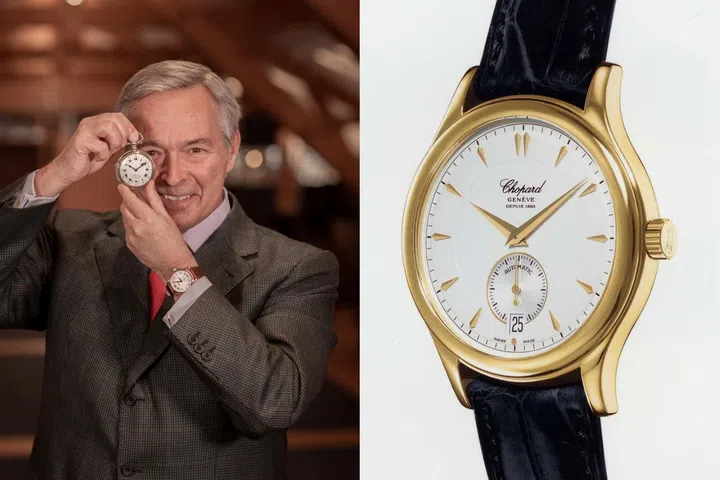
In 1997, the calibre debuted in the first L.U.C 1860, named for the year Louis-Ulysse Chopard founded the company. The 36.5mm watch paired its sophisticated mechanics with classical proportions and a hand-guilloched dial, earning the Poincon de Geneve and, almost immediately, being named “Watch of the Year” by Swiss magazine Montres Passion/Uhrenwelt.
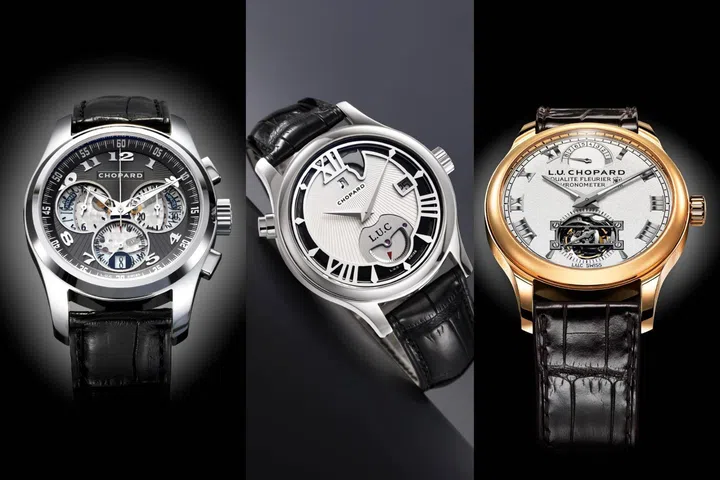
Chopard went on to create the world’s first four-barrel wristwatch in 2000; develop an integrated automatic flyback chronograph with a column wheel and vertical clutch in 2006; produce the first watch to combine COSC, Poincon de Geneve, and Qualite Fleurier certifications in 2011; and pioneer the world’s first COSC-certified watch running at 8Hz in 2012.
Its Full Strike minute repeater, with its revolutionary sapphire crystal gongs, went on to win the Aiguille d’Or at the Grand Prix d’Horlogerie de Geneve (GPHG) in 2017.
For collectors, therein lies much of L.U.C’s appeal. Its movements offer the architecture, finishing, chronometric credentials, and genuine technical innovation associated with the upper rungs of Swiss watchmaking.
Yet, L.U.C has not quite accumulated the same cultural cachet as some of haute horlogerie’s more famous names. This means the watches can offer a particularly compelling proposition for those who care as much about what lies inside the case as the name printed on the dial.
Return to form
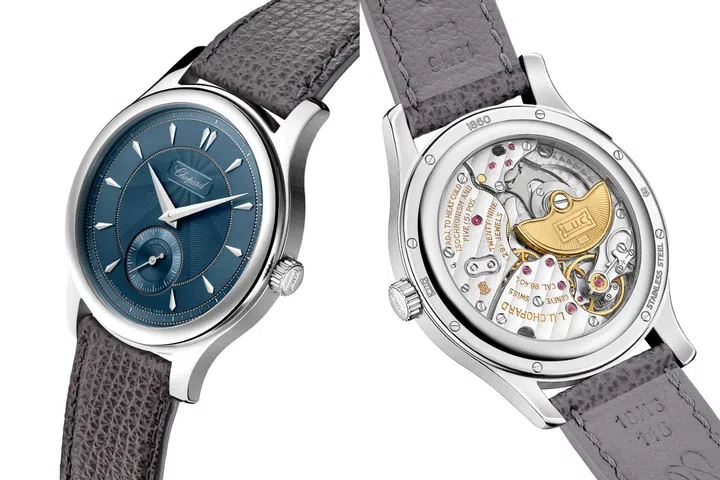
Three decades on, Chopard returns to that original piece with the L.U.C 1860 Chronometer — bearing the same 36.5mm case and a hand-guilloche sunburst dial worked by in-house artisans at the Metalem workshops using traditional lathes, some of which have been in operation for more than a century.
The most striking element is the dial colour. Chopard calls it “Areuse Blue”, inspired by the river that runs near the Fleurier manufacture through the Val-de-Travers, known for its dramatic limestone gorges and waters that shift between deep teal and vivid cobalt.
The dial is also made of 18K ethical white gold, hand-guilloched with a sunburst pattern, and structured by guilloche rings that catch the light at different angles. Polished white-gold chevron hour markers, Dauphine hands, and a small-seconds subdial at 6 o’clock complete the classical composition.
No date display, a deliberate choice that preserves the symmetry and purity on which the original was built.
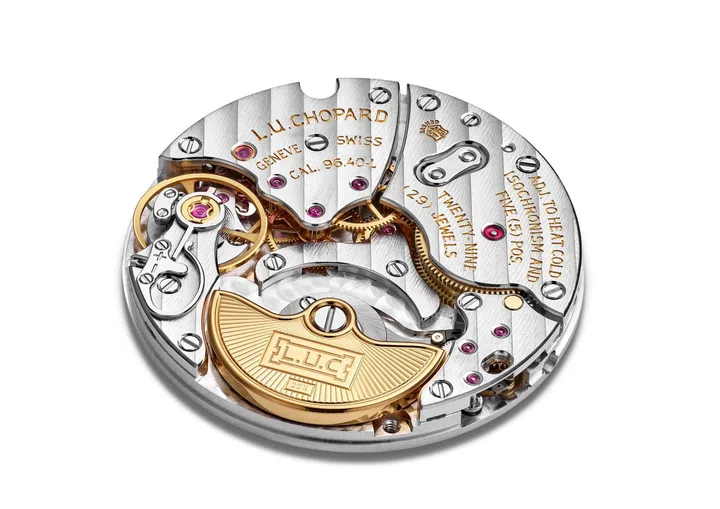
Inside beats the Calibre 96.40-L, a direct evolution of that first movement from 1996. At 3.3mm thick, it is wound via a 22-carat ethical gold micro-rotor charging two stacked barrels through Chopard’s Twin technology, offering 65 hours of power reserve and beating at 4Hz. A swan-neck regulator allows fine adjustment, while a stop-seconds function enables accurate time-setting to the second.
The watch carries both COSC certification and the Poincon de Geneve hallmark, while its 36.5mm case is crafted from Lucent Steel, Chopard’s proprietary alloy produced with a recycling rate of at least 80 per cent and polished to a brightness comparable to white gold.
Achieving both certifications in a steel watch is, as Chopard points out, genuinely uncommon.
Sounding new heights
If the new 1860 demonstrates why collectors have long admired L.U.C at its most restrained, the Grand Strike answers any lingering question about the manufacture’s technical standing.
Grande sonneries occupy one of the most rarefied corners of mechanical watchmaking, attempted by only a tiny number of houses. For Chopard to unveil one 30 years after its first proprietary calibre makes the distance travelled in Fleurier remarkable.
The L.U.C Grand Strike is the most complex watch Chopard has ever produced, and the sheer numbers reflect that. Some 11,000 hours of R&D went into the creation of 686 movement components, 10 proprietary patents (five of them newly developed for this piece), and the highly technical complications of a grande sonnerie, petite sonnerie, minute repeater, and 60-second tourbillon.
At the heart of it all is a striking system unlike any other watchmaker’s.
To understand how Chopard arrived here, it helps to go back to 2006, when the L.U.C Strike One became the manufacture’s first chiming watch. Scheufele soon began asking his research and development team about the possibility of a grande sonnerie. The question was not simply whether Chopard could build one, but whether it could build one that said something new.
The answer began to emerge a decade later with the L.U.C Full Strike minute repeater of 2016. For the first time in watchmaking history, a chiming watch struck the hours, quarters, and minutes not on polished steel gongs, but on ones made from sapphire crystal.
Rather than attaching the gongs separately to the movement as usual, the gongs and watch glass were machined from a single, seamless sapphire crystal block.
Chopard resolved the considerable engineering challenges and produced a chime of exceptional clarity and tonal purity, claiming GPHG’s 2017 Aiguille d’Or, the industry’s most prestigious best-in-show prize.
The L.U.C Grand Strike builds an entire architecture on that foundation. The sapphire monobloc system remains its acoustic centrepiece, now refined through five additional patents addressing elements ranging from hammer geometry to energy management.
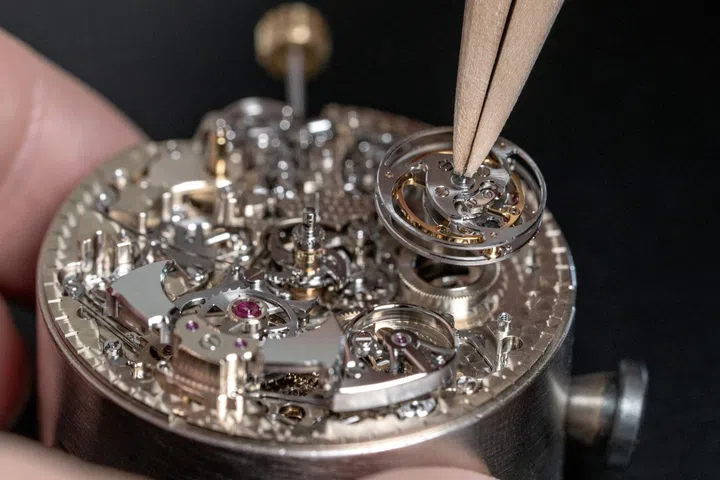
When the hammers strike, 34 components move in tandem, guided by 22 hand-adjusted blade springs, going from standby to action in 0.03 seconds. The sound is tuned to a C-sharp and F-natural chord.
Working with the Haute Ecole du Paysage, d’Ingenierie et d’Architecture in Geneva, Chopard studied the system’s acoustic properties to understand precisely why sapphire produces its distinctive sound.
The orthogonal, or square, cross-section of the sapphire gongs channels sound waves into distinct modes of vibration, while the monobloc construction eliminates the energy dissipation that can occur in conventional systems where gongs are attached to the movement. The atomic structure of monocrystalline sapphire contributes further to the resulting clarity. Chopard calls it the “Sound of Eternity”.
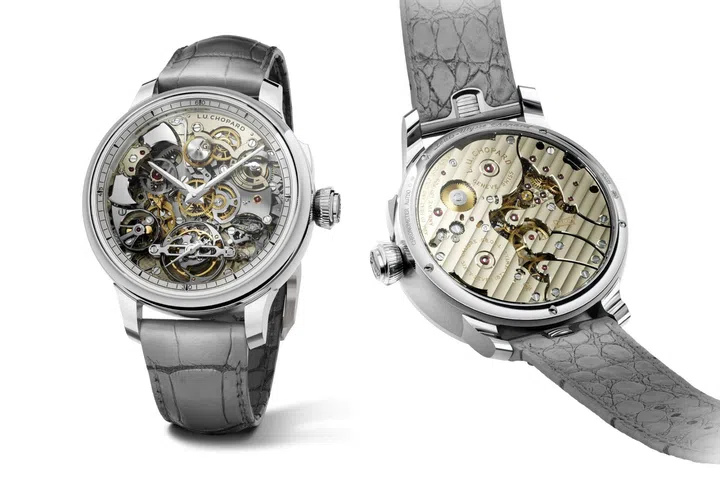
The Calibre L.U.C 08.03-L houses all components within a 43mm 18K ethical white gold case just 14.08mm thick. Two separate barrels independently power the timekeeping and chiming functions: the movement barrel provides 70 hours of reserve, while the sonnerie barrel provides at least 12 hours in grande sonnerie mode.
The movement beats at 4Hz, a notably high frequency for a grande sonnerie, where the striking mechanism’s considerable energy demands often necessitate compromises elsewhere.
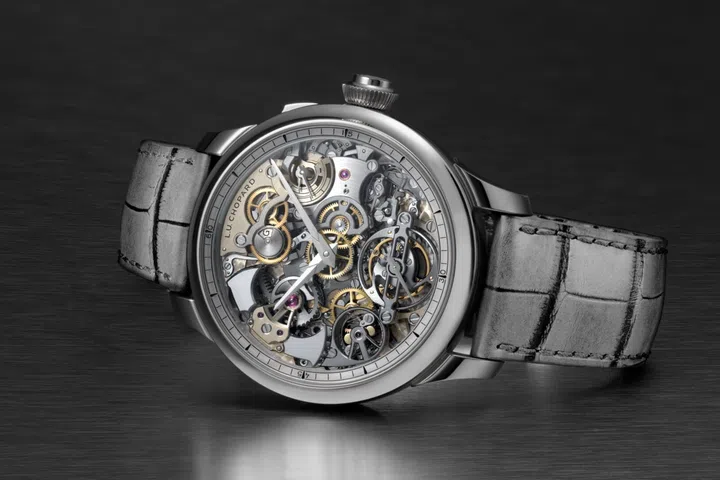
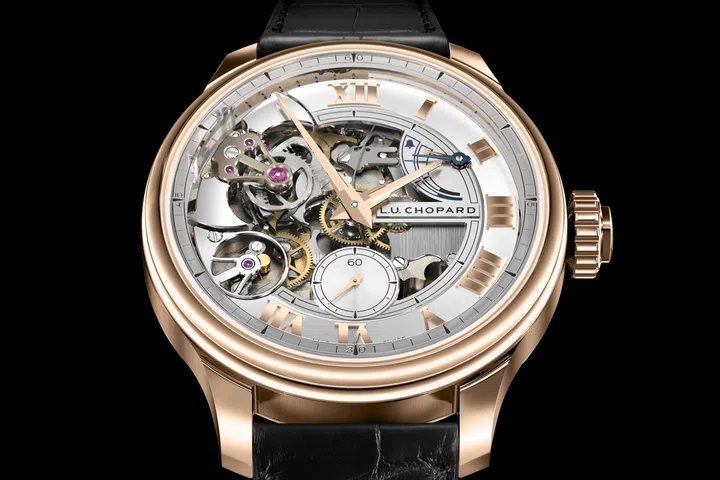
The design is open-worked by necessity and intent. With no conventional dial covering the movement, the Calibre L.U.C 08.03-L presents itself almost entirely to view: bridges in traditional maillechort, or German silver, that will develop a patina over decades of wear; solid-gold hands and hour markers; and a tourbillon case beneath a mirror-polished stainless steel bridge at 6 o’clock.
At 10 o’clock, two polished steel hammers wait in plain view, while a sliding selector switches between Grande Sonnerie, Petite Sonnerie, and Silence modes.
Before any piece leaves the manufacture, the sonnerie undergoes 62,400 activations in an accelerated process simulating five years of wear in three months, with the sapphire gongs struck more than half a million times.
Revisiting two signatures
Two further 25-piece limited editions, both carrying COSC certification and the Poincon de Geneve, round out the anniversary celebrations by drawing on established strands of L.U.C watchmaking.
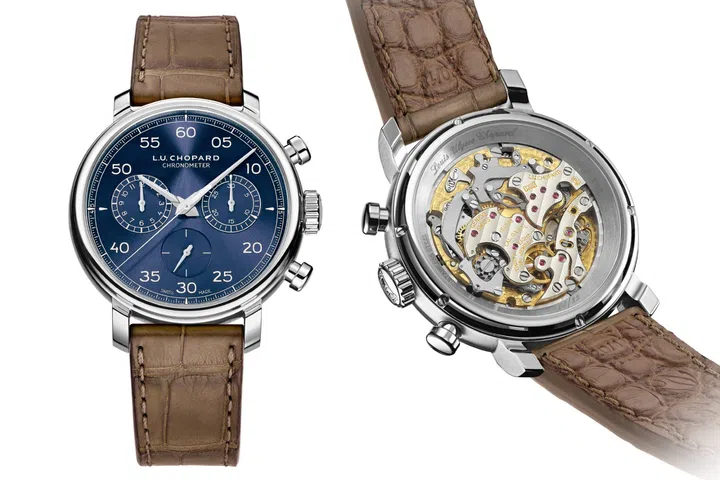
The L.U.C 1963 Heritage Chronograph returns to the integrated chronograph architecture Chopard first developed in 2006. Its 42mm Lucent Steel case frames a “Prussian Blue” dial inspired by the history of Neuchatel, where Chopard established its Fleurier manufacture.
Inside, the hand-wound Calibre L.U.C 03.07-L is a fully integrated column-wheel flyback chronograph with a vertical clutch and patented reset system. Visible through the sapphire caseback, it provides 60 hours of power reserve.
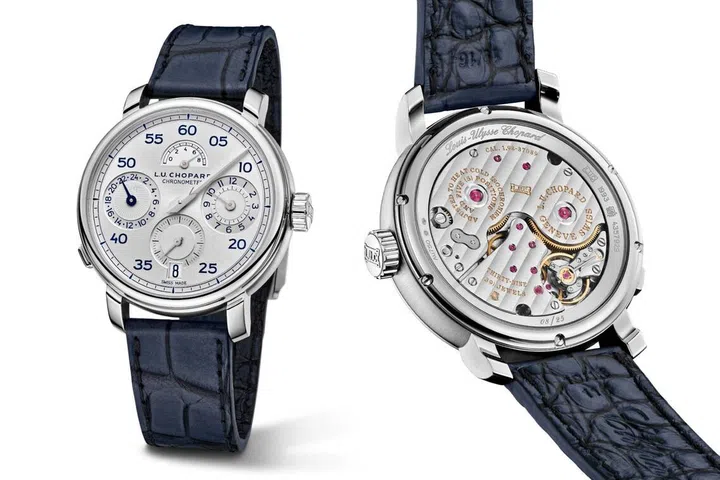
The L.U.C 1963 Heritage Regulator in 40mm ethical white gold, meanwhile, revives a format Chopard first brought to the wrist in 2006. Its regulator display separates the indications, with central minutes, hours at 3 o’clock, and small seconds at 6, supplemented by GMT, power-reserve, and date displays.
Its hand-wound Calibre L.U.C 98.02-L uses Chopard’s Quattro technology and four barrels to deliver an impressive nine-day power reserve, despite measuring just 4.9mm thick.
Together, these anniversary creations describe the full arc of 30 years in Fleurier. From the elegant simplicity of the L.U.C 1860 to integrated chronographs, long-running regulators, and the extraordinary complexity of the Grand Strike, they demonstrate just how far Chopard manufacture has come, calibre by calibre.