%22%3E%0A%3Cpath%20d%3D%22M412%20101.2H393.7C393.1%20101.2%20392.3%20100.9%20391.8%20100.5C377.3%2087.6004%20362.9%2074.6004%20348.4%2061.6004C344.8%2058.4004%20341.3%2055.2004%20337.7%2052.0004C337.1%2051.5004%20336.2%2051.1004%20335.5%2051.0004C334.2%2050.8004%20333%2051.0004%20331.5%2051.0004V101.1H316.7V0.100391H331.4V44.3004C331.9%2044.3004%20332.2%2044.4004%20332.5%2044.4004C334.9%2044.4004%20337.2%2044.5004%20339.6%2044.4004C340.4%2044.4004%20341.3%2044.0004%20341.8%2043.5004C351.6%2034.4004%20361.4%2025.2004%20371.1%2016.0004C376.5%2010.9004%20381.9%205.90039%20387.3%200.800391C387.9%200.200391%20388.5%200.000390626%20389.3%200.000390626H400.9C384.2%2015.8004%20367.8%2031.3004%20351.2%2047.0004C371.5%2065.0004%20391.8%2082.9004%20412.1%20100.9C412.1%20101%20412.1%20101.1%20412%20101.2ZM180.9%20101.2C184.1%2094.9004%20187.2%2088.9004%20190.3%2082.8004C198.3%2067.3004%20206.2%2051.8004%20214.2%2036.2004C220.3%2024.4004%20226.4%2012.5004%20232.4%200.700391C232.7%200.100391%20233%20-0.0996094%20233.7%20-0.0996094H248.1C248.8%20-0.0996094%20249.2%200.100391%20249.6%200.800391C256%2013.3004%20262.4%2025.7004%20268.8%2038.2004C279.3%2058.6004%20289.8%2079.0004%20300.3%2099.5004C300.5%20100%20300.8%20100.4%20301.1%20101.1C300.5%20101.1%20300.1%20101.2%20299.7%20101.2H286.5C285.6%20101.2%20285.1%20100.9%20284.7%20100.2C280.1%2091.3004%20275.4%2082.4004%20270.8%2073.4004C270.1%2072.1004%20269.3%2071.6004%20267.8%2071.6004H209.9C208.7%2071.6004%20208.1%2072.0004%20207.5%2073.1004C202.9%2082.1004%20198.2%2091.0004%20193.6%20100C193.1%20101%20192.6%20101.3%20191.5%20101.3C188.4%20101.2%20185.3%20101.3%20182.3%20101.3C182%20101.2%20181.6%20101.2%20180.9%20101.2ZM239.1%2011.4004C230%2029.2004%20221.1%2046.7004%20212.1%2064.3004H266.4C257.2%2046.7004%20248.2%2029.2004%20239.1%2011.4004ZM0%200.000390626H43.4C51.2%200.000390626%2058.7%201.20039%2065.7%204.80039C75.9%2010.0004%2078.9%2018.0004%2078.6%2027.4004C78.3%2034.3004%2076%2040.5004%2071.2%2045.5004C67.3%2049.6004%2062.4%2052.3004%2057.1%2054.3004C50.6%2056.7004%2043.9%2058.0004%2037.1%2058.6004C30.1%2059.2004%2023.1%2059.4004%2016.2%2059.7004C15.8%2059.7004%2015.3%2059.8004%2014.8%2059.8004V101.1H0.1C0%2067.4004%200%2033.8004%200%200.000390626ZM14.8%207.10039V52.2004C23.7%2052.4004%2032.6%2052.3004%2041.2%2050.1004C44.4%2049.3004%2047.6%2048.2004%2050.6%2046.7004C58.4%2043.0004%2062.3%2036.7004%2062.7%2028.0004C63%2019.9004%2059.5%2014.1004%2052.4%2010.5004C47.6%208.00039%2042.5%207.10039%2037.2%207.10039H14.8ZM95.9%20101.1V0.100391H167.3V7.20039H110.7V44.7004H158.1V51.9004H110.8V93.9004H171.1V101C146.1%20101.1%20121%20101.1%2095.9%20101.1Z%22%20fill%3D%22black%22%2F%3E%0A%3Cpath%20d%3D%22M35.0004%2025.7996H42.5004V20.6996H44.8004V33.1996H42.6004V27.5996H34.9004V33.2996H32.7004V20.7996H35.0004V25.7996ZM54.4004%2025.8996V27.2996H48.9004V31.6996H55.9004C55.9004%2032.1996%2056.0004%2032.5996%2056.0004%2033.0996H46.5004V20.5996H55.5004V21.8996H49.0004V25.7996C50.7004%2025.8996%2052.5004%2025.8996%2054.4004%2025.8996ZM25.9004%2033.0996H23.5004V21.9996H17.9004V20.6996H31.6004V22.0996H27.1004C26.2004%2022.0996%2025.9004%2022.2996%2025.9004%2023.1996C26.0004%2026.0996%2025.9004%2028.9996%2025.9004%2031.7996V33.0996Z%22%20fill%3D%22black%22%2F%3E%0A%3C%2Fg%3E%0A%3Cdefs%3E%0A%3CclipPath%20id%3D%22clip0_388_462%22%3E%0A%3Crect%20width%3D%22411%22%20height%3D%22101.2%22%20fill%3D%22white%22%2F%3E%0A%3C%2FclipPath%3E%0A%3C%2Fdefs%3E%0A%3C%2Fsvg%3E%0A)
The magic of Van Cleef & Arpels watchmaking lies in an existential mathematics equation
Here’s how it comes to life in the maison’s latest creations.
By Yanni Tan /
Share this article
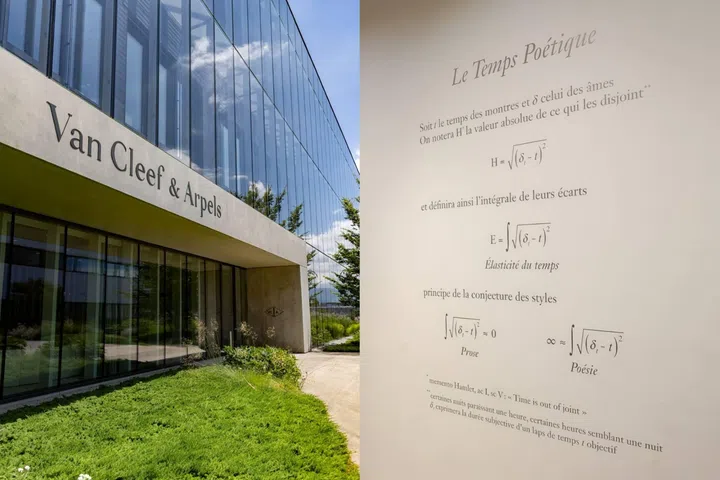
Displayed on a feature wall inside Les Ateliers Horlogers de Van Cleef & Arpels in Meyrin, Geneva, appears to be a page taken from a mathematics textbook. It is, in fact, an excerpt from French artist and researcher Laurent Derobert’s Algebre Existentielle (2019), part of his ongoing exploration of “existential mathematics”.
Titled Le Temps Poétique (”Poetic Time” in French), it defines two variables: t, the time measured by watches, and δ, the time experienced by the soul. The equations that follow calculate the difference between the two before culminating in a final proposition labelled “Prose” and “Poesie” (poetry).
His conclusion is a striking one: The greater the distance between objective time and emotional time, the more poetic the experience becomes. That is an unlikely manifesto for a watchmaker in a world that celebrates precision, accuracy, and chronometric performance.
Van Cleef & Arpels, however, begins instead with the notion that time is elastic. An hour spent waiting can feel like an eternity, while an afternoon with someone you love disappears in an instant. Horology, from the maison’s perspective, is about transforming how time is experienced.
Since introducing its first Poetic Complications in 2006, the maison has pursued a form of watchmaking in which technical ingenuity and emotional storytelling are inseparable — and won the highest industry accolades for it.
Its latest collection, presented under the theme Poetry of the Heavens during Watches and Wonders Geneva 2026, continues that vision through celestial complications, extraordinary metiers d’art, and jewellery watches inspired by the moon, stars, and legendary lovers.
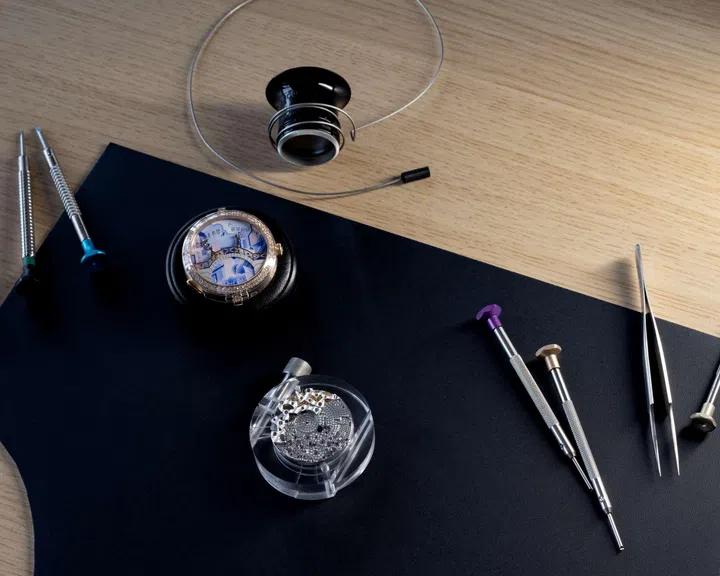
Yet behind the dreamlike imagery lies years of research into both mechanics and artistic craftsmanship, proving that for Van Cleef & Arpels, innovation can be measured not only in new movements and complications, but also in the materials and techniques.
For Rainer Bernard, the house’s director of watchmaking research and development, every project begins not with an engineering problem, but with an idea.
“We have love stories; we have ancient dances; we talk about nature; and we’re very curious. I think curiosity is the base for creativity,” he says. “We have rather the opposite problem from others. We have many, many possibilities, and we have to choose which one we want to bring to life.”

Chasing the moon
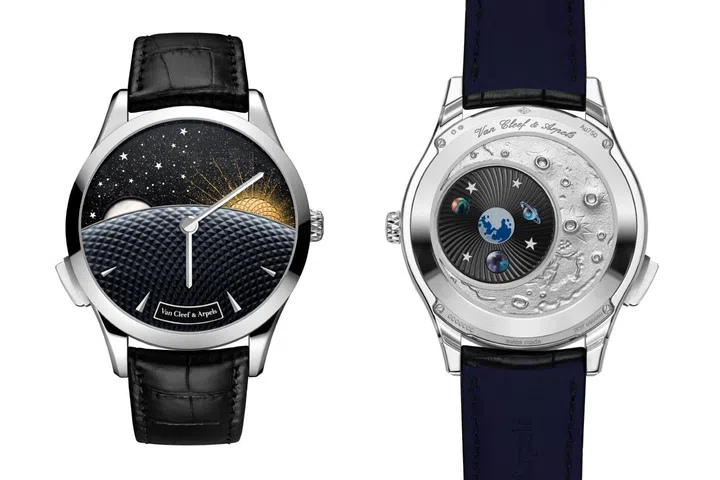
The showpiece of this year’s collection is the Midnight Jour Nuit Phase de Lune, a watch that expands the maison’s long-running Jour Nuit family with an entirely new astronomical complication.
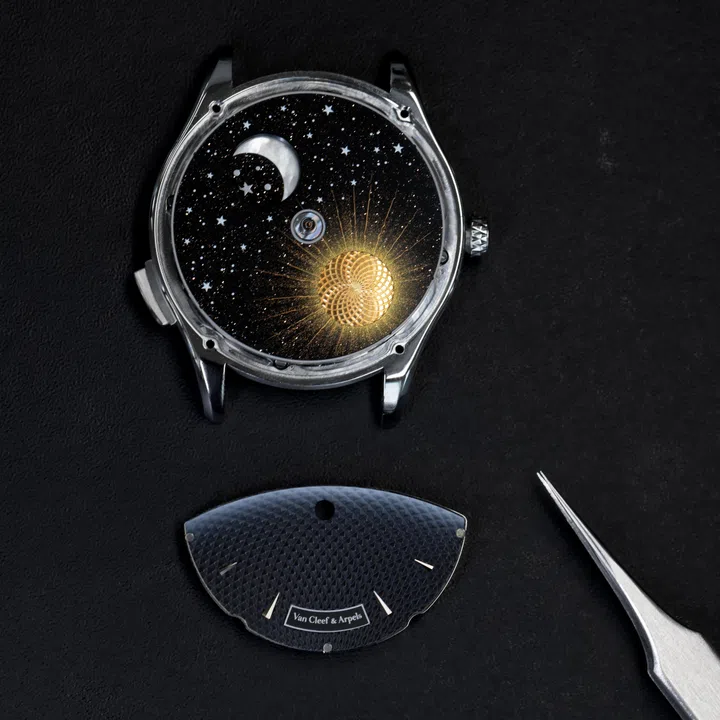
At first glance, it appears familiar. The 42mm white gold watch continues the poetic day-and-night display for which the collection is known, with a guilloche yellow gold sun and a mother-of-pearl moon gradually appearing and disappearing behind a softly curved earth horizon as the hours pass.
Look closer, however, and a second layer of complexity emerges. The watch combines the traditional Jour Nuit display with a moonphase indication capable of reproducing the moon’s changing appearance across its 29.5-day lunar cycle.
Rather than presenting this information through a conventional aperture, Van Cleef & Arpels has integrated it seamlessly into the celestial landscape of the dial. The project perfectly illustrates how the maison develops its watches.
“Our boss is the story,” Bernard explains. “The creative studio, craftsmanship, and engineering travel together. We have an idea of a destination, but we don’t know exactly how to go there. Everybody is an expert in his field, but we are highly dependent on each other.”
Creating the effect required four years of development by the maison’s Geneva watchmaking workshops. Two rotating discs work together to animate the display. One completes a 24-hour cycle, carrying the sun and moon across the sky, while the second rotates more slowly, subtly transforming the moon day after day to mirror its actual phase.
The most intriguing feature is an on-demand animation activated by a discreet button on the case. Even when the moon is hidden behind the horizon, the wearer can summon it into view. With a single push, the dial performs a complete rotation over approximately 10 seconds, revealing the current lunar phase before returning to its original position.
“The key challenge for this creation lay in developing the on-demand animation,” Bernard adds. “To avoid any inaccuracy in the moon phase, we had to take account of the changes that must occur during the course of the animation, since the discs are performing an additional full rotation.”
The engineering team also had to minimise the weight of the rotating components to ensure smooth operation while reducing friction.
Visually, the watch is equally compelling. The sky is rendered in black Murano aventurine glass co-developed by the famed Italian glassmaking town with the maison’s Innovation Department to achieve exceptional depth and sparkle, while the horizon is crafted from guilloche mother-of-pearl shaded from black to white.
Even the caseback continues the celestial narrative, depicting the cosmos from the moon’s perspective.
Innovation beyond the movement
If the Midnight Jour Nuit Phase de Lune showcases Van Cleef & Arpels’ mechanical ingenuity, the Midnight Heure d’ici & Heure d’ailleurs (“Midnight time here and time elsewhere”) demonstrates that the maison applies the same level of research to artistic craftsmanship.
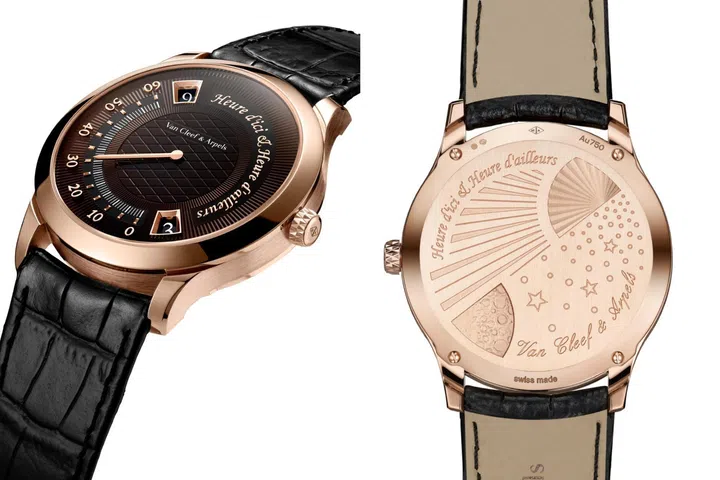
The 38mm rose gold watch offers an unconventional interpretation of dual-time functionality. Two jumping-hour windows indicate local and home time, while a retrograde minute hand sweeps gracefully across the lower half of the dial.
As the minute hand reaches 60, it instantly returns to zero while both hour displays advance simultaneously. The entirely redeveloped movement delivers a 65-hour power reserve, yet it is the dial that reveals the maison’s experimental spirit.

Seeking a colour that captured the optical qualities of a precious gemstone rather than conventional enamel, Van Cleef & Arpels’ specialists spent months experimenting with formulations inspired by the way rubies interact with light.
The final amber-brown enamel changes character according to its light and surroundings, with its depth enhanced by a mirror-polished gold base beneath. Yet the challenge did not end there. The house also wanted to emboss its signature pique motif directly into the enamel surface alongside a radiating guilloche pattern.
To achieve the necessary relief, artisans adapted techniques traditionally associated with glassmaking. The enamel underwent more than 30 hours of low-temperature work before multiple firings above 1,000 deg C, after which the surface was carefully shaped by hand.

For Bernard, such research is never pursued simply for the sake of innovation. “We never approach innovation first and then think, ‘What can we do with that?’” he says. “Innovation is driven by the story.”
He recalls an earlier Lady Arpels project that required the development of sculptable enamel and a technique for setting diamonds directly into enamel to recreate morning dew resting on leaves. “We see there are parts we can’t do, but it would be awesome to do, so let’s try it. And it took us two years.”
It is a philosophy that extends directly into this year’s Extraordinary Dials, where Van Cleef & Arpels introduces a patented “setting in enamel” technique developed over two years.
By securing gemstones directly into plique-a-jour enamel without visible metal supports, the maison achieves an extraordinary sense of transparency and weightlessness, allowing light to pass through the composition like stained glass.
Time as jewellery
Alongside its poetic complications, Van Cleef & Arpels continues to demonstrate why it remains one of the industry’s foremost creators of jewellery watches.
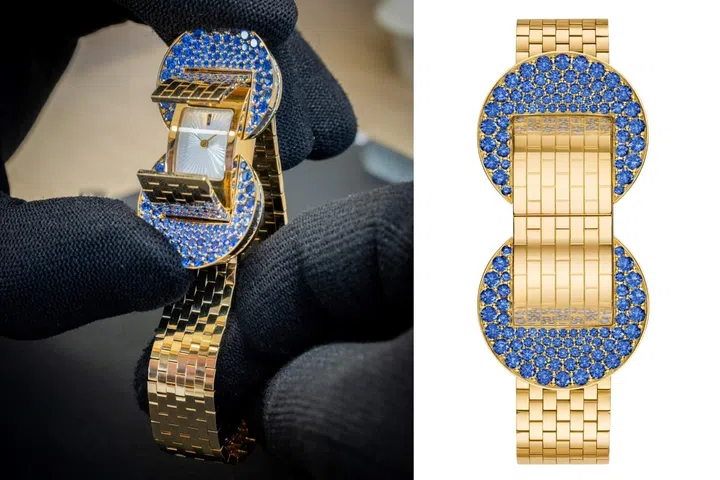
The new Ludo Secret watch revisits one of the maison’s most recognisable creations. Inspired by the Ludo bracelet introduced in 1934 and a historic watch from 1949, it takes the form of a supple yellow gold bracelet whose buckle conceals a hidden white mother-of-pearl dial with a baguette-cut sapphire at 12 o’clock.
Rows of vivid blue sapphires envelop the clasp, creating a seamless ribbon of colour that belies the painstaking gem selection required to match each stone for hue, clarity, and cut. A gentle press on both sides of the buckle reveals the watch beneath.

The Perlee watch offers a more contemporary expression of jewellery watchmaking. Framed by the collection’s signature golden beads, the 23mm white gold case surrounds a midnight-blue aventurine glass dial animated by a radiating guilloche motif.
Diamonds line both the bezel and inner flange, while an invisible button on the caseback allows the time to be adjusted and preserves the purity of the design.
Both reaffirm Van Cleef & Arpels’ longstanding belief that jewellery and watchmaking should complement, rather than compete with, one another.
Love written in the cosmos
The collection concludes with two of the most enchanting creations unveiled this year: Lady Rencontre Celeste and Lady Retrouvailles Celestes.
Part of the Extraordinary Dials collection, the watches draw inspiration from the historical Chinese romantic legend of Niulang, a mortal cowherd, and Zhinu, a heavenly weaver girl, represented by the stars Altair and Vega in traditional Chinese astronomy. Separated by the Milky Way, the star-crossed lovers are permitted to reunite only once each year.
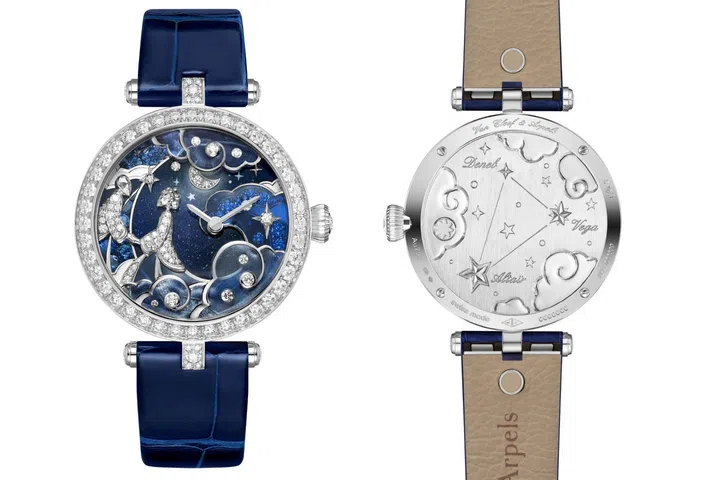
Lady Rencontre Celeste (“Celestial Encounter”) depicts the couple standing hand-in-hand beneath a moonlit sky. Their white gold silhouettes emerge from clouds fashioned in plique-a-jour enamel, while rose-cut diamonds form their faces and champleve and grisaille enamel create remarkable depth across the celestial backdrop.

Capturing the climax in the folktale, Lady Retrouvailles Celestes (“Celestial Union”) depicts the duo reaching towards one another across a bridge formed by sculpted white gold birds (a flock of magpies were the original enablers). Pink sapphires, translucent enamel, and diamond-set clouds heighten the sense of anticipation and longing.
Each dial brings together multiple artistic disciplines, from miniature painting and champleve enamel to grisaille and plique-a-jour enamel. Despite the technical sophistication involved, the engineering remains almost entirely invisible.
The astronomical narrative continues on the reverse, where the Summer Triangle — the asterism formed by Altair, Vega and Deneb — is engraved onto the caseback, a discreet reminder of the lovers’ position among the stars.
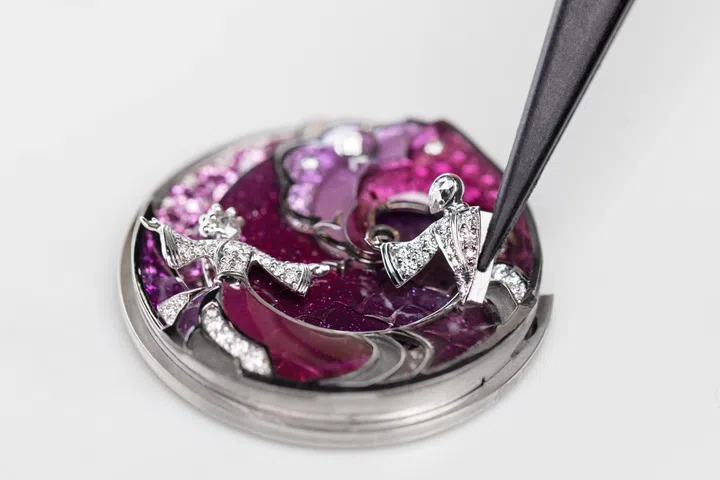
“Technique is always hidden in the background,” Bernard states. “To hide the technique is way more complicated than to show it.”
After discovering the new collection, the equation on the atelier wall begins to make perfect sense. Whether through an astronomical movement that took four years, a newly invented enamelling technique, or lovers reunited beneath the stars, the maison strives to narrow the distance between the time measured by a watch and the time experienced by the heart.
It is a philosophy expressed not only by the equation, but by every watch unveiled this year. As Bernard puts it: “If you have lovers kissing and you don’t even see how they move, this is what we love.”