%22%3E%0A%3Cpath%20d%3D%22M412%20101.2H393.7C393.1%20101.2%20392.3%20100.9%20391.8%20100.5C377.3%2087.6004%20362.9%2074.6004%20348.4%2061.6004C344.8%2058.4004%20341.3%2055.2004%20337.7%2052.0004C337.1%2051.5004%20336.2%2051.1004%20335.5%2051.0004C334.2%2050.8004%20333%2051.0004%20331.5%2051.0004V101.1H316.7V0.100391H331.4V44.3004C331.9%2044.3004%20332.2%2044.4004%20332.5%2044.4004C334.9%2044.4004%20337.2%2044.5004%20339.6%2044.4004C340.4%2044.4004%20341.3%2044.0004%20341.8%2043.5004C351.6%2034.4004%20361.4%2025.2004%20371.1%2016.0004C376.5%2010.9004%20381.9%205.90039%20387.3%200.800391C387.9%200.200391%20388.5%200.000390626%20389.3%200.000390626H400.9C384.2%2015.8004%20367.8%2031.3004%20351.2%2047.0004C371.5%2065.0004%20391.8%2082.9004%20412.1%20100.9C412.1%20101%20412.1%20101.1%20412%20101.2ZM180.9%20101.2C184.1%2094.9004%20187.2%2088.9004%20190.3%2082.8004C198.3%2067.3004%20206.2%2051.8004%20214.2%2036.2004C220.3%2024.4004%20226.4%2012.5004%20232.4%200.700391C232.7%200.100391%20233%20-0.0996094%20233.7%20-0.0996094H248.1C248.8%20-0.0996094%20249.2%200.100391%20249.6%200.800391C256%2013.3004%20262.4%2025.7004%20268.8%2038.2004C279.3%2058.6004%20289.8%2079.0004%20300.3%2099.5004C300.5%20100%20300.8%20100.4%20301.1%20101.1C300.5%20101.1%20300.1%20101.2%20299.7%20101.2H286.5C285.6%20101.2%20285.1%20100.9%20284.7%20100.2C280.1%2091.3004%20275.4%2082.4004%20270.8%2073.4004C270.1%2072.1004%20269.3%2071.6004%20267.8%2071.6004H209.9C208.7%2071.6004%20208.1%2072.0004%20207.5%2073.1004C202.9%2082.1004%20198.2%2091.0004%20193.6%20100C193.1%20101%20192.6%20101.3%20191.5%20101.3C188.4%20101.2%20185.3%20101.3%20182.3%20101.3C182%20101.2%20181.6%20101.2%20180.9%20101.2ZM239.1%2011.4004C230%2029.2004%20221.1%2046.7004%20212.1%2064.3004H266.4C257.2%2046.7004%20248.2%2029.2004%20239.1%2011.4004ZM0%200.000390626H43.4C51.2%200.000390626%2058.7%201.20039%2065.7%204.80039C75.9%2010.0004%2078.9%2018.0004%2078.6%2027.4004C78.3%2034.3004%2076%2040.5004%2071.2%2045.5004C67.3%2049.6004%2062.4%2052.3004%2057.1%2054.3004C50.6%2056.7004%2043.9%2058.0004%2037.1%2058.6004C30.1%2059.2004%2023.1%2059.4004%2016.2%2059.7004C15.8%2059.7004%2015.3%2059.8004%2014.8%2059.8004V101.1H0.1C0%2067.4004%200%2033.8004%200%200.000390626ZM14.8%207.10039V52.2004C23.7%2052.4004%2032.6%2052.3004%2041.2%2050.1004C44.4%2049.3004%2047.6%2048.2004%2050.6%2046.7004C58.4%2043.0004%2062.3%2036.7004%2062.7%2028.0004C63%2019.9004%2059.5%2014.1004%2052.4%2010.5004C47.6%208.00039%2042.5%207.10039%2037.2%207.10039H14.8ZM95.9%20101.1V0.100391H167.3V7.20039H110.7V44.7004H158.1V51.9004H110.8V93.9004H171.1V101C146.1%20101.1%20121%20101.1%2095.9%20101.1Z%22%20fill%3D%22black%22%2F%3E%0A%3Cpath%20d%3D%22M35.0004%2025.7996H42.5004V20.6996H44.8004V33.1996H42.6004V27.5996H34.9004V33.2996H32.7004V20.7996H35.0004V25.7996ZM54.4004%2025.8996V27.2996H48.9004V31.6996H55.9004C55.9004%2032.1996%2056.0004%2032.5996%2056.0004%2033.0996H46.5004V20.5996H55.5004V21.8996H49.0004V25.7996C50.7004%2025.8996%2052.5004%2025.8996%2054.4004%2025.8996ZM25.9004%2033.0996H23.5004V21.9996H17.9004V20.6996H31.6004V22.0996H27.1004C26.2004%2022.0996%2025.9004%2022.2996%2025.9004%2023.1996C26.0004%2026.0996%2025.9004%2028.9996%2025.9004%2031.7996V33.0996Z%22%20fill%3D%22black%22%2F%3E%0A%3C%2Fg%3E%0A%3Cdefs%3E%0A%3CclipPath%20id%3D%22clip0_388_462%22%3E%0A%3Crect%20width%3D%22411%22%20height%3D%22101.2%22%20fill%3D%22white%22%2F%3E%0A%3C%2FclipPath%3E%0A%3C%2Fdefs%3E%0A%3C%2Fsvg%3E%0A)
How Japan’s tides inspired the new Grand Seiko Spring Drive U.F.A. Ushio 300 Diver
We travelled from Tokyo to the volcanic shores of the Izu Peninsula to discover how unseen forces of nature, Japanese philosophy, and groundbreaking engineering gave rise to Grand Seiko’s most compelling dive watch yet.
By Yanni Tan /
Share this article
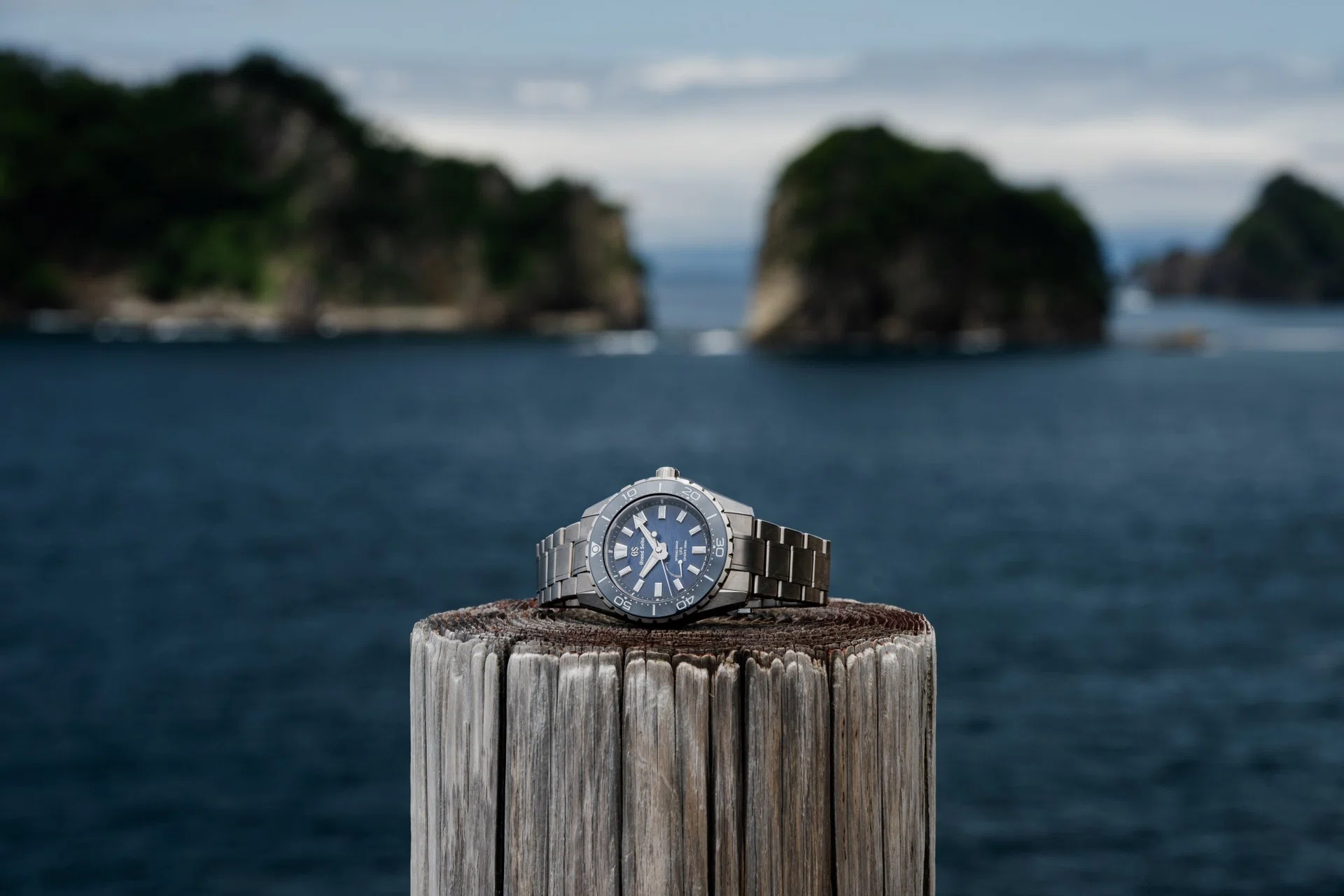
The verdict on Watches and Wonders Geneva 2026 is out: Among the year’s standout launches, the Grand Seiko Evolution 9 Collection Spring Drive U.F.A. Ushio 300 Diver has emerged not only as one of the finest timepieces unveiled, but arguably the dive watch to beat.
Not content to just make a splash at the fair, the Asia-Pacific regional headquarters of the luxury Japanese house decided to invite a select group of Southeast Asian media for an exclusive, first-of-its-kind immersion into its homeland and heartbeat.
The objective of the Ushio Journey was not simply to explain what the watch was, but why it exists at all. Over four days, we travelled from Tokyo to the Izu Peninsula, tracing the philosophy, landscapes, and craftsmanship that ultimately found expression in the new 40.8mm titanium diving watch.

The itinerary began with the origins of its parent brand, Seiko, in Tokyo, before moving towards the waters that inspired the Ushio dial. Only after experiencing Japan through the brand’s own eyes, and understanding what Grand Seiko calls “The Nature of Time”, did the new Ushio Diver truly begin to reveal itself.
Where it all began
The first stop was fittingly The Seiko Museum Ginza, just a short walk from where founder Kintaro Hattori established his watch business in 1881. Guiding us was the curator, Takeki Nakaha, a veteran Seiko employee of over three decades whose enthusiasm for the company’s history proved infectious.
For him, the museum exists for a reason beyond preserving old watches. “We try to appeal not only with the products,” he said during an introductory presentation before leading an insightful tour through the institution, including a dedicated Grand Seiko Museum on the sixth floor. “We also try to explain the way of thinking of Grand Seiko, and the story behind the manufacturing.”
That single sentence would become the theme of the entire journey. The museum traces Grand Seiko’s evolution from the inaugural reference of 1960 through the defining 44GS of 1967 and eventually to the Evolution 9 Collection introduced in 2020.
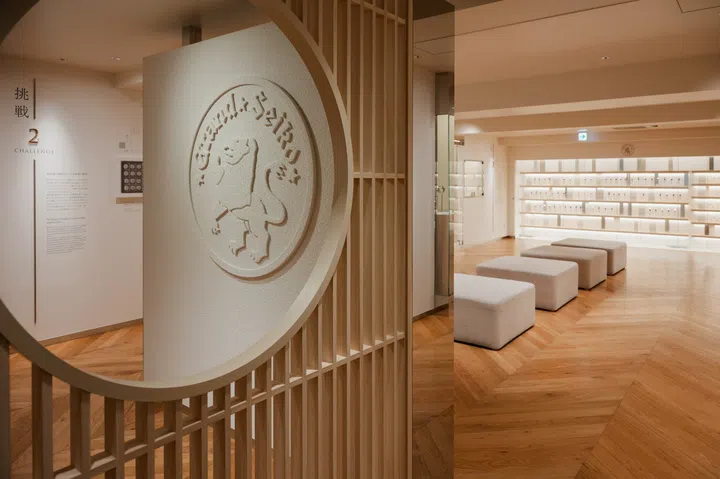
More importantly, it illustrates the remarkable consistency of the brand’s philosophy. Every technical milestone, from high-beat mechanical movements to quartz and Spring Drive, has been driven by one enduring ambition: pursuing ever greater precision without losing sight of beauty.
And the new Ushio Diver is one of the latest expressions of that philosophy. Powered by the new Spring Drive Calibre 9RB1, which is the world’s most accurate mainspring-powered wristwatch movement, it achieves an astonishing annual accuracy of ±20 seconds.
Yet Grand Seiko doesn’t dwell on breaking records, not even during the welcome dinner with its global division’s director and senior vice president Tatsuya Asami. Instead, the conversation continually returns to balance: function and aesthetics, performance and wearability, engineering and emotion. That approach became clearer as we left Tokyo behind.

From metropolis to ocean
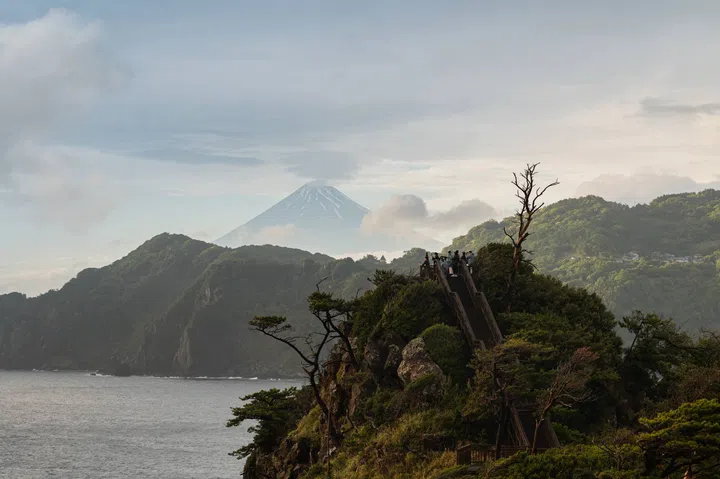
The 2.5h journey southwest aboard the Saphir Odoriko luxury train, named after the blue gemstone for its deep-sea hue, felt deliberately symbolic. Tokyo’s bustling cityscape quickly softened into verdant forests, coastal towns, and an endless Pacific shore with Mount Fuji making a fleeting appearance.
The further we travelled, the more it felt as though Grand Seiko was stripping away distractions until only nature remained.
The destination was the Izu Peninsula, where two great ocean currents meet. Here, the warm Kuroshio Current converges with the colder Oyashio Current, creating some of Japan’s richest fishing waters.
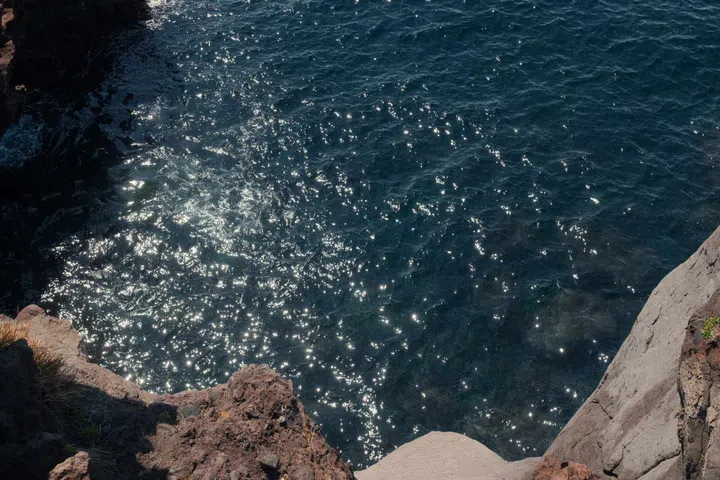
This wider region is also where three tectonic plates collide, creating its rugged volcanic landscape and giving rise to Fujisan immediately to the north. Unesco now recognises the peninsula as a Global Geopark, but no plaque can prepare visitors for the mesmerising sight of foamy waves crashing against jagged black rock.
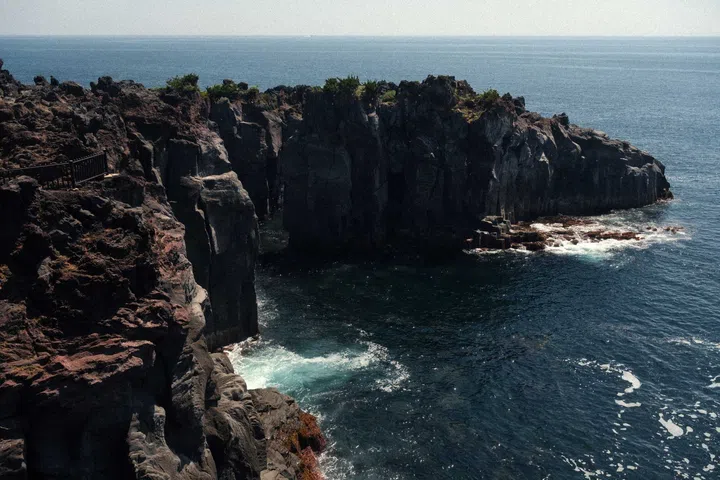
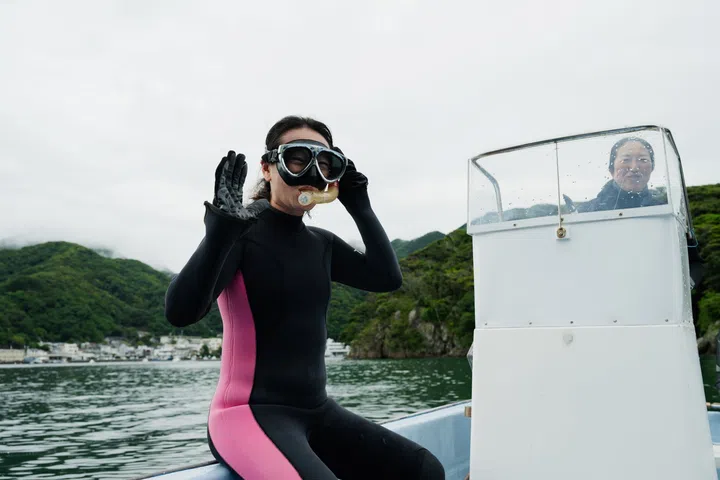
Hiking the dramatic cliffs of Jogasaki Coast, gazing across Suruga Bay towards Mount Fuji from Ao Terrace at the Izu Panorama Park, before slipping beneath the waters off Tago Bay in Dogashima for a snorkelling session, those forces of nature became something tangible.
The tides shape not only the marine life, but the rhythm of daily life. Only then did the name Ushio begin to make sense.
Translated simply, it means “tide”. However, in Japanese culture, tides represent more than moving water. They are invisible forces that shape coastlines, sustain ecosystems, and herald the passage of time. Grand Seiko’s latest diver seeks to evoke precisely that.
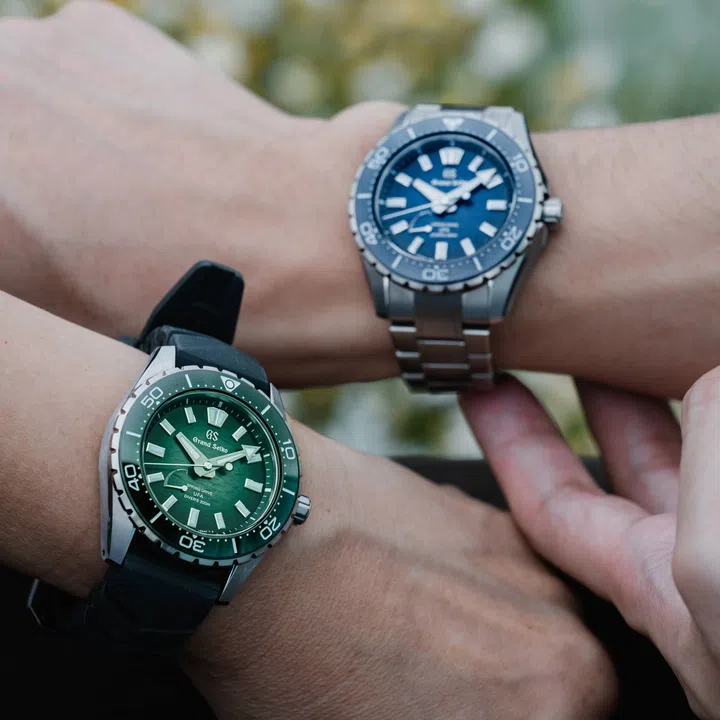
Unlike many sports watches that borrow generic maritime motifs, the Ushio dial is rooted in the specific imagery of this locality.
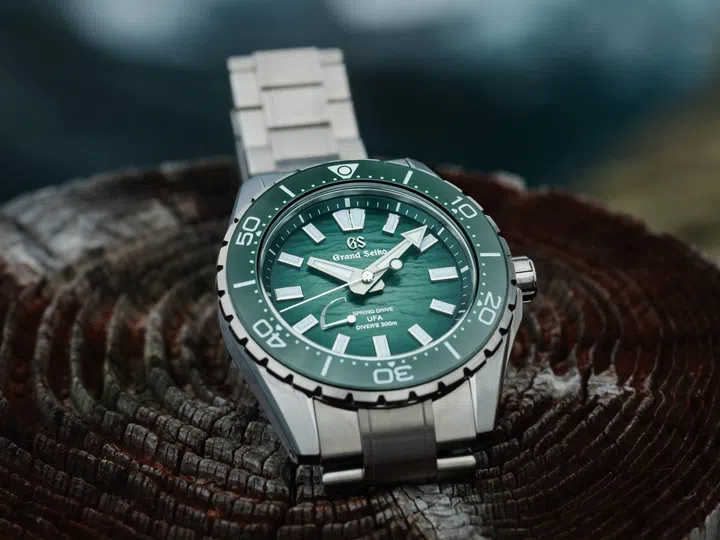
The blue version (SLGB023) recalls sunlight disappearing into deeper water, while the green edition (SLGB025) reflects the calmer, crystal-clear shallows. Grand Seiko wasn’t merely asking us to look at a dial; it wanted us to experience the elements that created it.
The deeper we ventured into Izu, the more it became apparent that the Ushio was not simply inspired by nature, but by the Japanese way of appreciating it.
Unlike any other
Setting itself apart from many brands that speak of drawing inspiration from landscapes, Grand Seiko’s approach is more restrained. Nature is rarely reproduced literally. Instead, it is distilled into texture, proportion, and light — leaving room for the wearer to complete the unseen picture.
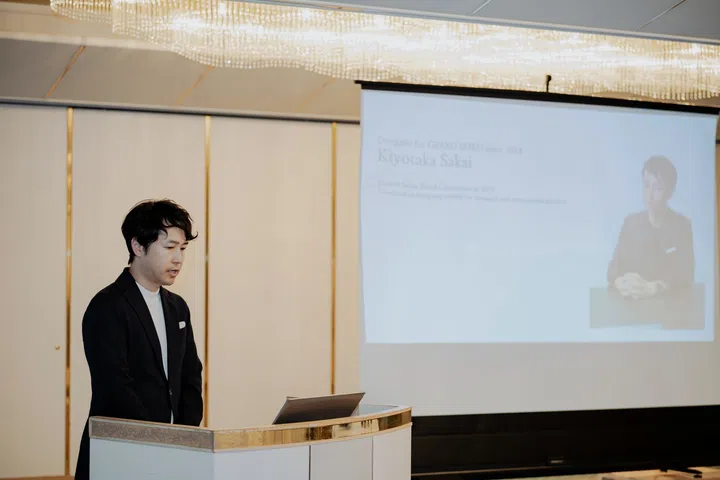
That philosophy was best articulated by Kiyotaka Sakai, Grand Seiko’s product designer responsible for creations that won two Red Dot Design Awards and a Grand Prix d’Horlogerie de Geneve (GPHG) Men’s Watch Prize, not including nominations.
Boasting a tenure of 14 years conceiving the aesthetics of Seiko and Grand Seiko, he is the creative mind behind many of the brand’s most recognisable modern dials, including White Birch, Lake Suwa, Omiwatari, and Shunbun.
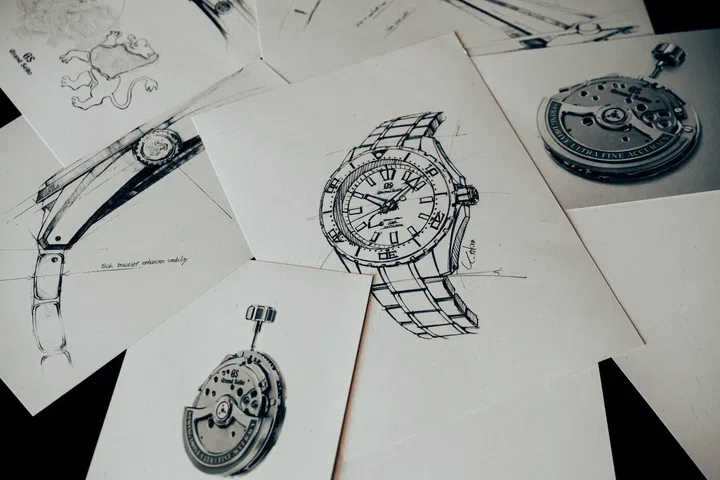
Yet when Sakai spoke about design, he didn’t just mention watches. Instead, he referenced his childhood sport of Japanese archery. “I feel that Grand Seiko shares something in common with kyudo (‘the way of the bow’). Every movement follows a precise form, and we first learn to master those forms completely. Once they are internalised, we are then able to break them. This is known as shu-ha-ri.”
An ancient Japanese martial arts concept, it refers to the three stages of mastering a skill — to protect, to break, and to transcend. The Evolution 9 Collection, introduced in 2020, embodies that spirit.
Based on the brand’s core next-generation design language, which is conceived by Sakai and similarly named the Evolution 9 Style, it respects the design grammar established by the seminal 44GS while refining it through three guiding principles: aesthetics, visibility, and wearing comfort.
Every facet, every proportion, and every Zaratsu distortion-free mirror-polished surface is conceived in service of how the watch functions as much as how it draws the eye. It also explains why the new Ushio Diver is a complete rethinking.
At 40.8mm, it is the smallest Grand Seiko diver ever produced, a considerable reduction from the much larger sizes of its predecessors. From numerous try-ons, the verdict is that it wears superbly well on Asian wrists, and anyone who prefers an ergonomic alternative to the oversized.
The brand’s merchandise planner Hiroki Oya explained, “We wanted it to be made not only for diving, but also a luxury watch for daily use. We also clearly understood that the market is now asking for more compact sizes. Thanks to the development of the new calibre, we were able to make this possible.”
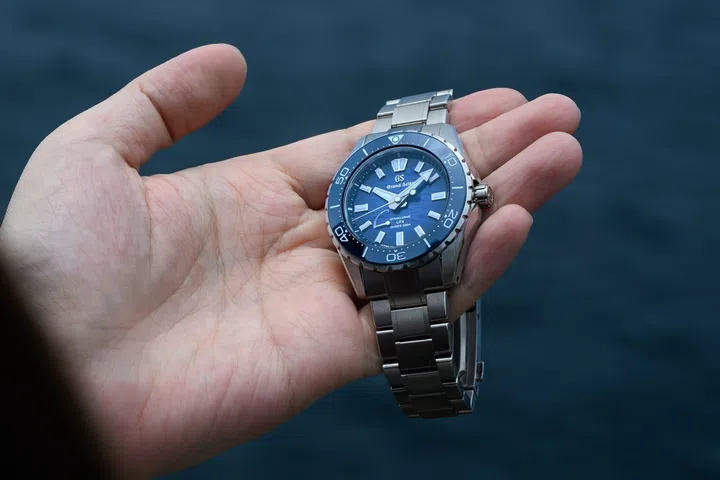
The case, crafted from High-Intensity Titanium, is around 30 per cent lighter than stainless steel while retaining the bright lustre for which the metal is known.
Water resistance has increased to 300m, which was impressed upon us by way of lunch one day when we were served locally caught kinmedai (golden-eye snapper), a prized deep-sea fish that inhabits the nutrient-rich waters at roughly the same depth.
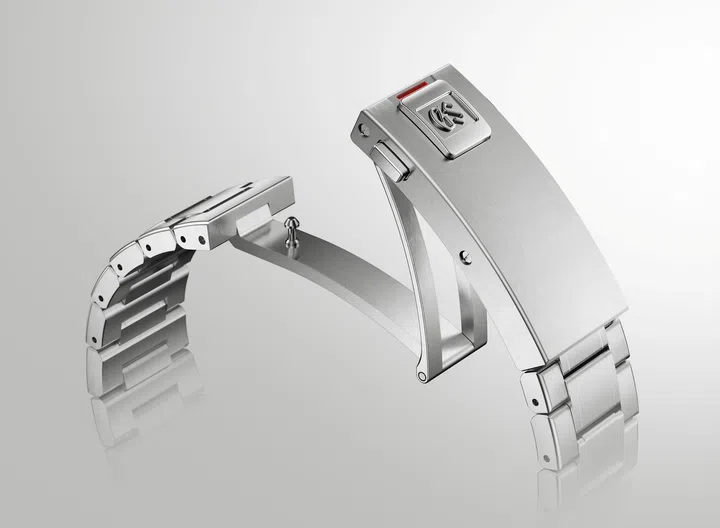
In addition, a newly developed (and well-received) bracelet and clasp introduces three-step micro-adjustment together with an 18mm diving extension, allowing up to 24mm of total adjustment.
Engineered in tandem
While many might assume the new diver was simply adapted to house Grand Seiko’s latest Ultra Fine Accuracy (U.F.A.) movement, Oya revealed exactly the opposite. “The diver’s model was not an afterthought,” he emphasised. “It was part of the original concept from the start.”
Development of the groundbreaking Spring Drive U.F.A. movement began in 2020, building on a concept first established in 2017. From the outset, Grand Seiko had envisioned its first sports watch equipped with the movement as a diver.
Why? Because Spring Drive’s architecture naturally lends itself to demanding environments. Unlike a conventional mechanical watch, it regulates time without a balance wheel and escapement, relying instead on Grand Seiko’s proprietary Tri-synchro Regulator and quartz oscillator.
Fewer moving regulating components mean greater resistance to shocks, while the absence of a battery eliminates the risk of sudden power failure during a dive. As Oya pointed out, Spring Drive has already proven itself beyond earth, accompanying an astronaut aboard the International Space Station.
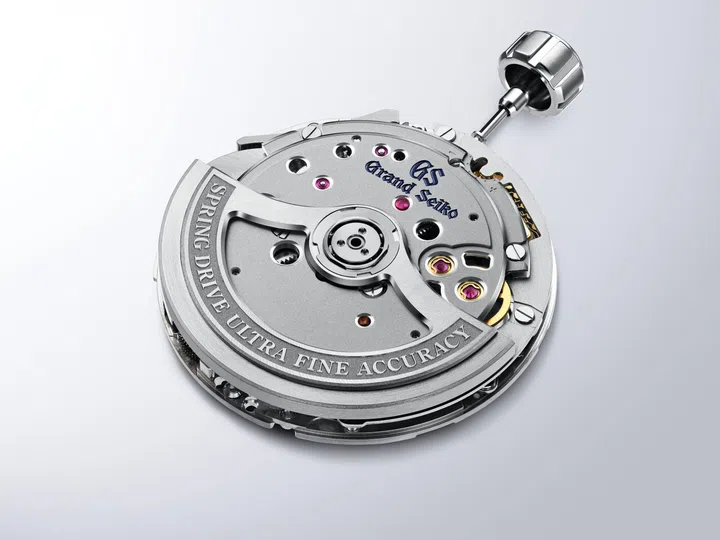
Of course, the extraordinary accuracy of the new Calibre 9RB1, which delivers ±20 seconds of accuracy per year and ±3 seconds per month, is the headline achievement. Despite retaining a 72-hour power reserve, the movement is significantly thinner than its predecessor, helping reduce the case to just 12.9mm while accommodating a repositioned power reserve indicator on the dial side.
Also, the calibre’s amazing precision comes from an entirely new vacuum-packaged integrated circuit housing a carefully aged quartz oscillator, combined with temperature compensation that measures ambient conditions hundreds of times daily.
Perhaps most tellingly, Grand Seiko also engineered a regulation switch that allows watchmakers to fine-tune accuracy during servicing decades into the future.
“We wanted to maintain the accuracy without replacing the movement,” Oya elaborated on Grand Seiko’s far-sighted thinking, which honestly, also speaks of the Japanese customer service mindset. “Rather than being satisfied with achieving perfection over a short period, we wanted a method that allows for long-term use.”
Visualising the tide
As impressive as the movement may be, the watch’s emotional appeal lies almost entirely in its dial.

We didn’t just take in the aquatic beauty of Izu, but also participated in a meditative deep breathing exercise on Dogashima's Sebama Coast one evening led by award-winning freediving underwater photographer Kohei Ueno, who’d flown in from his home base in Bali to join us on this adventure.
Sitting by the calm waters at sunset, it became impossible not to notice how dramatically the sea transformed within just a few hours. And that was the very inspiration for Sakai, who had joined us during our seaside ryokan retreat.
“During our stay in Nishi-Izu, we observed how the expressions of the sea change dynamically depending on the location and the time of day,” he reflected afterwards. “In the same way, the Ushio dial reveals a variety of expressions depending on the direction of the light and the surrounding environment, as if it were reflecting the ever-changing character of the waves themselves.”
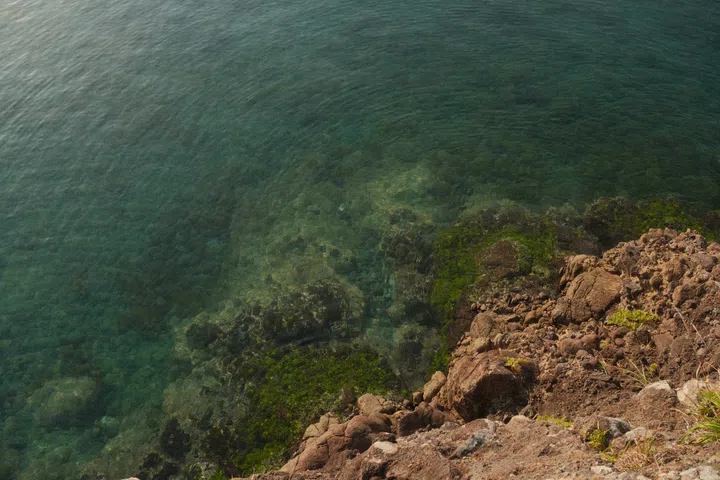
That changing character owes much to Grand Seiko’s design philosophy of mitate (“seeing something as something else”). Rather than depicting waves directly, the dial abstracts them into a deeply stamped texture that fuels the imagination.
Multiple translucent layers, plating, painting, and clear coating create surprising depth beneath the applied Evolution 9 indexes, while the new gradient finishes make the dial appear almost fluid as the light changes.
“We created around ten different patterns. We studied everything from calm water to rough waves before arriving at the final expression, Sakai said. “For the new diver, the gradient finish adds more depth. It feels as though you’re really looking at the surface of the water.”

Even the redesign of the hands and indexes stemmed from function rather than fashion. The minute hand adopts a bold arrow shape for immediate underwater legibility, while the fully faceted rectangular indexes strengthen the Evolution 9 identity and reflect light from almost every angle. Removing the date window further improves symmetry while contributing to the slimmer 12.9mm profile.
Every design decision, however small, serves a practical purpose. “We believe the best diver’s watch is one that you can use naturally, without even thinking about it,” Sakai said.
The right moment
As our final evening drew to a close, the conversation shifted away from movements and design towards language.
Sakai shared a Japanese word that neatly captured everything we had experienced over the previous four days: shiodoki (“tidal hour”), which connotes recognising the right moment to begin something when circumstances align.
“We would be delighted if people wore this watch with that feeling in mind,” he added.
Looking back, that sentiment speaks louder than any specification sheet. Yes, the Spring Drive U.F.A. Ushio 300 Diver is an engineering milestone. It is the world’s most accurate mainspring-powered diver’s watch, housed in Grand Seiko’s most compact diver case to date, combining 300m of water resistance with remarkable everyday comfort.
It represents the continued evolution of Spring Drive, Evolution 9 design, and Grand Seiko’s relentless pursuit of precision. None of those achievements, however, fully explain why the watch resonates.
That answer lies somewhere between the volcanic cliffs of Jogasaki, the gentle waters of Dogashima, the museum in Ginza where the Seiko story began, and the craftsmen in Shiojiri who transformed those ideas into titanium and brilliance.
As Takeki Nakaha reminded us on the very first day, Grand Seiko wants to explain its vision. After four days observing the tides, it is difficult to imagine a more convincing way of doing so than taking us on the Ushio Journey.