
What happens when ancient Egyptian gods get the Van Cleef & Arpels treatment?
From miniature Cleopatra and animal god sculptures to a pop-art pharoah and secret hieroglyphic messages, Van Cleef & Arpels brings ancient Egypt to life in some 180 extraordinary high jewellery creations.
By Yanni Tan /
Share this article
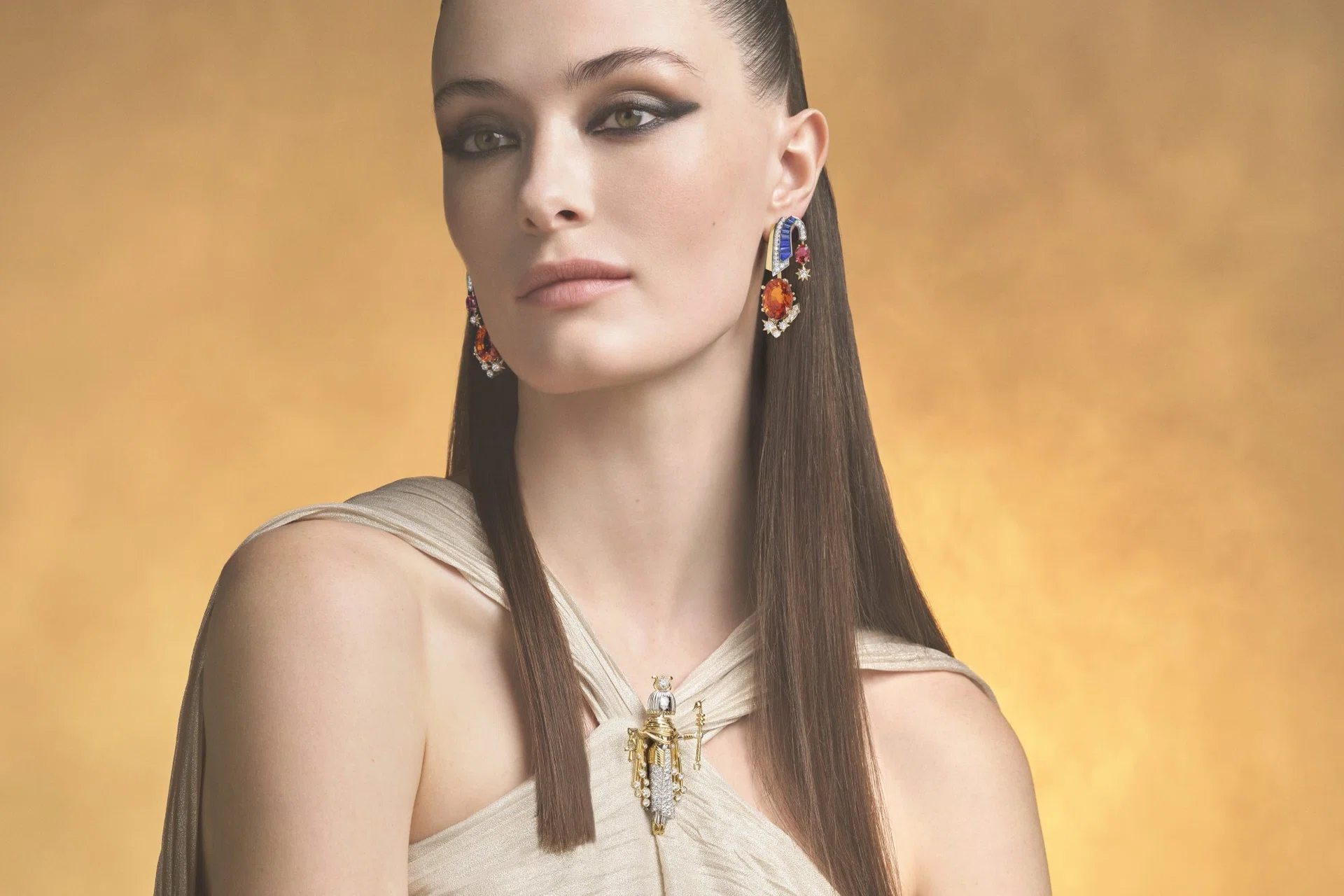
If the royalty and elite of ancient Egypt could commission their jewellery from Van Cleef & Arpels today, what might they wear? Perhaps a diamond-encrusted headdress, an extravagant collar studded with emeralds, or a pair of earrings that could double as sacred amulets.
For Van Cleef & Arpels, the possibilities are practically endless. Its latest high jewellery collection, Fascinating Egypt, takes a deep dive into one of history’s most visually spectacular civilisations, where jewellery was much more than personal adornment. It could signify power, offer protection, celebrate life, or serve as a connection to the divine.
The result is a collection of some 180 creations that brings together Egyptian mythology, royal regalia, sacred animals, monumental architecture, and scenes of everyday life.
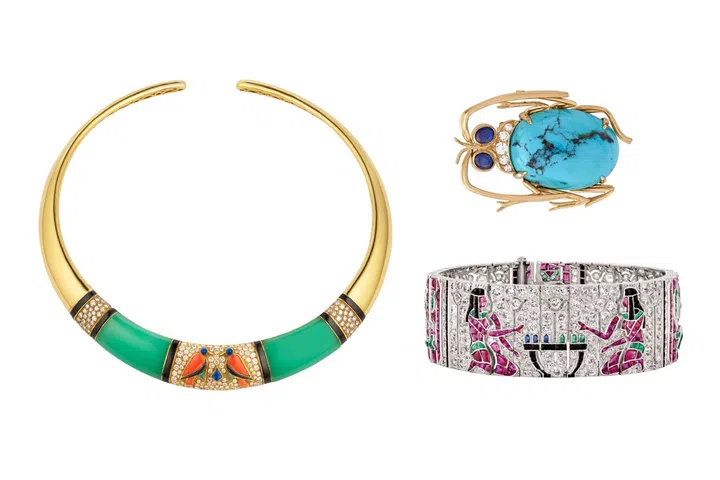
Some pieces are remarkably faithful to ancient imagery. Mind-blowing to the modern connoisseur, others take considerable artistic liberties, incorporating influences from Art Deco, pop art, comic books, and even science fiction.
Even the maison’s signature monogram gets a makeover, reproduced in hieroglyphics within a cartouche hallmarked on every creation.
As fascinating as it seems, this recent wave of ancient Egyptian revival is hardly new. Van Cleef & Arpels was already exploring Egyptian motifs in the 1910s, and the discovery of Tutankhamun’s tomb in 1922 helped fuel a wave of Egyptomania that inspired its jewellery throughout the following decade.
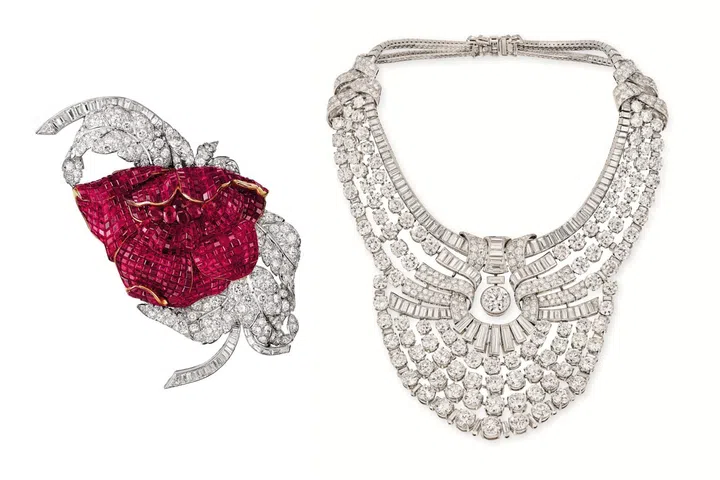
The connection eventually became personal. Members of the Egyptian royal family acquired pieces from the maison, which also created magnificent jewels for Princess Fawzia’s wedding in 1939.
More than a century after the discovery that captivated the world, Van Cleef & Arpels is returning to the land of the pharaohs. This time, the ancient characters are ready for their close-ups.
Cleopatra, pharaohs, and the ultimate royal wardrobe
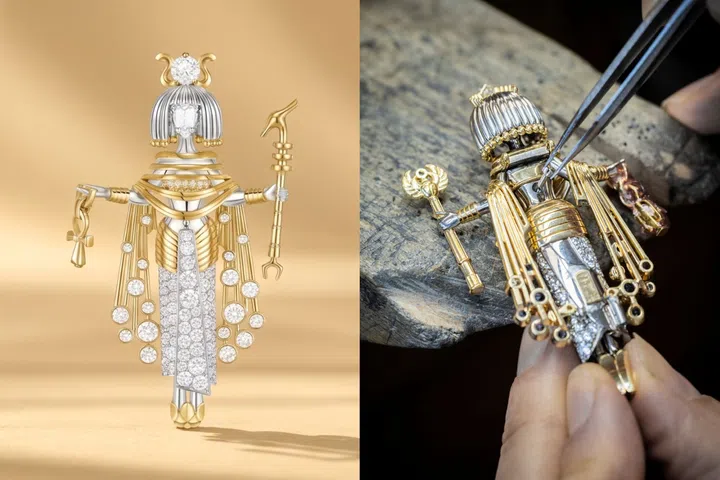
No jewellery collection celebrating ancient Egypt would be complete without Cleopatra. The legendary queen makes an appearance in the Muse Éternelle clip, a diamond-studded figure holding two symbols of royal authority: the hieroglyphic of ankh known as the key of life, and a sceptre.
Her elaborate headdress, flowing costume and jewelled shoes are rendered in white and yellow gold and diamonds. A rose-cut diamond represents her face, continuing the maison’s tradition of creating dancer and fairy figurines that dates back to the early 1940s.
Providing Cleopatra with a suitably regal counterpart is the Pharaon Sacré clip, featuring the double crown of ancient Egypt, a sceptre, and two emblems of pharaonic authority called nekhekh. A pear-shaped ruby adorns his crown, while rubies and diamonds illuminate his ceremonial costume.
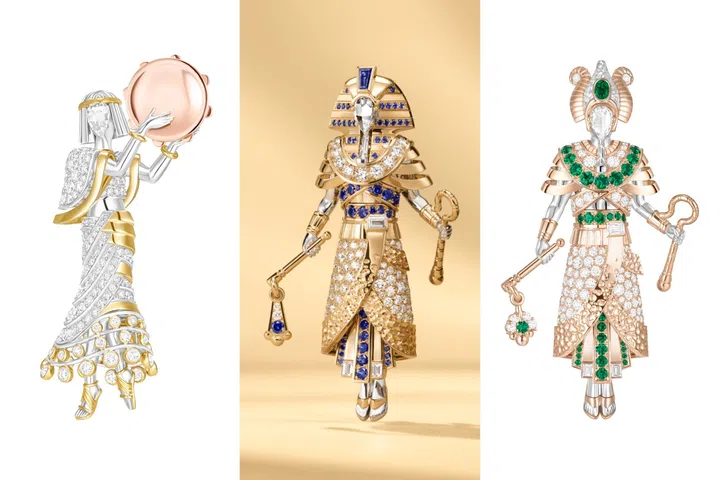
Beyond the symbolism is its stupendous craftsmanship. The gold has been polished, hammered and engraved to distinguish the different parts of his clothing and accessories. Tiny golden beads add further texture.
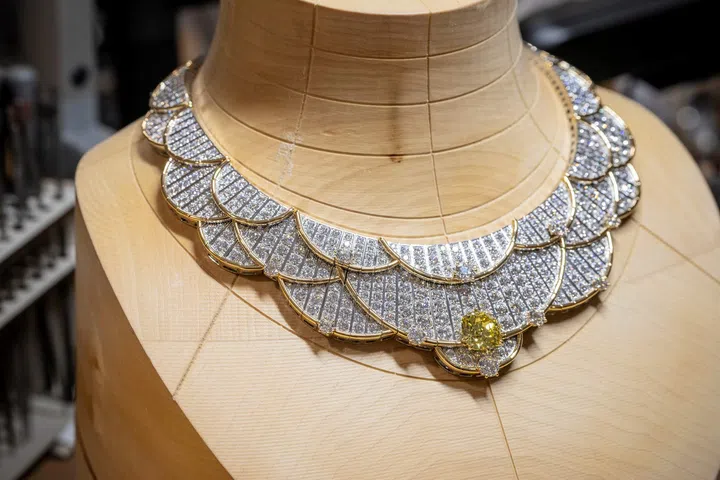
For a more dramatic interpretation of ancient royal dressing, there is the Beauté Légendaire necklace, inspired by the broad breastplate ornaments associated with Egyptian royalty. At its heart is a 10.02-carat fancy vivid yellow diamond, surrounded by an elaborate arrangement of diamonds and polished yellow gold garlands.
Despite its substantial appearance, the necklace is entirely flexible, thanks to an intricate system of double articulation. Its clasp is cleverly concealed beneath a lotus flower decorated with sapphires and gold.
The Princesse du Nil necklace offers a different kind of royal glamour, with an even more direct historical connection. Its inspiration comes from a 1929 Van Cleef & Arpels collaret owned by Princess Faiza of Egypt, sister of Princess Fawzia, that featured cascading emerald drops and diamonds, with another emerald suspended from the clasp at the back.
For the contemporary interpretation, the arrangement is echoed with 10 Colombian emerald drops totalling 107.37 carats, accompanied by seven white natural pearls weighing approximately 85.13 carats.
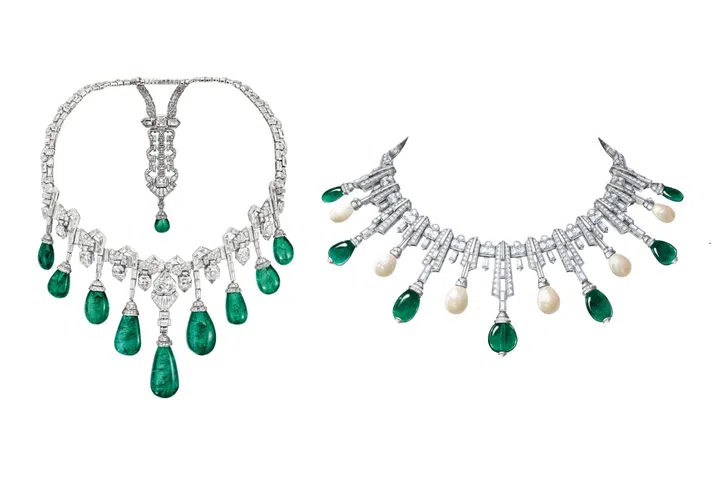
The emeralds and pearls form an elaborate fringe beneath a diamond-set structure, while the design extends to the back of the necklace, where a detachable motif provides an unexpected decorative flourish.
This is a particularly compelling example of the maison revisiting its own history rather than merely borrowing motifs from ancient Egypt.
Meet the gods, goddesses and mythical creatures
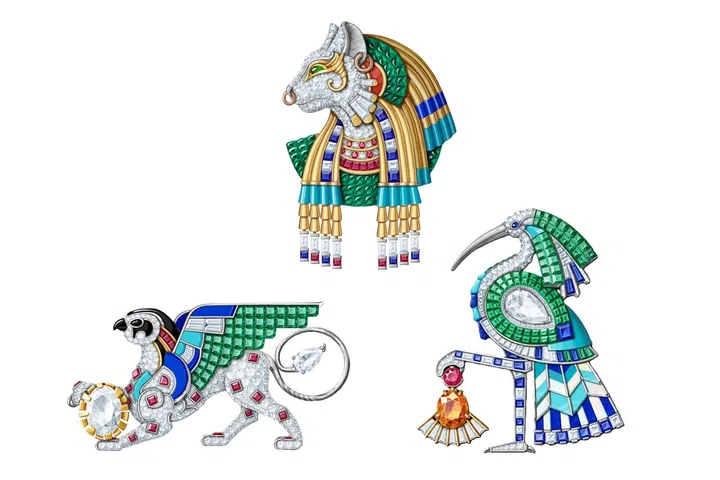
Beyond the legendary rulers, ancient Egyptian mythology was also populated by an extraordinary cast of characters, from powerful deities to supernatural animals. In reverence, Van Cleef & Arpels has turned several of them into miniature jewelled sculptures, each with its own personality.
Cat lovers will be particularly drawn to the Bastet Mystérieuse clip, depicting Bastet, the cat-headed goddess and protector of the home. Rather than presenting her as an ordinary feline, the maison has dressed her in the finery of a queen.
Her bust and headdress are adorned with emeralds using the maison’s Traditional Mystery Set technique, which conceals the metal holding the gemstones in place. Coral, lapis lazuli and turquoise introduce striking contrasts, fine engraving accentuates her ears, while articulated pendants sway with the wearer’s movements.
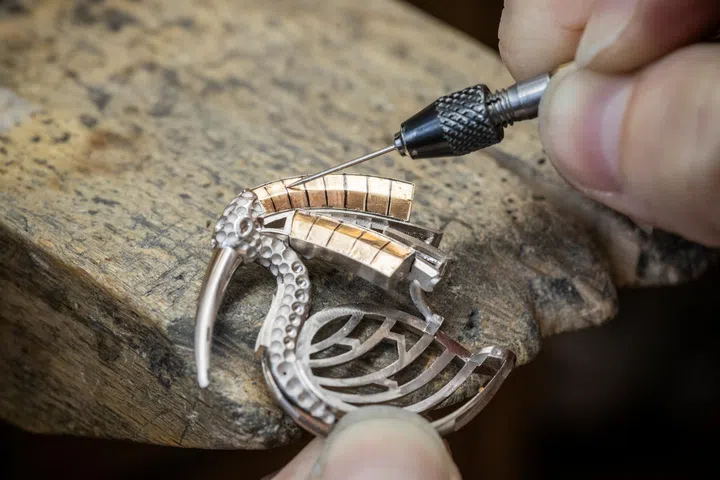
Another mythical creature makes an appearance in the Bénou Mystérieux clip. The Bennu, associated with the sun god Ra, was believed to have created itself in a fire. Represented as a grey heron, it is translated into a colourful composition of precious and ornamental stones.
A 4.08-carat spessartite garnet and a red spinel represent the bird’s connection to fire, while its plumage combines mother-of-pearl, turquoise, lapis lazuli and emeralds. A 2.63-carat pear-shaped diamond sits among the emeralds on one wing, adding another flash of brilliance to this fantastical bird.
The Griffon Mystérieux clip is an equally elaborate creation. Inspired by a sphinx with a falcon’s head and a lion’s body, the creature clasps a 3.94-carat diamond between its paws. Its wings feature lapis lazuli, turquoise and Mystery Set emeralds, while rubies punctuate its diamond-covered body. A braided white gold tail curves around another pear-shaped diamond weighing 1.01 carats.
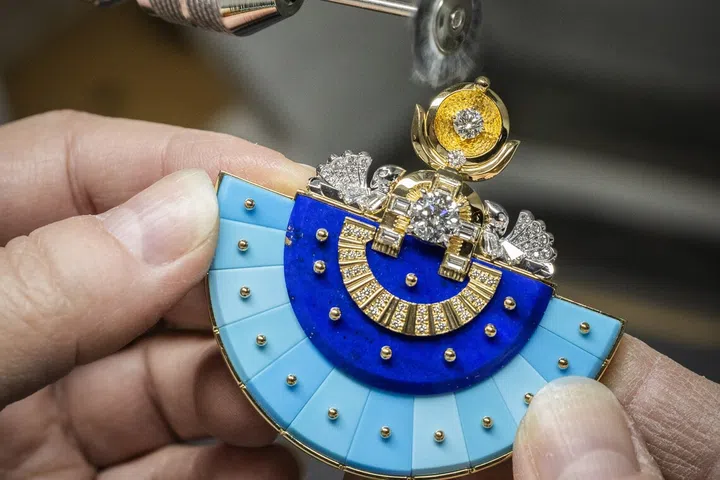
The Vénus Égyptienne clip offers another interpretation of a revered deity — referencing Hathor, the goddess associated with love, beauty, music and motherhood — through her characteristic symbols of a solar disc and cow’s horns.
Crowned with falcons in white gold and diamonds, the creation also features a 1.51-carat round diamond on a striking composition that juxtaposes deep-blue and pyrite-flecked lapis lazuli against yellow gold and an enclosing turquoise semi-circle.
The latter showcases intricate marquetry involving three shades of the ornamental stone, with each section individually hand-cut for perfect fit. The segments are then meticulously adorned with tiny gold studs that evoke the sun.
Together, these clips demonstrate how Van Cleef & Arpels approaches Egyptian mythology not as a collection of static historical symbols, but as an opportunity to create characters with distinctive silhouettes, colours and personalities.
Sacred symbols, secret messages and vibrant landscapes
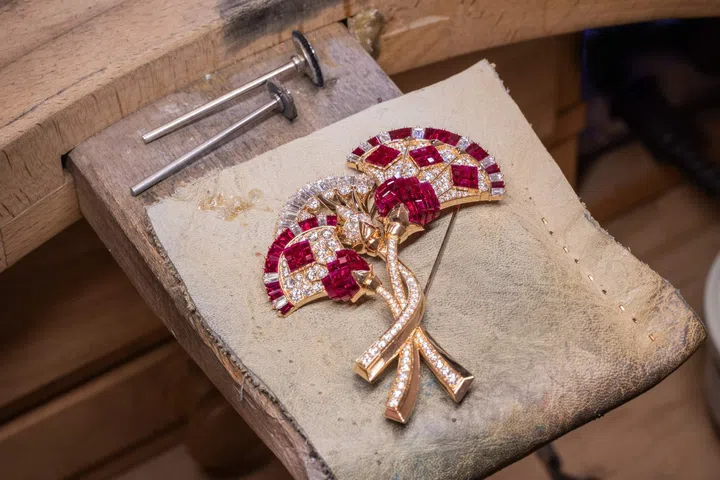
For the ancient Egyptians, symbols carried meanings that extended far beyond decoration. The lotus represented an important element of Egyptian iconography, while hieroglyphics could convey ideas about life, nature and eternity. Van Cleef & Arpels has incorporated this visual language into the finest creations.
The Fleur de Lotus Mystérieuse clip depicts three lotus flowers with ruby-studded petals and interlacing gold stems. Some of the rubies are held using the Traditional Mystery Set technique, creating uninterrupted surfaces of velvety colour that contrast with the sparkle of diamonds.
The composition also draws on an Art Deco textile design by French artist Émile-Allain Séguy, illustrating how the maison combines Egyptian motifs with influences from other artistic periods.
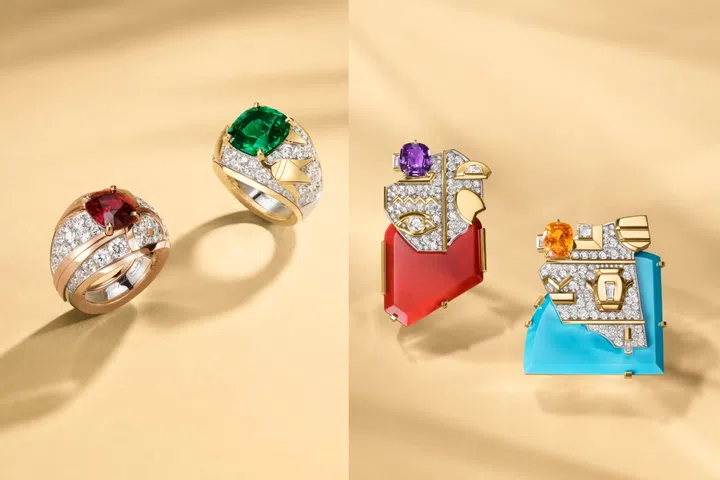
Reinterpreting hieroglyphic symbols associated with elements of nature, every one of the Origine range of cocktail rings features a cushion-cut gem surrounded by diamonds and stylised gold motifs. Among a wonderful selection of coloured stones are an 8.71-carat Sri Lankan sapphire, an 8.02-carat Colombian emerald, and a 5.04-carat Mozambican ruby.
Meanwhile, the Fragment de Bonheur, Fragment Magnifique and Fragment de Beauté clips take not just the form of archaeological treasures, but also their names from the hieroglyphic symbols inscribed on them.. Each features an irregularly shaped frieze of gold and diamond-set hieroglyphics, paired with ornamental stones and a cushion-cut gemstone.
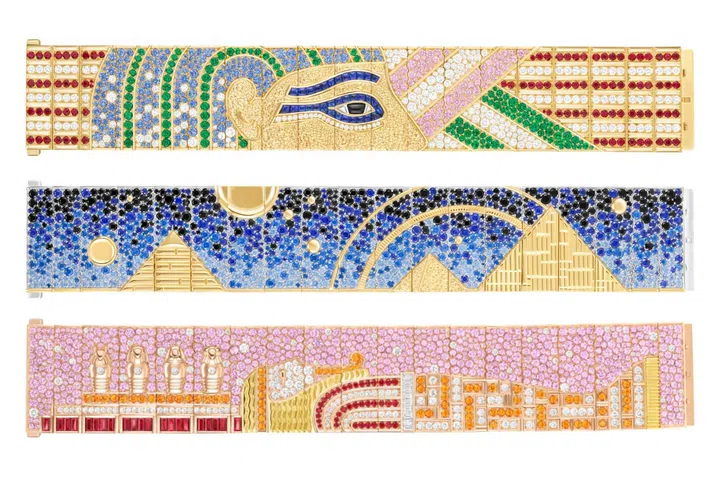
Perhaps the most entertaining interpretations of Egyptian imagery are the quartet of Paysage wide cuffs resembling miniature panoramas, each telling an astounding visual story.
Paysage Merveilleux portrays a landscape of pyramids beneath a starry sky, with an aesthetic that could almost belong in a science-fiction film, while Paysage Royal presents pharaonic imagery in vibrant, pop-art-inspired colours.
Paysage Secret takes a more mysterious approach, featuring rows of columns interspersed with hieroglyphs that spell out a hidden message: “horizon of eternity”, while Paysage Éternel depicts the profile of a sarcophagus alongside four funerary canopic jars representing the four sons of Horus.
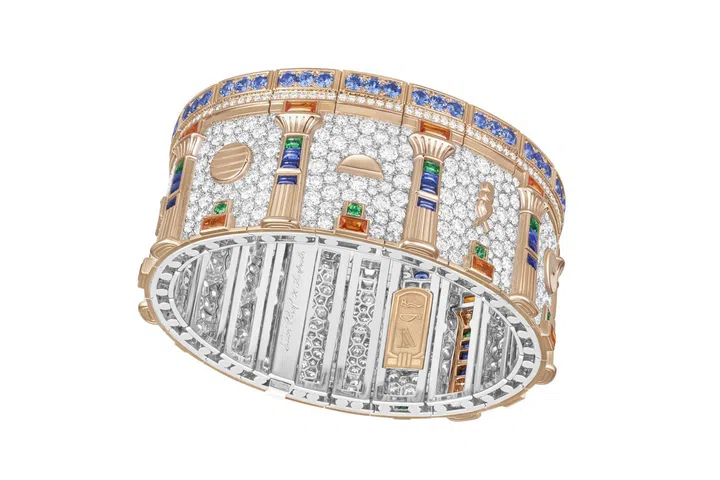
Feats of technical craftsmanship, these creations flaunt articulated structures that allow them to curve around the wrist, while precision-fitted gemstones create mosaic-like surfaces. The gold is sculpted, engraved, hammered, and polished to produce varying textures.
Even their reverse sides have been carefully crafted, with openwork allowing light to pass through the gemstones. Furthermore, each contains a secret that only those familiar with its symbolism might recognise.
Jewels that change shape, and a clock that hides time
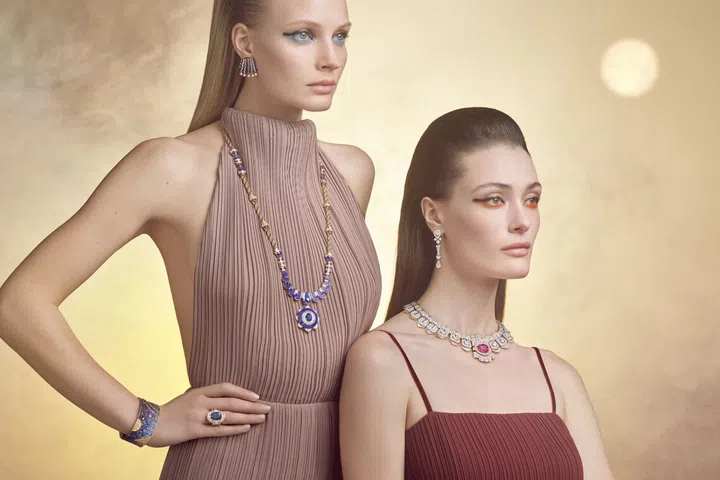
Ancient Egyptian imagery provides the inspiration, but Van Cleef & Arpels also introduces an element of surprise through its longstanding expertise in transformable jewellery. One of the most striking examples is the Déesse Ailée Mystérieuse necklace, inspired by the protective wings associated with Egyptian deities.
Its dramatic, wing-like structure spreads around the neck in a composition of diamonds, Mystery Set rubies and polished rose gold. Interestingly, the maison also acknowledges the influence of comic books and science fiction on the design.
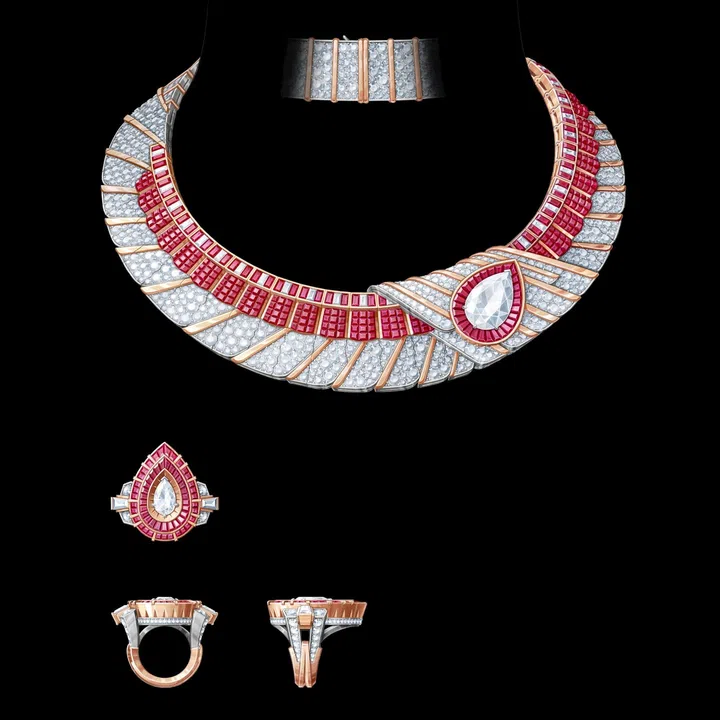
Positioned on one side of the necklace is a 14.05-carat pear-shaped diamond, mounted in a raised setting, which can be detached and transferred to a matching ring. A second motif, adorned with rubies and a 2.07-carat pear-shaped diamond, can likewise be mounted on either the necklace or ring, allowing the wearer to interchange the two centrepieces.
The Ornement de Saphir necklace takes versatility even further. Inspired by ancient Egyptian chest ornaments and the long necklaces fashionable during the 1920s, it combines a 6.59-carat Sri Lankan sapphire with lapis lazuli, rubies, diamonds and gold.
Its modular construction allows it to be worn in two long necklace configurations, two shorter versions or as two bracelets. A detachable medallion can also become a clip.
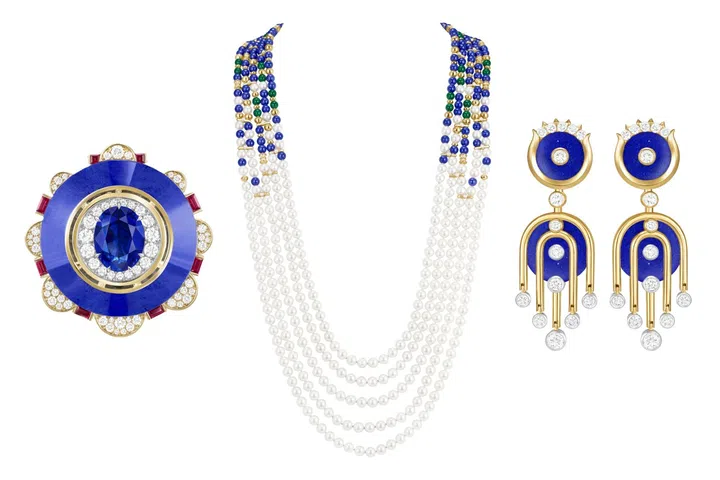
The design incorporates influences from the Memphis Group, the Italian design movement associated with the bold geometric forms and colours of the 1980s. It is an unexpected connection that gives the Egyptian-inspired piece a distinctly contemporary personality.
The collection’s surprises extend beyond wearable jewellery. The Nuit Étoilée table clock draws inspiration from the monumental temples of ancient Egypt, particularly their richly decorated celestial ceilings.
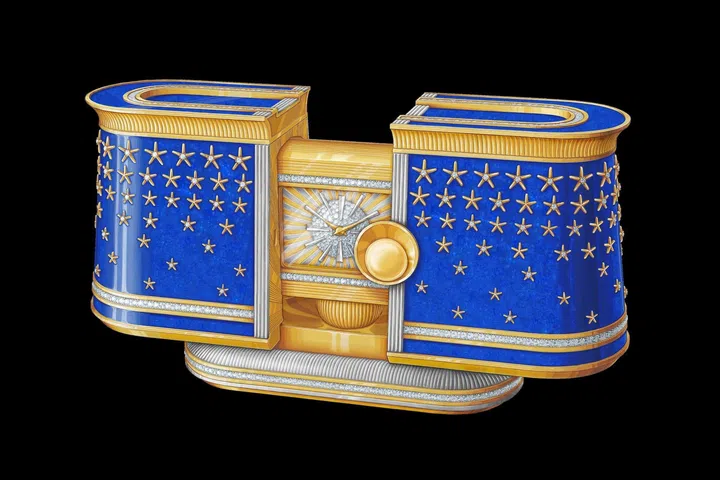
Its lapis lazuli surfaces evoke a night sky scattered with golden stars, some set with diamonds. Yet the most incredible detail is what the clock initially refuses to reveal: the time.
A central gold motif pivots to open two concealed doors, exposing a diamond-set dial powered by a manually wound mechanical movement. Measuring approximately 20cm wide, the clock combines the skills of gemologists, lapidaries, goldsmiths and watchmakers in an object that is as much a decorative sculpture as an enchanting timekeeper in Van Cleef & Arpels’ signature whimsical horological style.